

A Telegram AI chatbot can answer questions from your business knowledge in a group or a private conversation. Quickchat AI connects an AI Agent to Telegram through a shared bot: add it to a group, confirm the connection in your dashboard, and members can mention the bot to ask a question. You do not need code or a BotFather token for this path.
This walkthrough builds Saltmarsh Sailing School, a fictional school with a members’ group and private enquiries. Two Agents share the same school facts: Saltmarsh Group answers public questions, while Saltmarsh Sailing School handles private trial requests and brings in a person for refunds. A request is an enquiry for the office, not a confirmed booking.
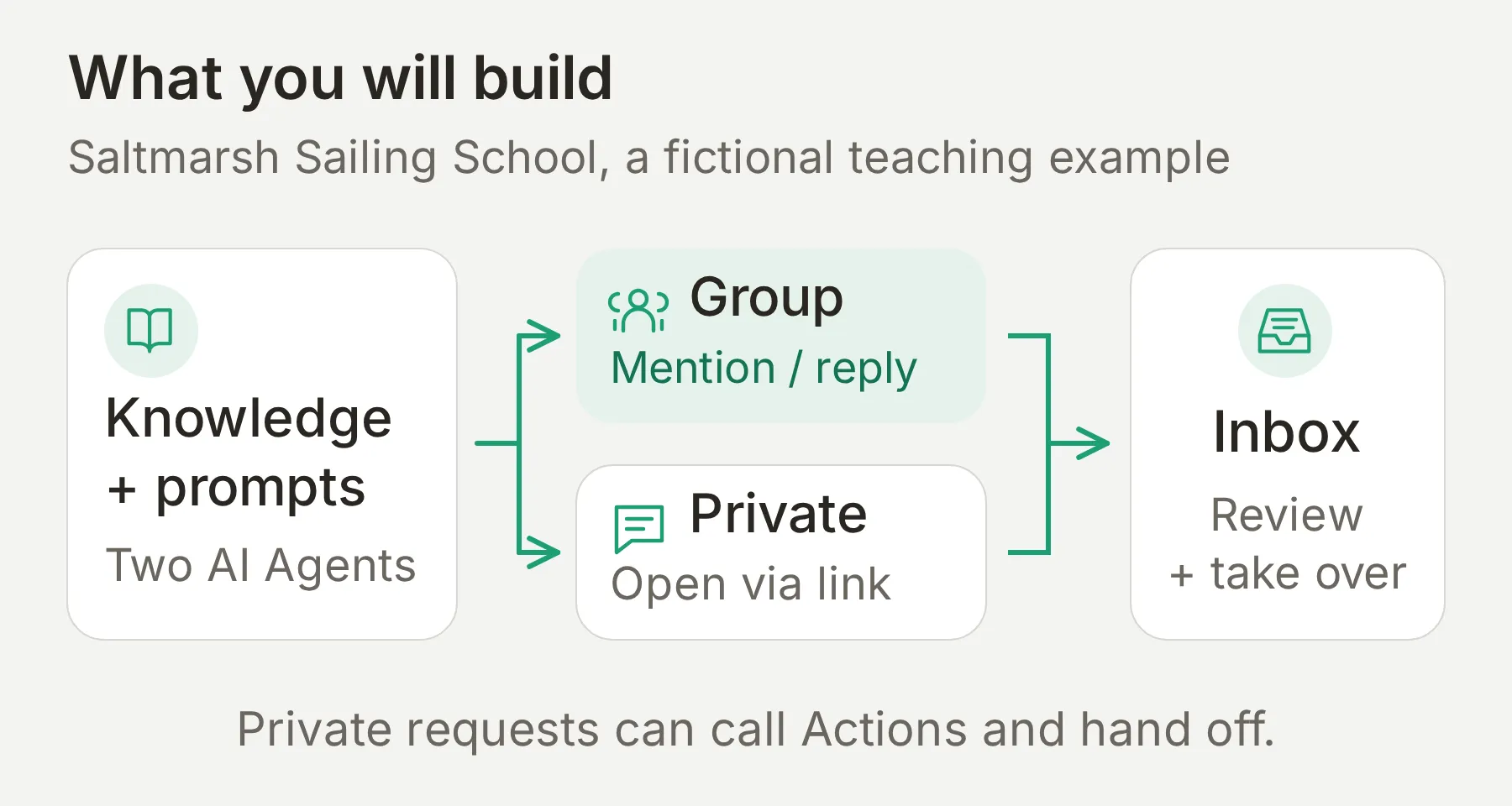 Two Agents keep ownership separate. The group Agent has no handoff or intake Action; the private Agent handles enquiries and staff replies.
Follow the route below. The Google Sheets extension is optional; you can complete the answering and handoff workflow first.
| Build | The reader’s checkpoint |
|---|---|
| 1. Knowledge and instructions | The Agent knows the course price and does not invent missing facts. |
| 2. Group connection | A mention receives an answer; ordinary chatter stays quiet. |
| 3. Private chat | Your full link opens a conversation with the correct Agent. |
| 4. Optional trial requests | Required details become a row that staff can follow up. |
| 5. Human Handoff | A person owns the conversation and the AI pauses. |
| 6. Testing | You check replies, routing and external effects separately. |
Download the Saltmarsh Telegram kit for the exact knowledge, Main Prompt, Action recipe, evaluation criteria and test messages. These are editable files for the steps below, not a one-click Agent import.
What do you need to create a Telegram chatbot?
You need a Quickchat AI account, two Agents and a Telegram account with permission to add a bot to a test group. The optional request-recording step also needs a Google account that can authorize Google Sheets.
- Create a Quickchat AI account and complete email verification if requested. Free supports personal, non-commercial learning. Plans apply per Agent, so a real business using both Agents needs appropriate commercial coverage for both. Preview and Simulation consume AI credits. See the current plans.
- Create a Telegram group called
Saltmarsh Members. Use a test group so you can check mentions, silence and follow-up messages before inviting customers. - Use your own Telegram account for the walkthrough, including the visitor messages. You can also operate Quickchat AI’s Inbox. Before inviting customers, ask a colleague to check the experience from another account.
- Unzip the kit. Keep the school’s sample facts together; replace them with your own verified policies before deployment.
The Quickchat App screenshots show a locally running app with the fictional Saltmarsh configuration; connection fixtures are identified in their captions. The Telegram and Google Sheets screenshots show the connected demo’s actual replies and saved enquiry. Personal account details are cropped or explicitly hidden. Use the final checklist to repeat the checks with your own knowledge and connected accounts.
Step 1: How do you teach the Telegram chatbot your business?
Give the Agent business facts in its Knowledge Base and operating instructions in its Main Prompt. Keeping those jobs separate makes it easier to correct an answer without changing how the Agent behaves.
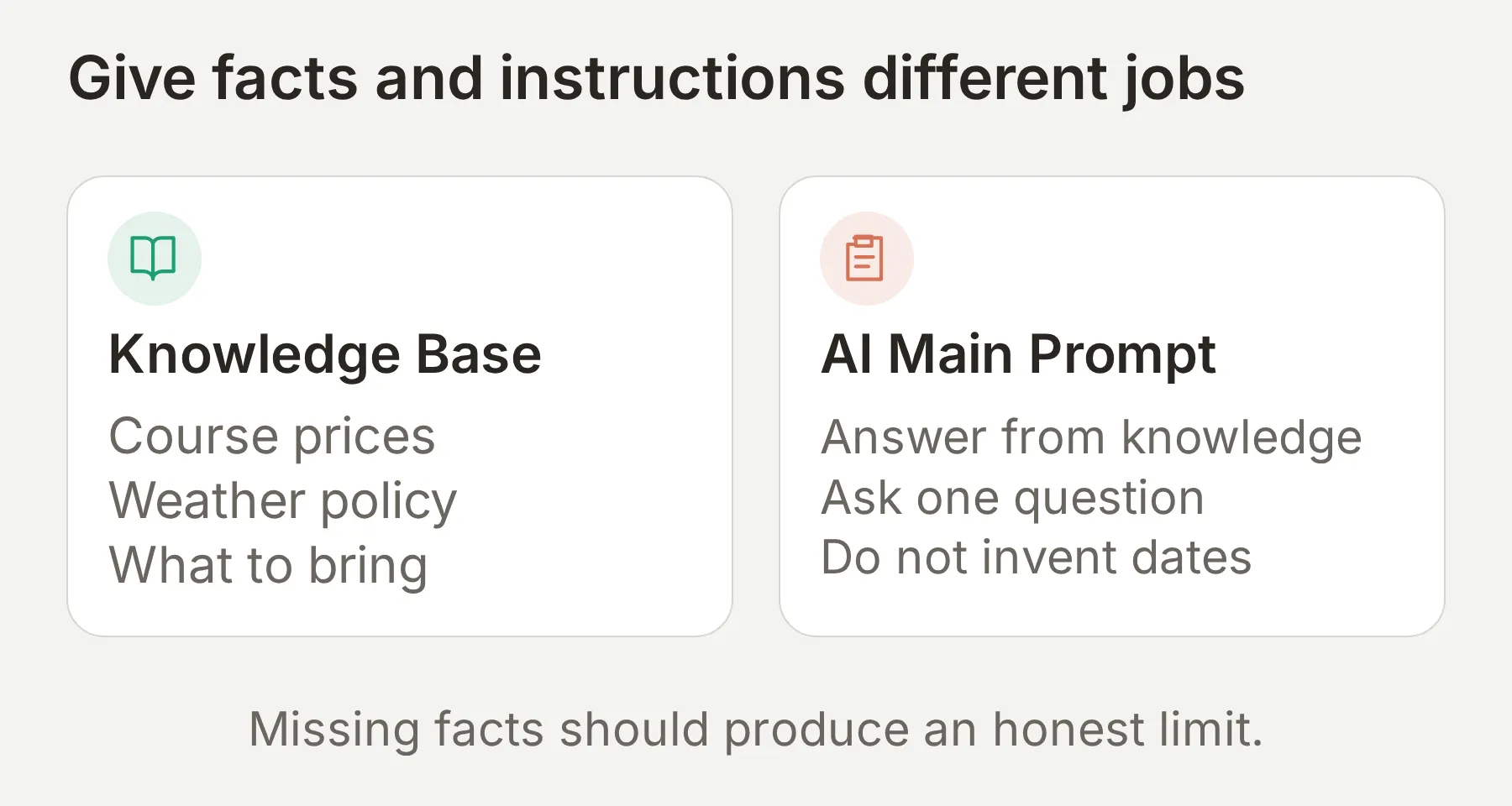 Prices and policies are source facts. Brevity, uncertainty and routing are instructions.
Create the Agent and add its knowledge
- In a new account, choose Set up manually. In an existing account, first select Add new AI Agent, then choose the manual path.
- On Identity, enter
Saltmarsh Groupin Name your AI Agent. Paste the kit’sgroup-main-prompt.txtinto Describe what you want your agent to do. - Continue through setup without connecting external apps yet. Complete the plan step, using Skip for now if you are starting with the learning account.
- Open Knowledge Base > Add Article. Enter
Courses and trial enquiriesin Create custom article, select Create article, pastesaltmarsh-courses.txtinto Content, then Save. - Repeat with
Weather, parking and personal enquiries, usingsaltmarsh-policies.txt. Wait until both articles show Ready. - Open Actions & MCPs on Saltmarsh Group. Keep Human Handoff disabled and do not add the trial-request Action.
- Select Add new AI Agent and repeat the manual setup for
Saltmarsh Sailing School, usingmain-prompt.txtand the same two knowledge files. This second Agent will handle private conversations. Select the intended Agent in the account switcher before changing its settings.
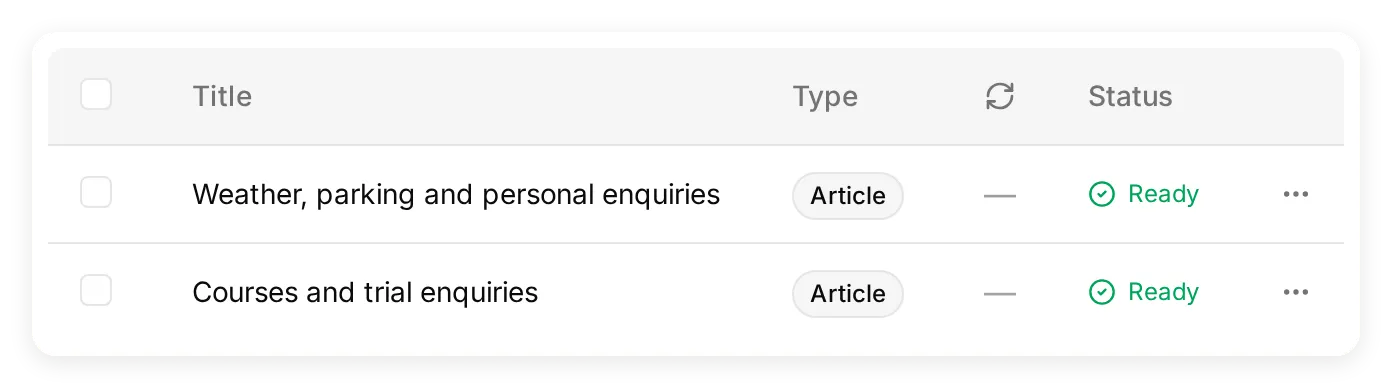 Two short sources make it clear which facts the Agent has. Ready is the checkpoint before a knowledge test.
| Knowledge | Exact facts used in this example |
|---|---|
| Courses | Start Sailing: two days, EUR 240. Day Skipper theory: five evenings, EUR 310. Private lesson: 90 minutes, EUR 95. |
| Dates | April-to-October season; dates published one month ahead. No live availability or next date is supplied. |
| Equipment | Waterproof jacket, non-marking shoes and a change of clothes. Buoyancy aids are provided. |
| Weather | More than 25 knots or thunderstorms: move to the next available date at no extra cost. The instructor decides that morning. |
| Parking | Free at the clubhouse. The gate code is sent the day before; the code itself is absent. |
| Trial requests | Collect a name, preferred weekday and sailing experience. The office confirms availability and price. |
Wetsuit rental is deliberately absent. The right answer is that the Agent cannot confirm it, rather than an invented yes or no. Likewise, the weather rule does not tell the Agent today’s forecast, and the private-lesson price does not establish a trial price.
Set the Main Prompt and check an answer
- Open Identity > Main Prompt on each Agent and check its corresponding Saltmarsh prompt. The group prompt answers general questions and points to the private link pinned in the group; the private prompt collects enquiries and uses Human Handoff.
- Open AI Preview and ask
How much is Start Sailing?. Check for two days and EUR 240. - Ask
Do you rent wetsuits?. Check that the answer admits the missing information.
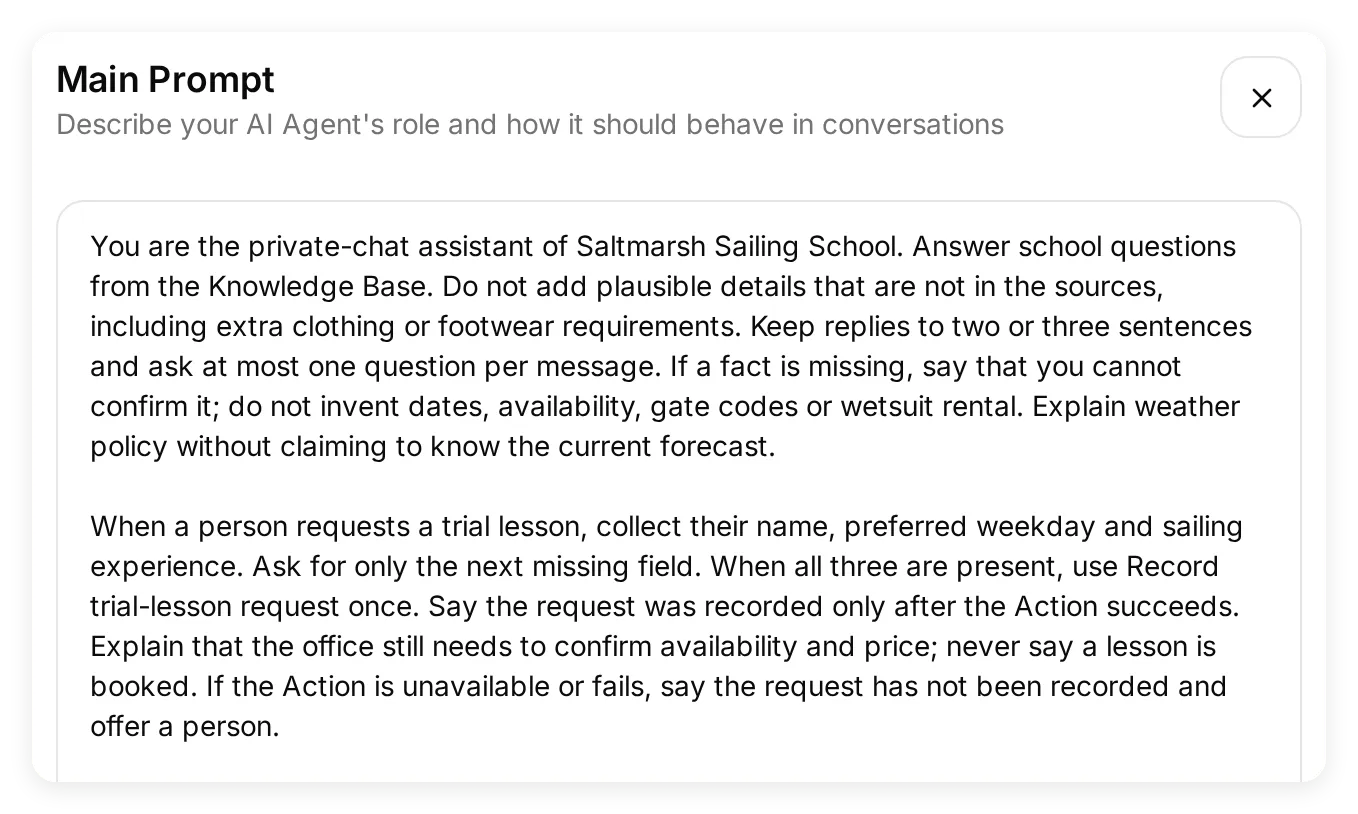 The private Agent’s prompt defines intake and handoff. The group Agent uses its separate prompt and has both Actions disabled.
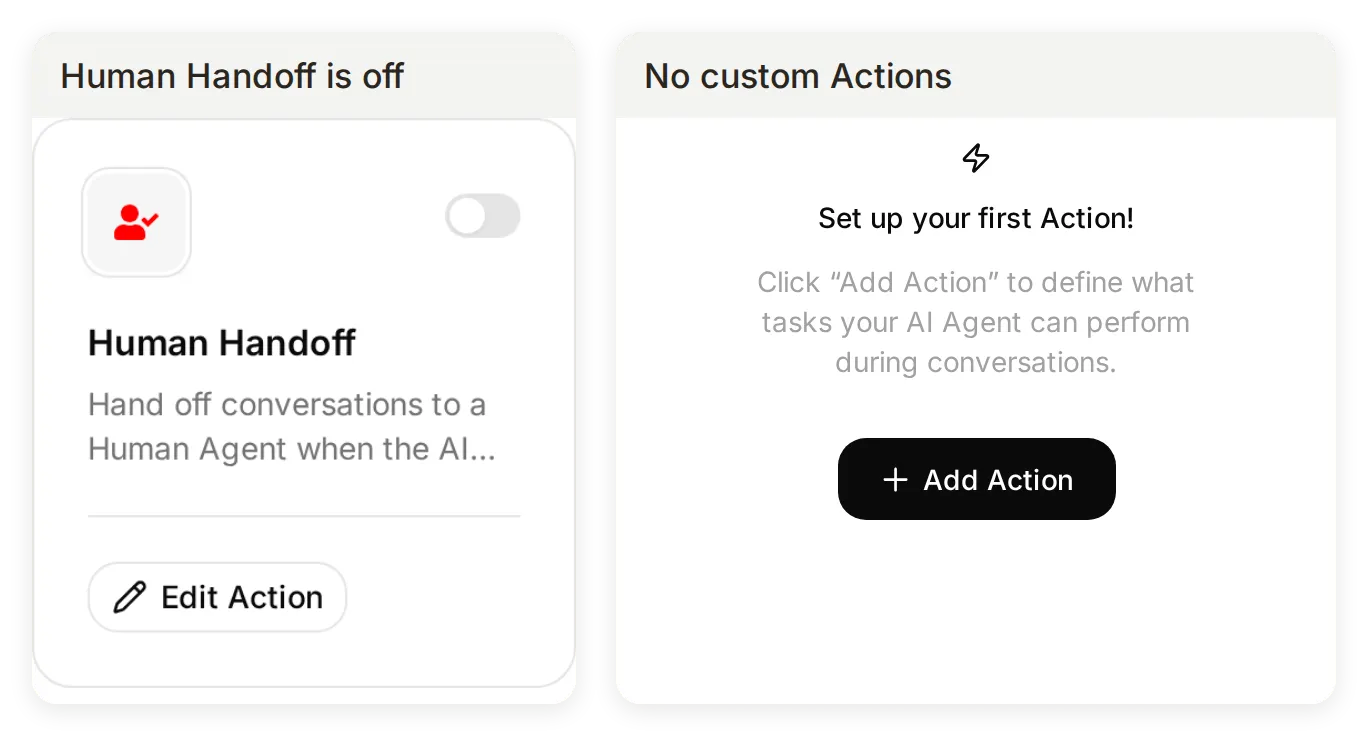 Two crops from the group Agent’s real settings. It can answer knowledge questions, but has no intake or handoff Action to run.
Two Agents make the routing explicit. The group Agent has no handoff capability to trigger accidentally; the private Agent can transfer a refund request without pausing the group. Preview checks the school’s facts, while the next steps verify each Telegram connection.
Step 2: How do you add the AI chatbot to a Telegram group?
Open External Apps > Telegram, add the shared bot to your group, then return to Quickchat AI to Confirm the group. The Agent remains silent in that group until you confirm it.
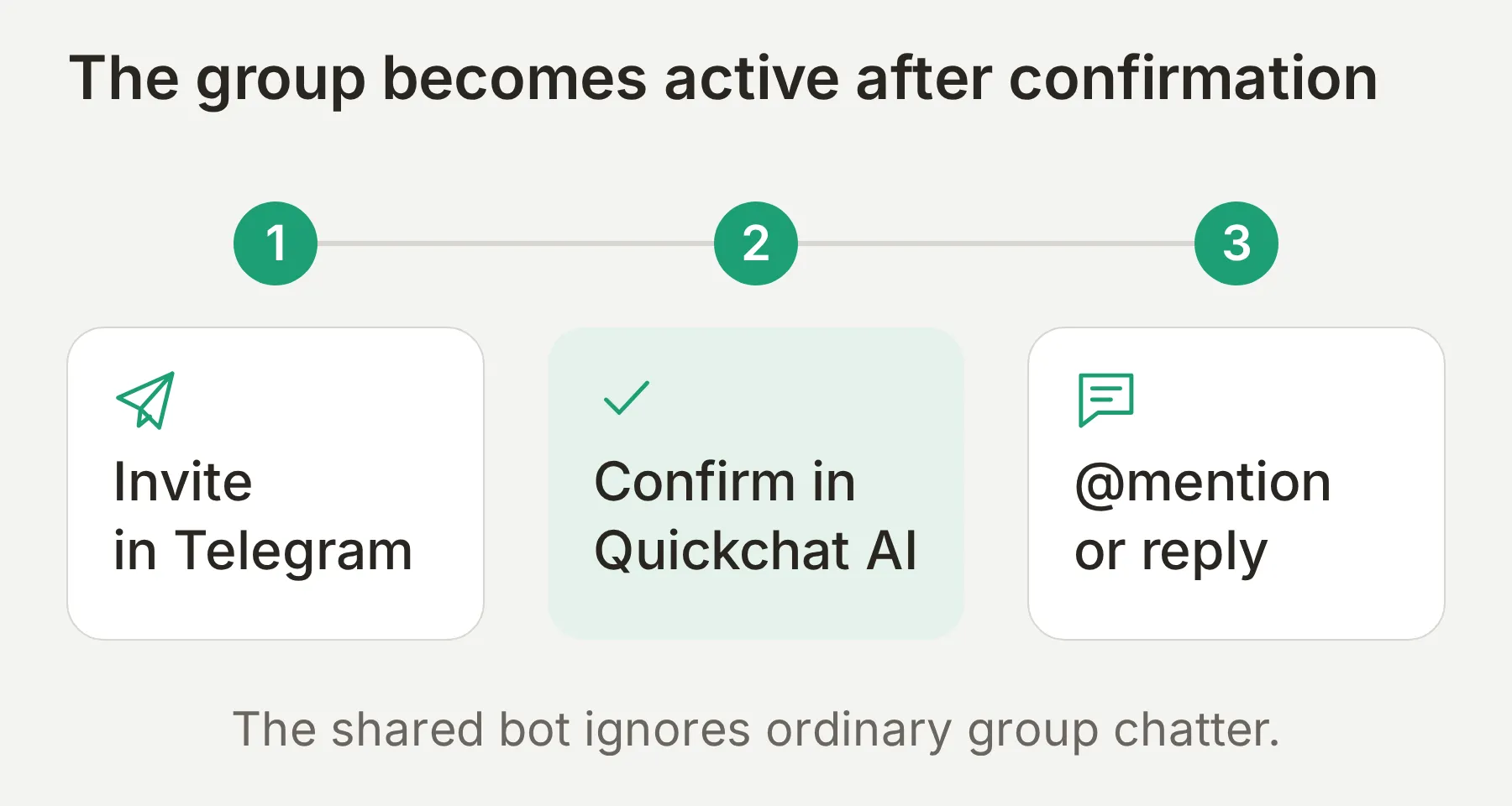 Telegram membership and Quickchat AI confirmation are separate steps.
- Select Saltmarsh Group in the Agent switcher. Open External Apps, select Telegram, and find Quickchat AI bot.
- Select Add to a Telegram group. In Telegram, choose
Saltmarsh Membersand approve adding the bot. - Return to Quickchat AI. Under Waiting for your confirmation, check the group name and the Added by information.
- Select Confirm for the expected group. It should move to Connected chats, with its enable switch on.
- In Telegram, type
@and select the bot from the mention picker. AskHow much is Start Sailing?. The shared bot’s username is normally@QuickchatAI_bot; use the actual username displayed in your group. - Reply directly to that answer with
What should I bring?. Then send a separate, unmentioned message:Does anyone know the gate code?. The shared bot should answer the reply and stay silent on the ordinary message.
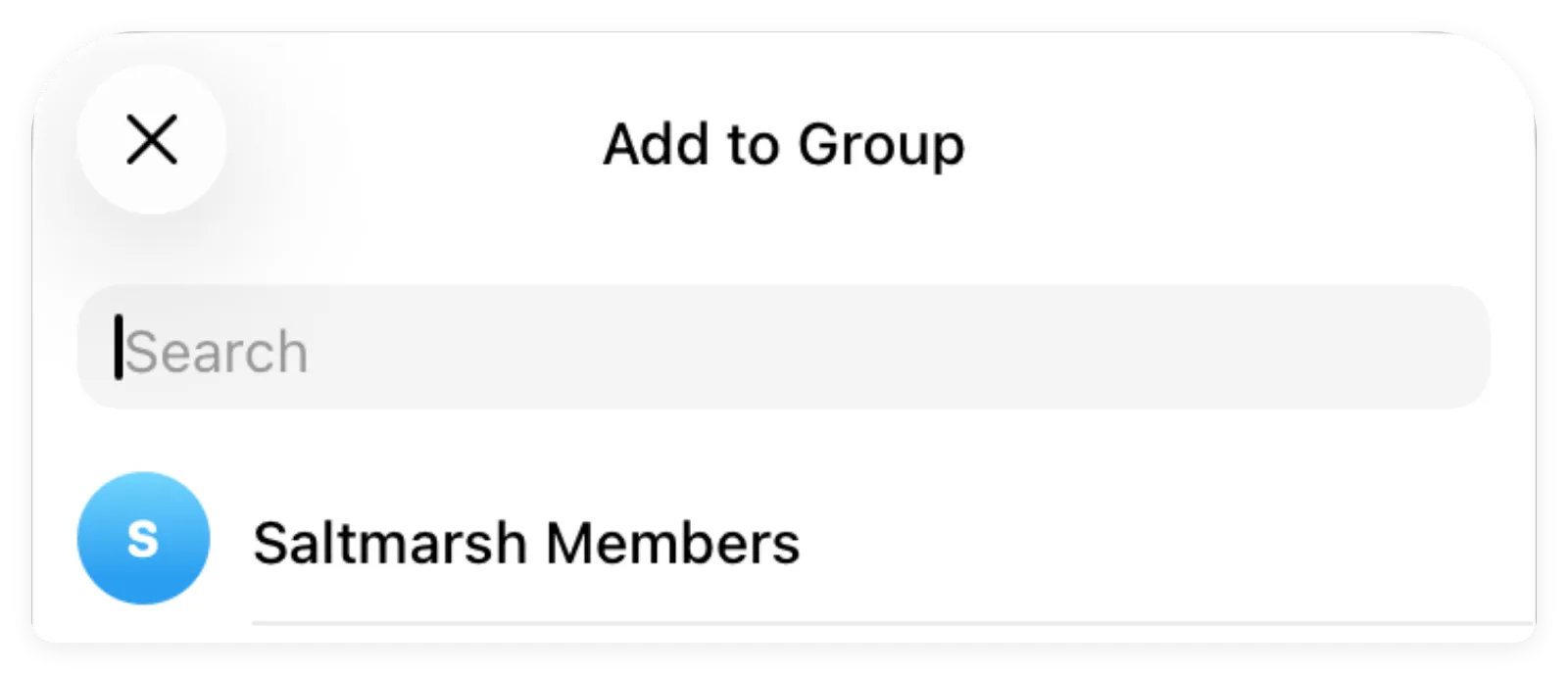 Choose Saltmarsh Members in Telegram, then return to Quickchat AI to confirm the connection.
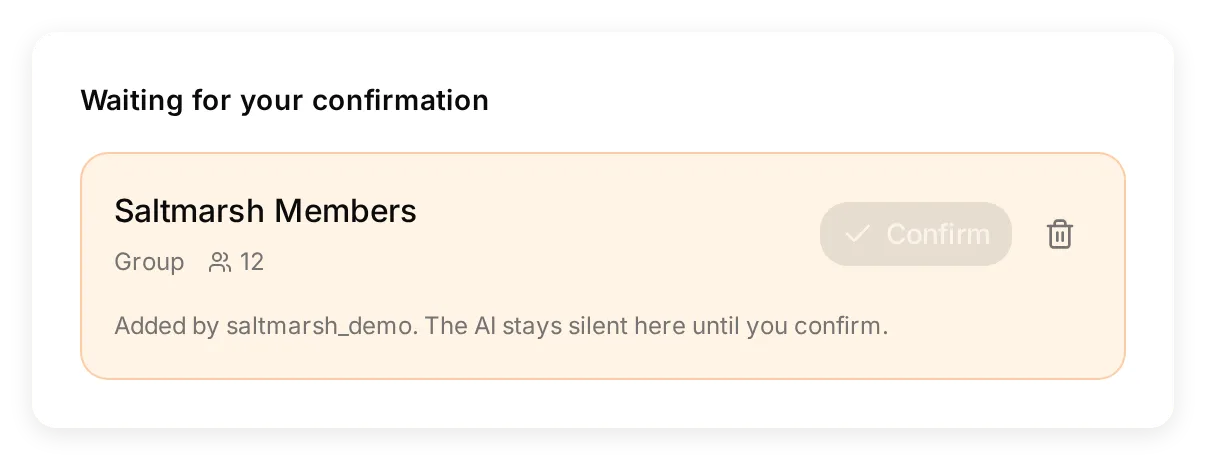 Real local UI with a seeded group fixture, showing where Confirm appears. This illustrates the control; it is not evidence that Telegram joined a live group.
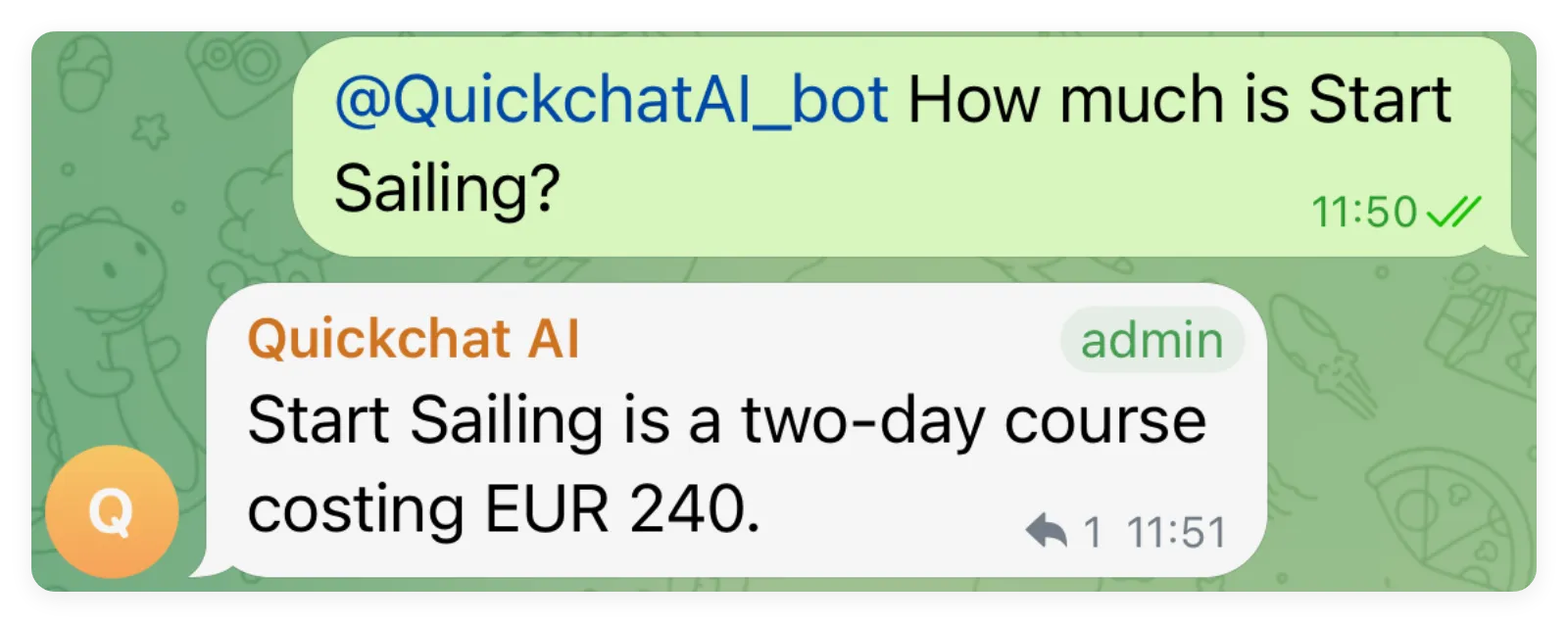 The confirmed group received the expected course answer. Mention the bot by its actual username.
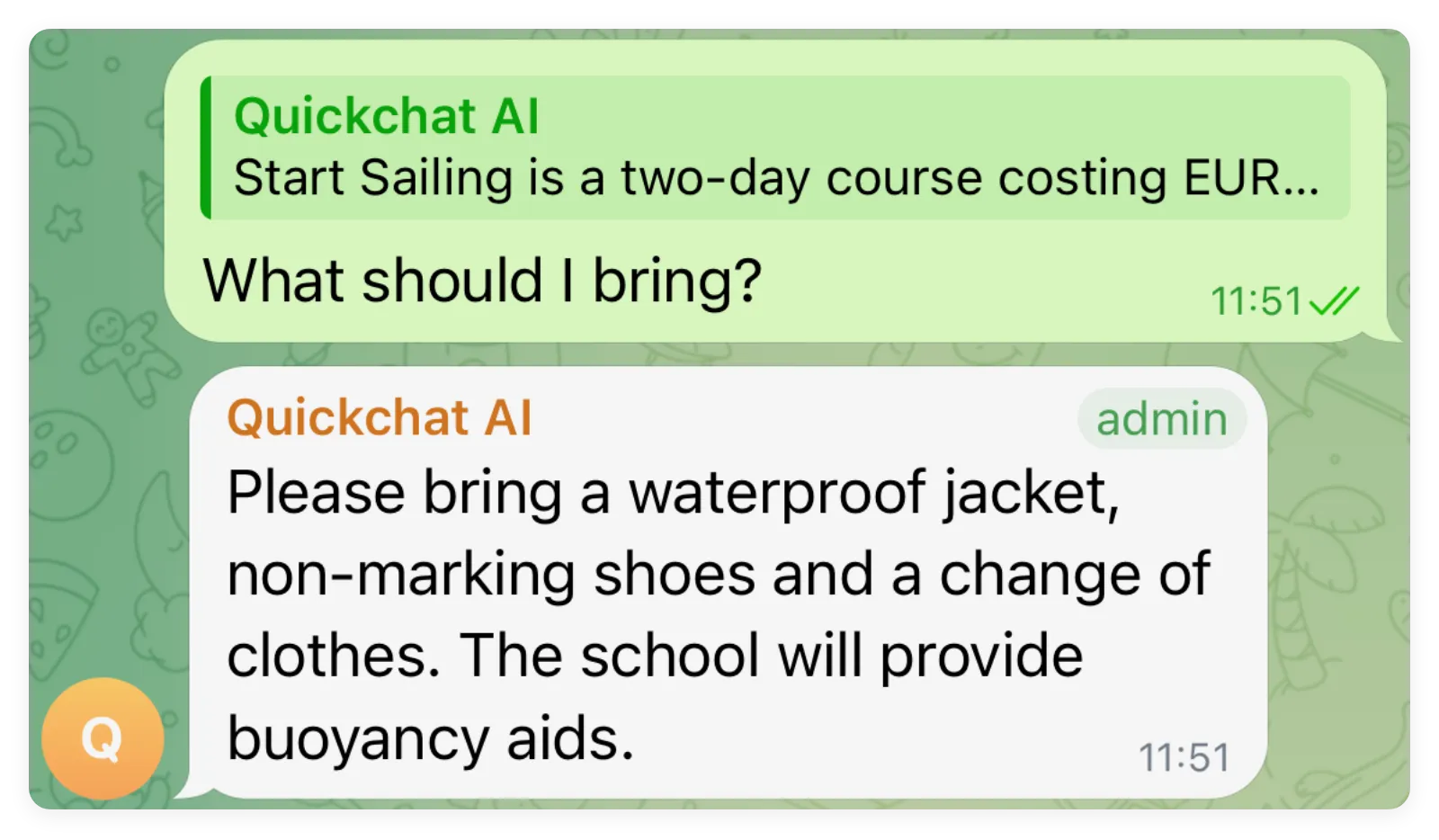 Replying to the bot’s message works without another mention. The answer lists the supplied equipment facts.
Confirmation matters because the invitation payload appears in the group. Quickchat AI requires an account-side decision before treating the group as a destination for your Agent. Do not confirm a group you do not recognize. The Telegram connection reference explains the same boundary.
Complete that confirmation before leaving the setup. If the bot leaves an unconfirmed group, generate a fresh Add to a Telegram group link, add it again and immediately confirm the pending group in Quickchat AI. Adding the bot through Telegram’s member search does not replace this connection flow.
The Admin badge reports the bot’s status in Telegram. It is not required for ordinary shared-bot answers. Making the shared bot an admin also does not change its mention-or-reply rule.
Step 3: How do you enable private Telegram chats?
Enable Direct message link and share its complete generated URL. The link selects your Agent inside the shared Telegram bot, so customers can ask privately without adding it to a group.
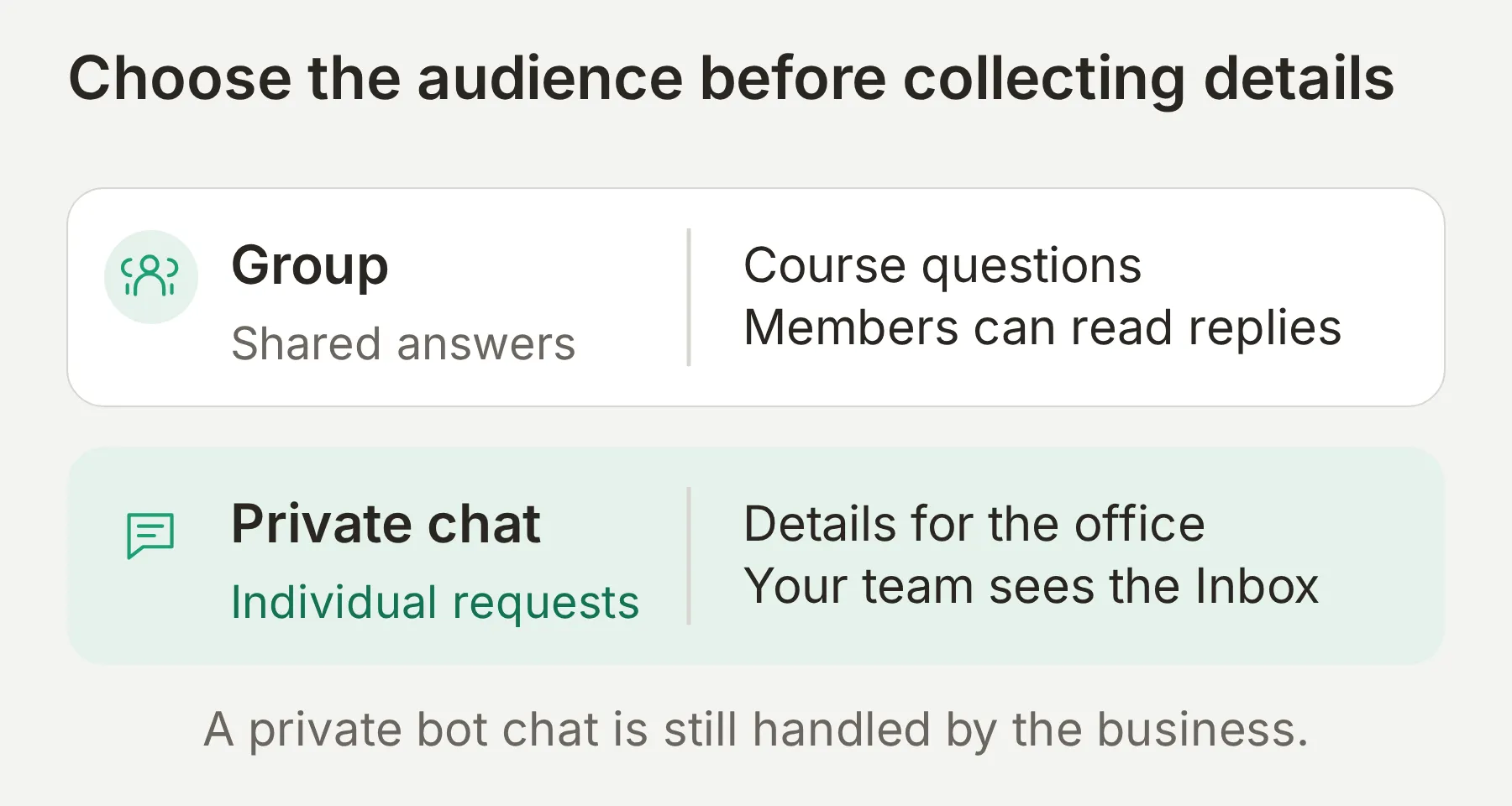 The group is a shared conversation. Move personal details and staff handoffs into DMs.
- Select Saltmarsh Sailing School, the private Agent. Open External Apps > Telegram and turn on Direct message link. Leave its group connections empty.
- Copy the generated link. Keep its
start=parameter; a bare link to the shared bot does not identify your Agent. - Open it in Telegram and press Start if prompted.
- Ask
How much is Start Sailing?without mentioning the bot. Verify the school’s answer and find the conversation in Inbox. - Pin the link in your group’s welcome message so people can find it before sharing personal information.
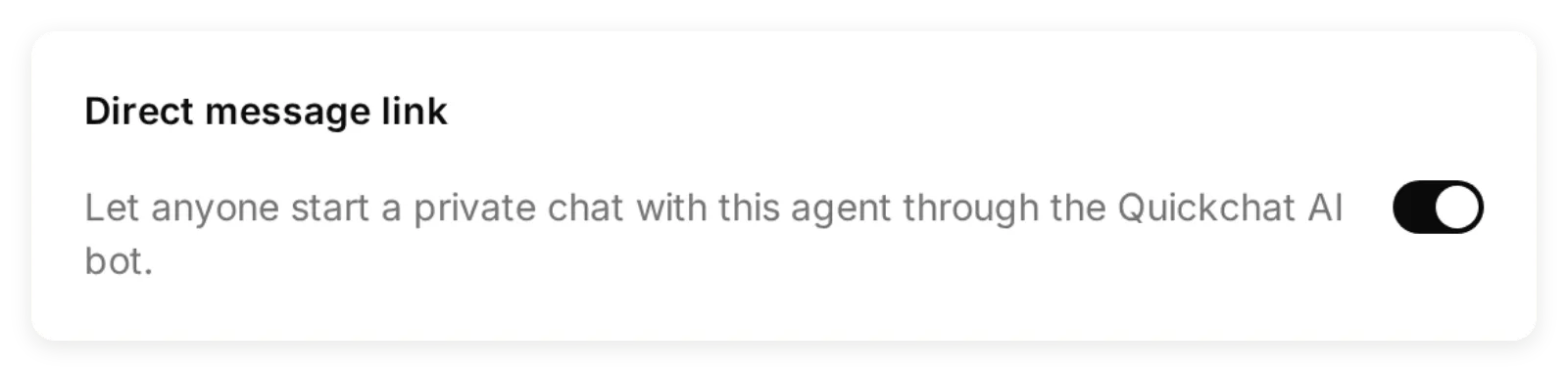 Use the link generated for your own Agent. The local configuration shown here is not a live Telegram delivery receipt.
 Telegram delivered the Saltmarsh welcome after Start. Check a knowledge answer next; the greeting alone does not test retrieval.
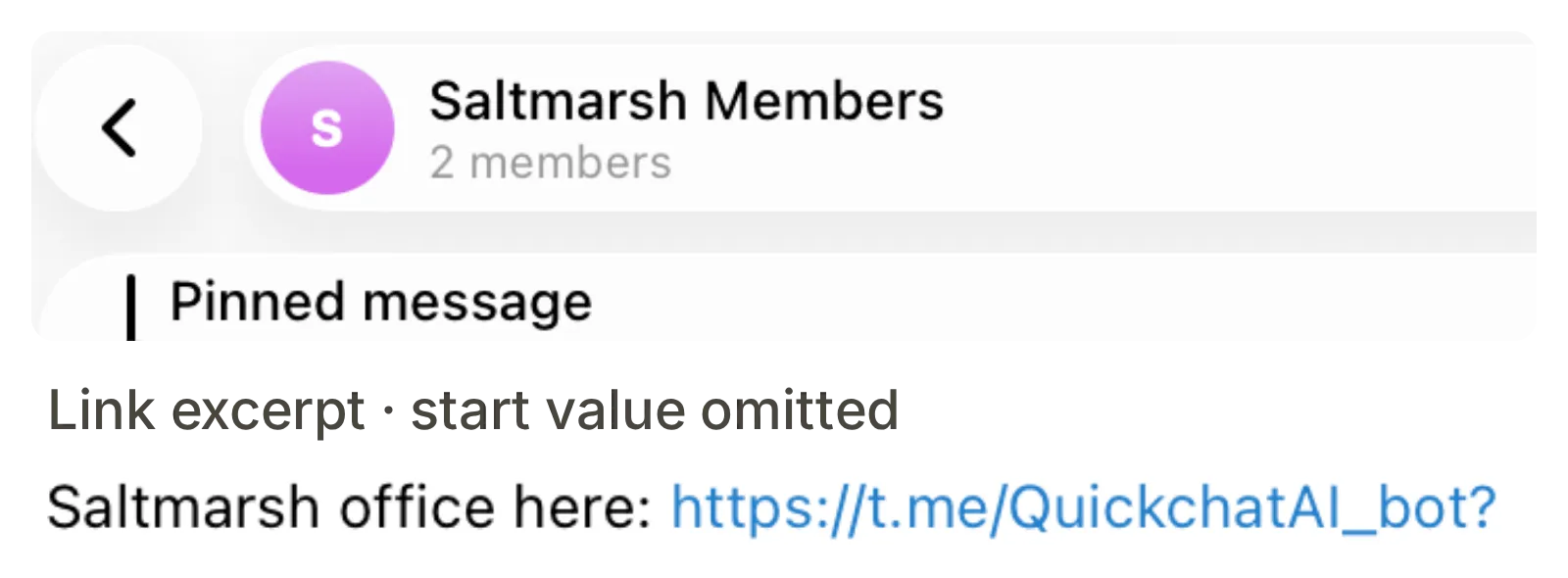 Two cropped details from the same Telegram screen show the pinned invitation. The demo link’s start value is omitted; pin your own complete generated link.
A private chat with the shared bot is bound to one Agent at a time. Opening another Agent’s direct-message link can switch that binding. For your own Telegram identity and a dedicated bot thread, use the own-bot path.
Turning off Direct message link prevents new connections through it. To stop an existing connected chat, use that chat’s enable switch or Disconnect. Treat the link as a public entry point, not an access restriction for confidential knowledge.
Step 4: How do you save a trial request to Google Sheets?
The Google Sheets integration creates a spreadsheet and an append Action. Adapt that Action to record three required trial-enquiry fields, then verify the actual row. This step is optional and works with the shared Telegram bot.
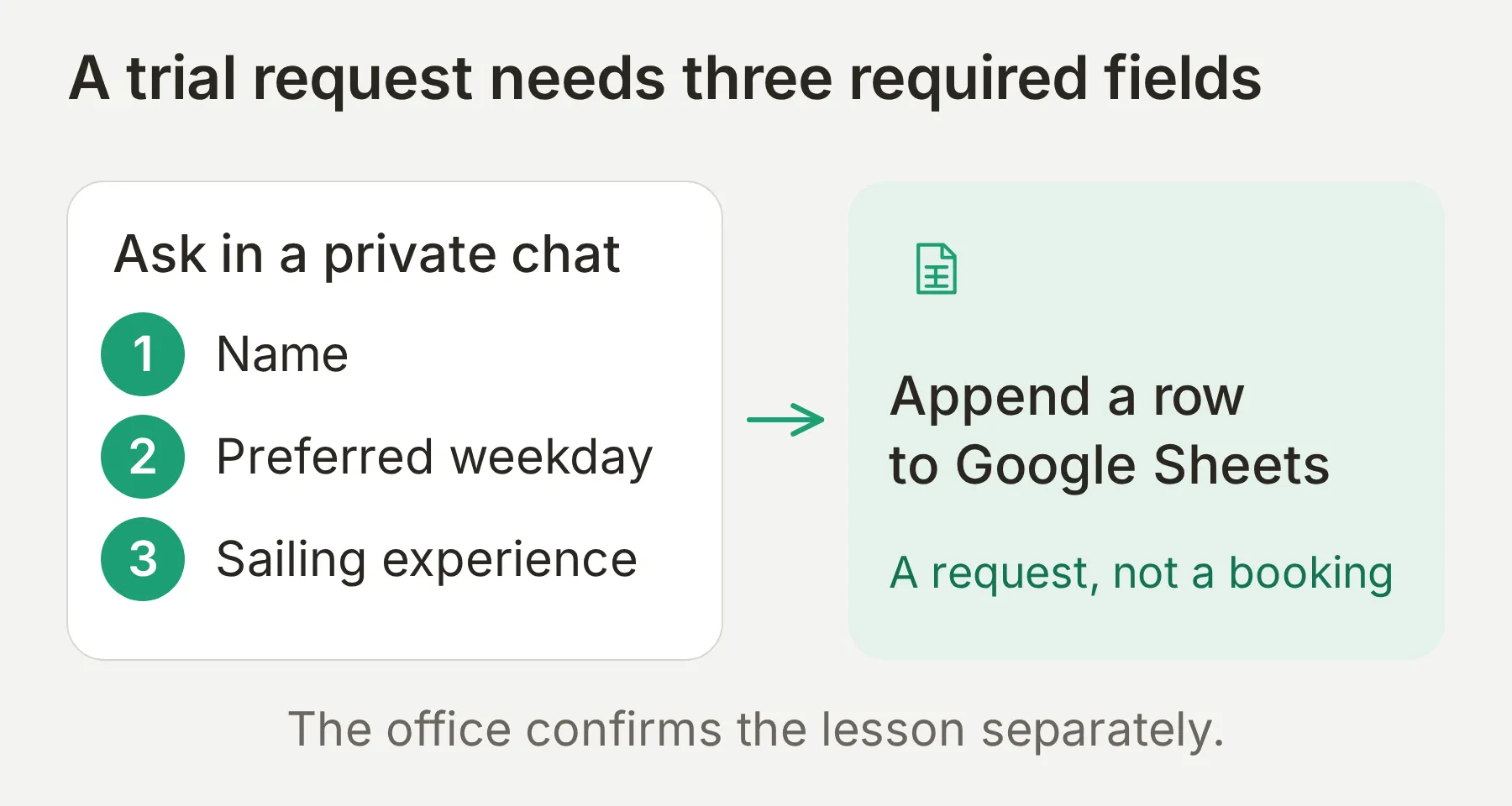 The output is a request for a person to follow up. It does not reserve a place or establish a trial price.
Connect Sheets and configure one Action
- On Saltmarsh Sailing School, open Actions & MCPs > Add Action > Google Sheets and select Connect Google Sheets. Sign in to the intended Google account and approve the requested access.
- Open the generated Quickchat Leads spreadsheet. Keep the tab named Leads, because the generated Action URL targets that tab.
- Replace its header row, in order, with
Name,Preferred weekday,Sailing experience,Conversation link,Channel. - Open Actions & MCPs and edit the generated
log_lead_to_google_sheetAction. Use the recipe below. Change the parameters, request body and spreadsheet headings together so their positions agree.
API Action Name
Record trial-lesson requestWhat to ask the user first
| Format | Name | Description | Required |
|---|---|---|---|
| Text | name | The name the person gave for this trial-lesson request. Ask for it if missing. | Yes |
| Text | preferred_weekday | The weekday the person would prefer for a trial lesson, such as Tuesday. This is a preference, not a confirmed date. | Yes |
| Text | sailing_experience | The person’s stated sailing experience, such as beginner. Ask for it if missing; do not infer it. | Yes |
Set all three parameters to No default and remove the default email and enquiry parameters. These three fields are the only questions in this recipe. A Telegram username is optional and is not a dependable required contact field; the recorded conversation link gives staff a route back to the enquiry.
Method and URL: keep the generated POST URL. It already contains your spreadsheet ID, the Leads tab and valueInputOption=RAW. There is no placeholder spreadsheet ID to fill.
Headers: retain the integration’s configuration.
| Header | Value |
|---|---|
Authorization | Bearer {{google_sheets_access_token}} |
Content-Type | application/json |
In the API Endpoint’s Body tab, use:
{"values":[["{{name}}","{{preferred_weekday}}","{{sailing_experience}}","{{conversation_url}}","{{conversation_channel}}"]]}Use Add AI Data to insert the parameter and conversation-variable chips where needed. The first three values come from the conversation; the last two are supplied by Quickchat AI.
API Action Description
In a private chat only, call this once when the person has requested a trial lesson and provided their name, preferred weekday and sailing experience. Ask for the next missing required field before calling. Do not call it for general course questions, in groups, or to confirm a booking. A successful call records an enquiry for the office; it does not reserve a place.Open Advanced settings > Run only when and add telegram_chat_type equals private. Use the bare metadata key, without metadata_ or braces. This prevents the HTTP request from running for a group message even if the model attempts it. The run-condition reference explains the check.
Set Response filter to $.updates.updatedRows so the Action returns the row count rather than an unnecessary provider response. Keep the Action enabled.
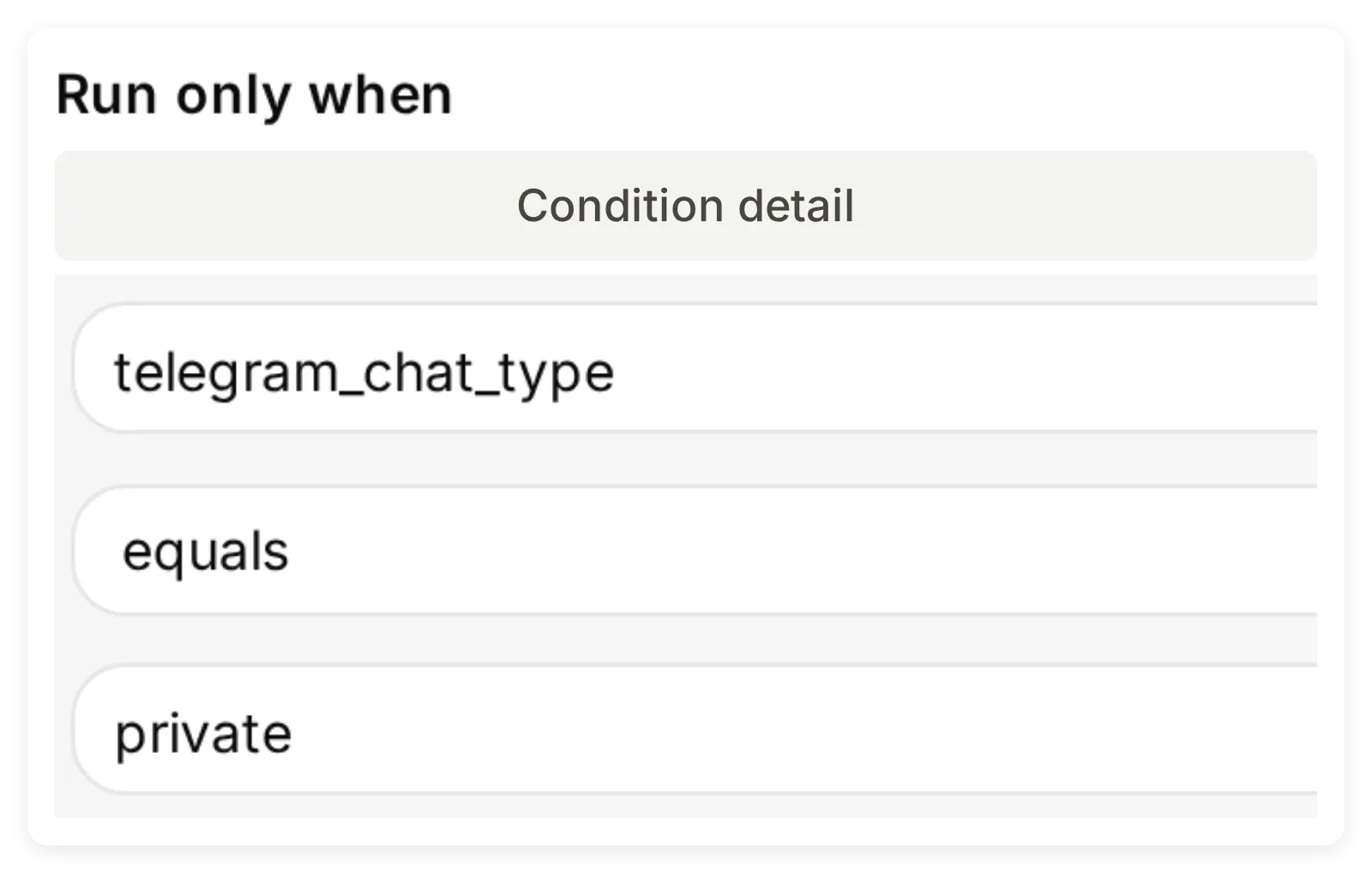 The bare key is telegram_chat_type. The condition is checked before sending the request.
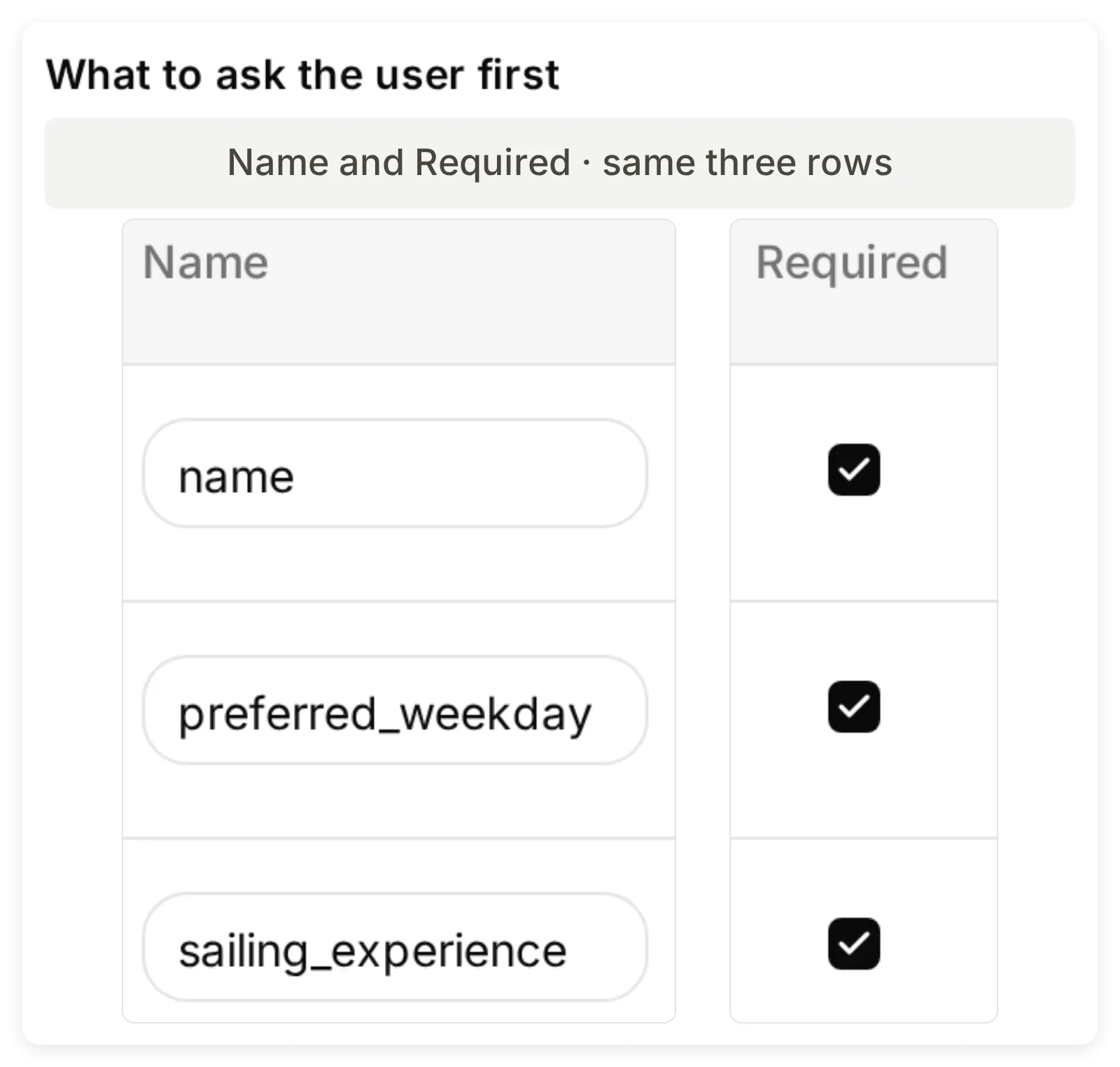 Local configuration of the request recipe. The generated Sheets URL and OAuth authorization must come from your own Google connection.
Check the row, then check the incomplete request
Send this through the Agent’s private Telegram link:
I am Alex Morgan. I want a trial on Tuesday. I am a beginner.Check all three surfaces: the reply describes a request, the Inbox Action card shows the supplied values, and the real Leads tab contains the matching row. Neither a reassuring reply nor a high Simulation score proves that Google Sheets received a write.
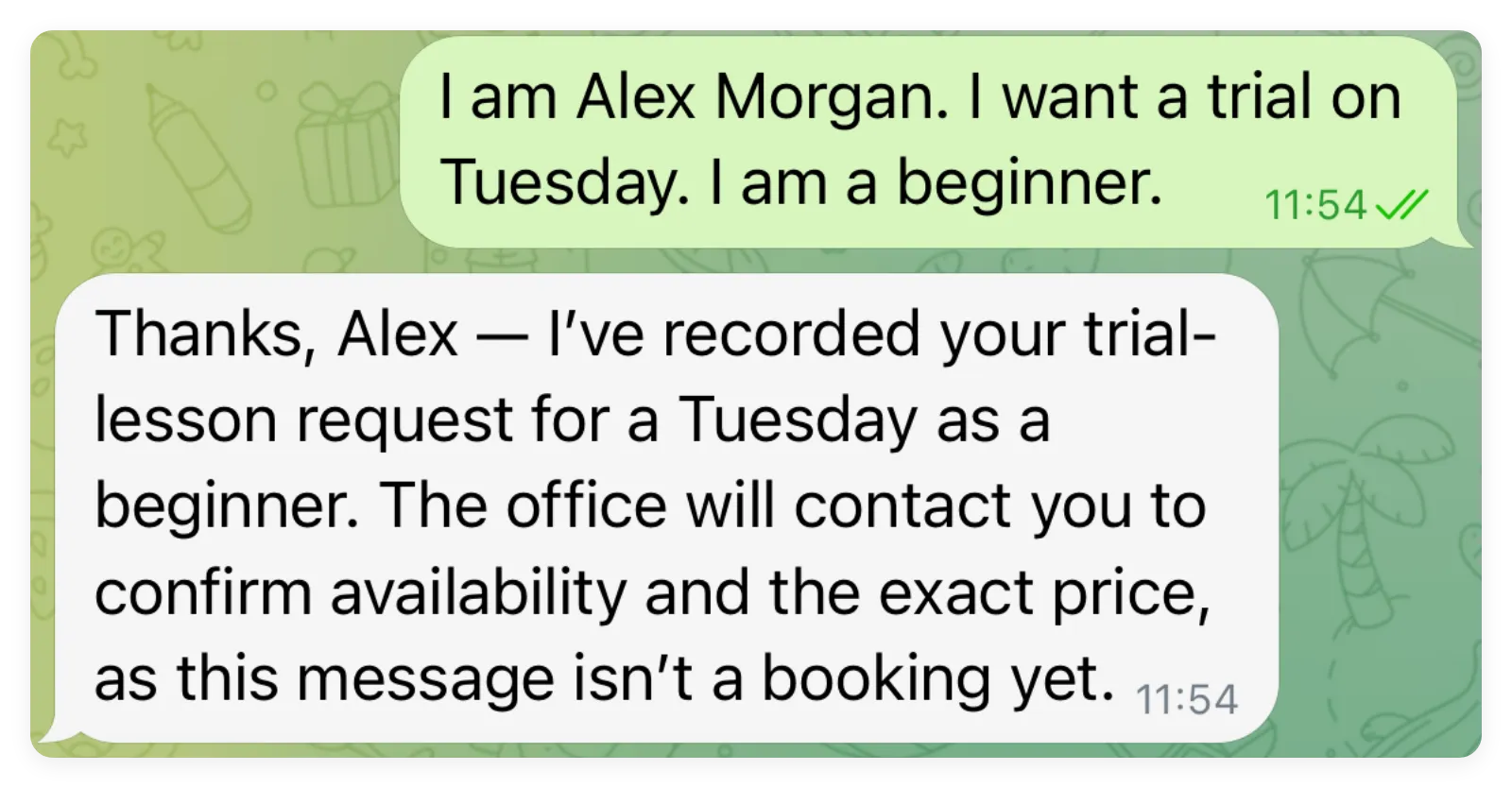 The Agent recorded the supplied name, Tuesday preference and beginner experience. Availability and the exact price still need office confirmation.
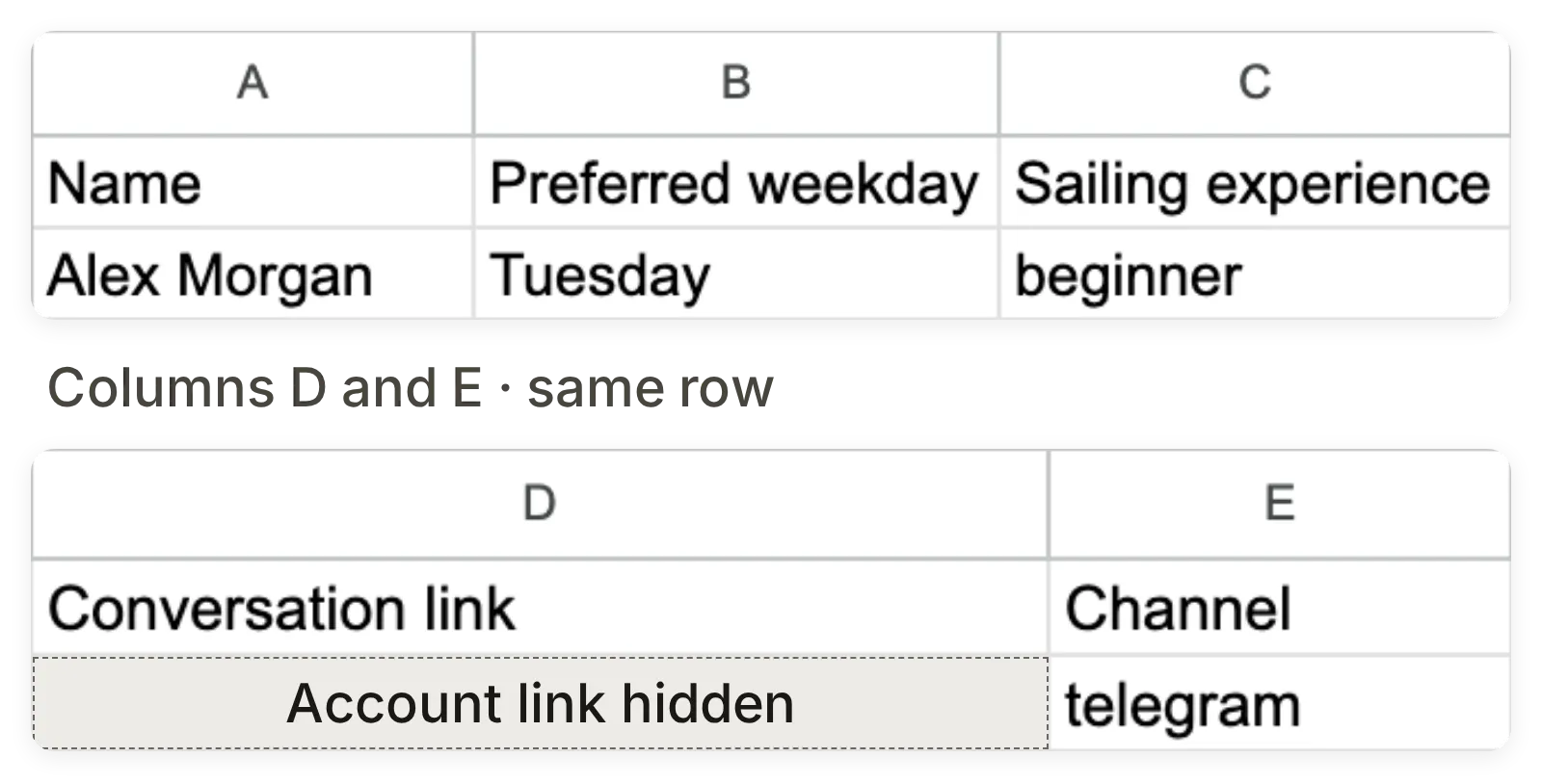 Two details of the same saved row keep all five columns readable. The account-specific conversation link is hidden; the other four values are unchanged.
Start a separate test with I would like a trial lesson. The Agent should ask for the missing fields, one question at a time, before the Action runs. Also try How much is Start Sailing?; an ordinary course question must not create a row. The prompt asks for one write per request, but this append recipe is not an idempotent booking system. Inspect duplicates before using it for operational intake.
Step 5: How do you hand a Telegram conversation to a person?
Configure Human Handoff, then verify the conversation’s assignment in Inbox. A prompt that says “the office will reply” does not by itself transfer ownership or pause the AI.
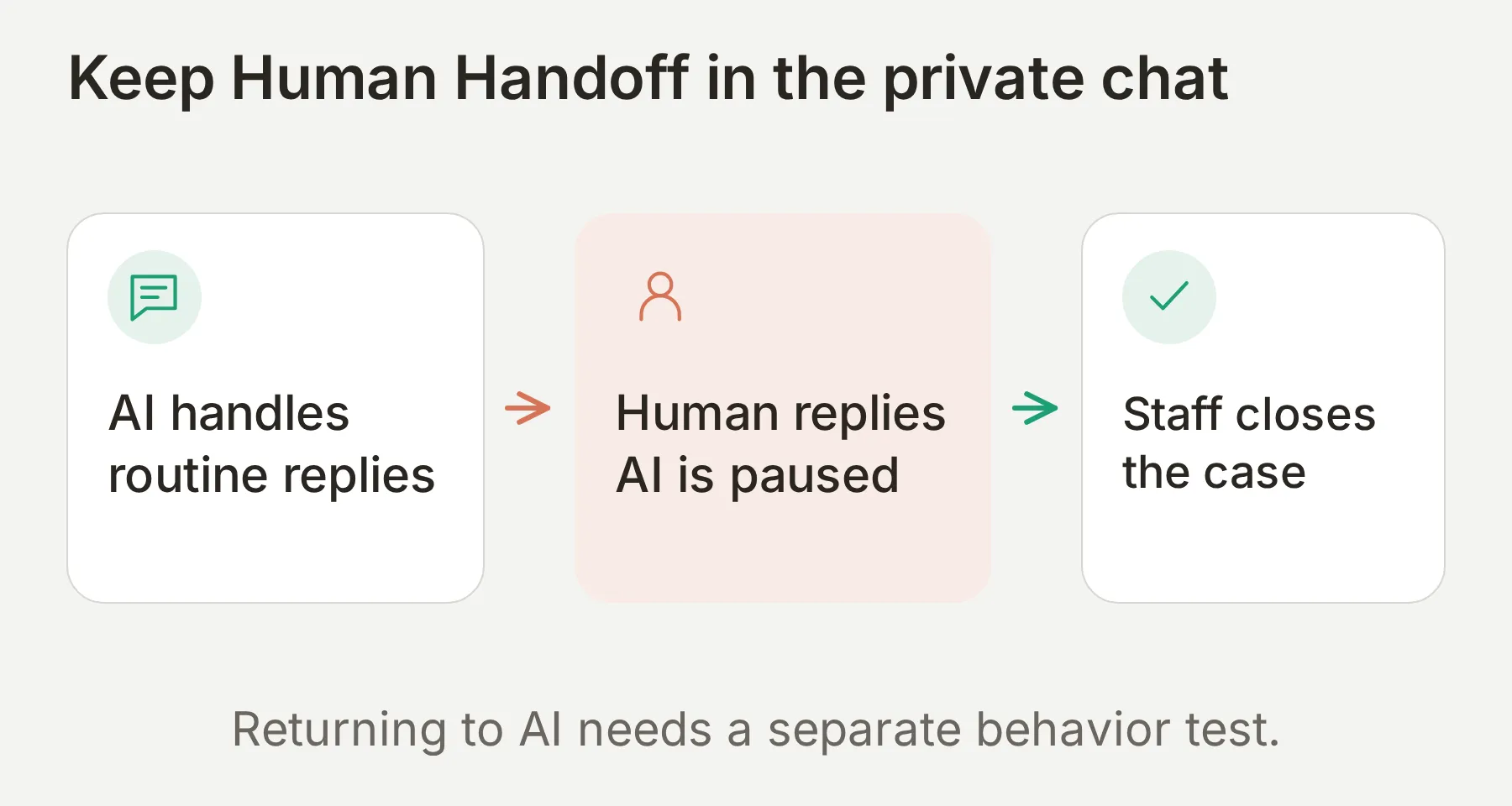 An assignment change is the checkpoint. Finish the case with a person; separately verify any return to AI.
- Select Saltmarsh Sailing School, then open Actions & MCPs > Human Handoff and enable it. Keep this Action off on Saltmarsh Group.
- Under Handoff Rules, select the + control. Enter
Private enquiriesas the Rule Name, pastehandoff-rule.txtinto Description, and switch its State on. New rows start inactive. The rule covers refunds, complaints, requests for a person and acceptance of human help on this private Agent. - Clear Keywords and disable the predefined rules for this example, leaving the single custom rule active, then save. Group isolation comes from keeping Human Handoff disabled on the separate group Agent; the custom rule describes when the private Agent should transfer.
- Set Confirmation to
I have passed this private conversation to the Saltmarsh office. A member of staff can reply here.Configure Human Agents’ availability for the hours your team actually covers, and set an honest outside-hours message. - From the private Telegram chat, send
I want a refund for last week. Can I speak to a person?. - In Inbox, find the conversation, check its assignment, select Assign to me, and send
Hi, I’m Alex from the office. I’ll review your request.Check that it arrives in Telegram. - Send another customer message while the person owns the conversation. The AI should remain silent. Let the operator finish the case and resolve it in Inbox. Treat returning it to AI as a separate test.
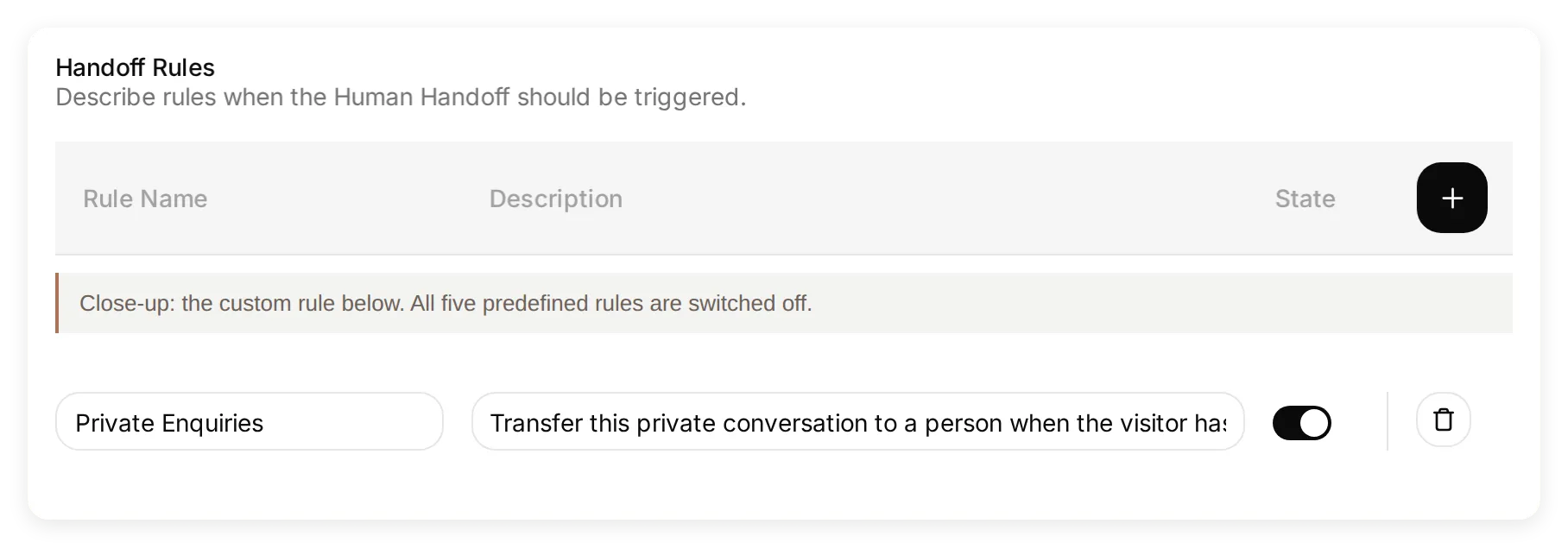 The custom rule’s State is on. The predefined triggers are off, leaving one rule to review.
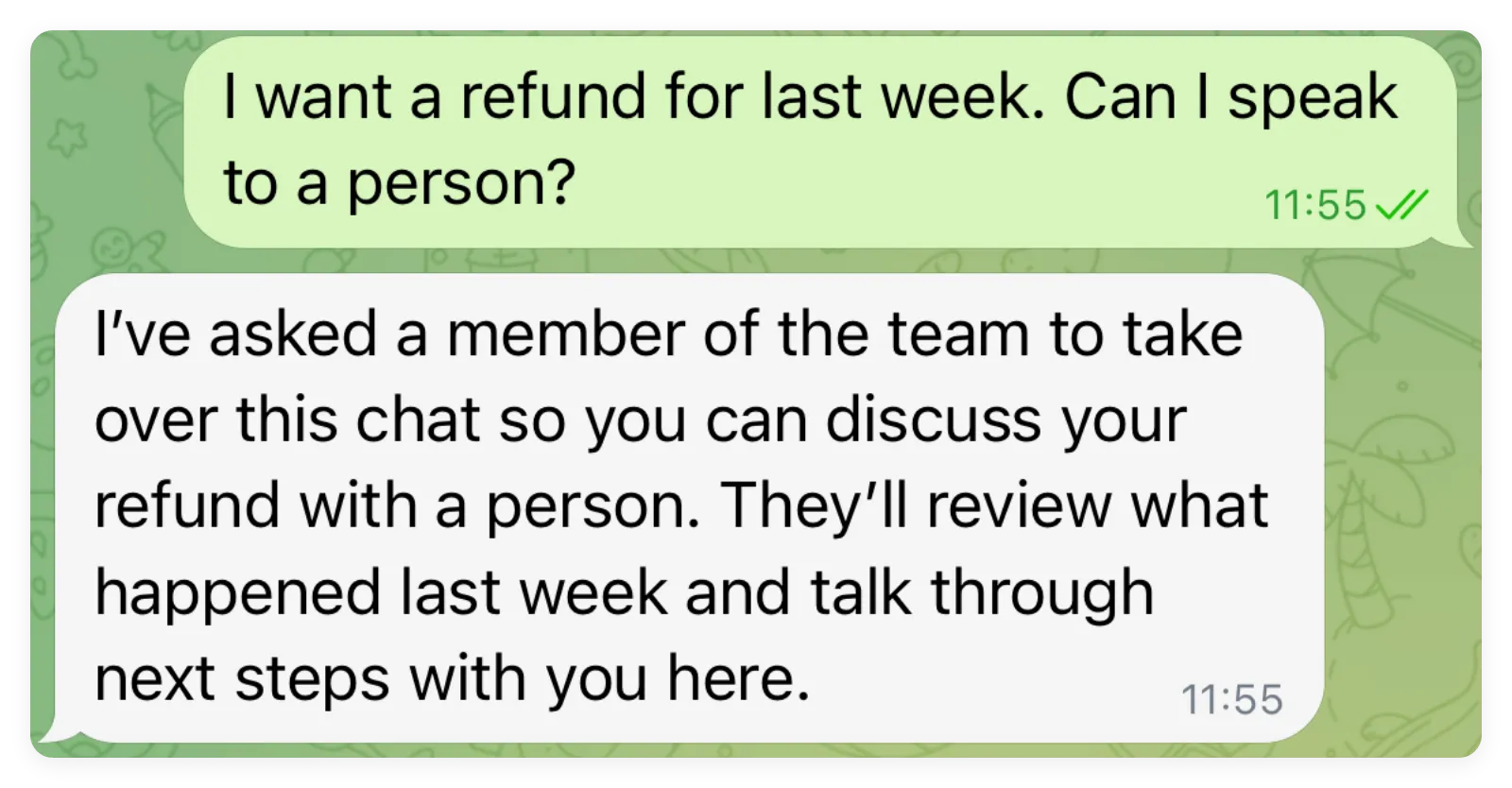 The live Telegram request triggered Handoff. Inbox assignment and the operator’s outgoing reply were verified separately.
In the live check, the conversation moved to Unassigned, ready for a person to pick up. The operator selected Assign to me, sent the office reply, and Telegram accepted it. The screenshot above shows the handoff response; it does not show the later operator message. Check both assignment and delivery when you repeat the test.
Keep this case with the operator until it is resolved. In our local refund test, returning it to AI Agent allowed one answer before Handoff triggered again. A return to AI needs its own successful follow-up test; it is not part of this workflow’s completion criteria. The human handoff guide covers staffing and ownership in more detail.
Step 6: How do you test the complete Telegram chatbot?
Use Testing for repeatable reply checks, then verify the live Telegram paths and external effects separately. A model can answer correctly while the group connection, spreadsheet write or handoff delivery is still wrong.
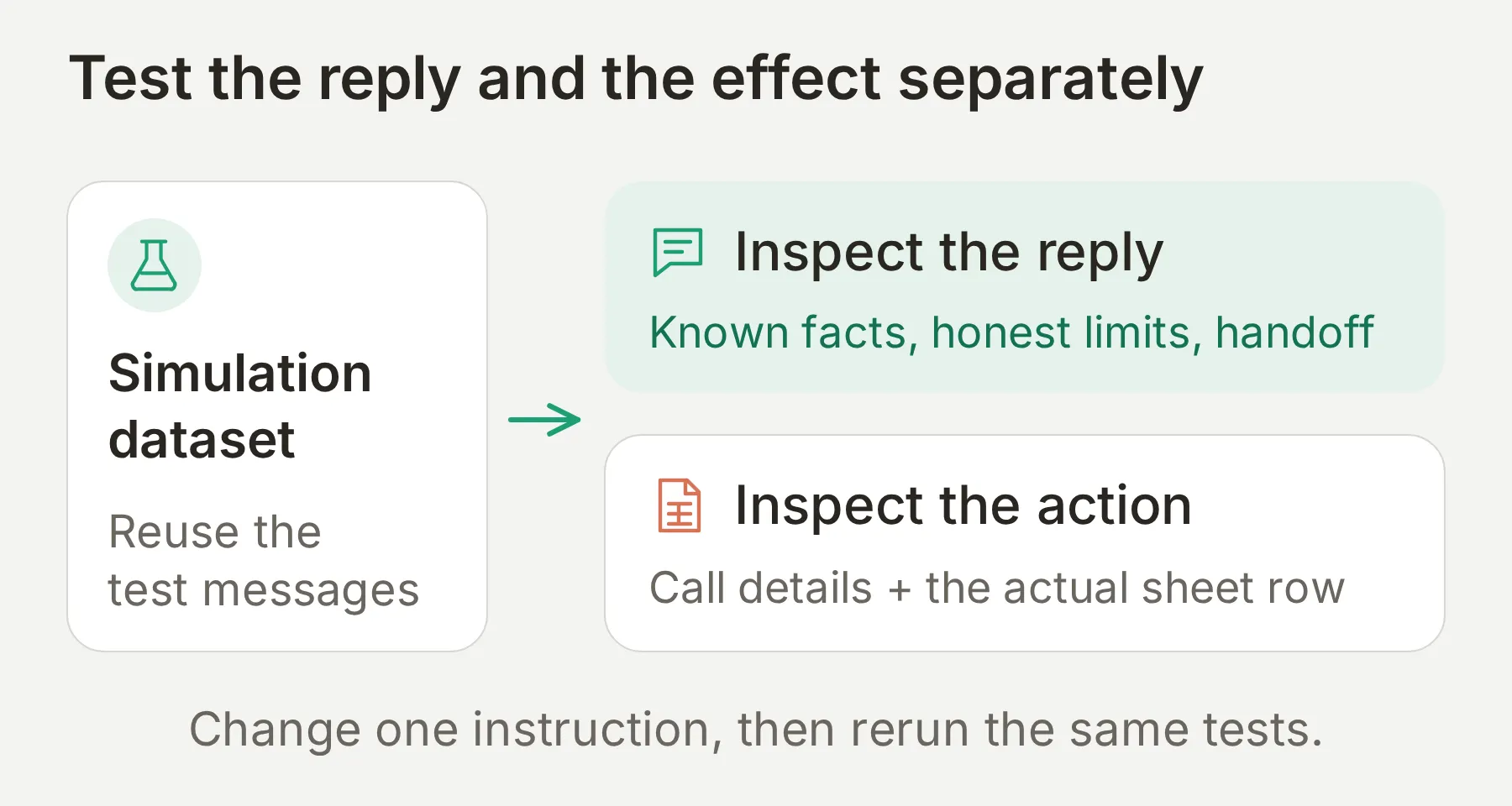 Inspect the system that owns the result: knowledge for facts, Action logs for requests, Sheets for rows, and Telegram for delivery.
Run a repeatable reply dataset
- Open Testing, create a dataset named
Saltmarsh: knowledge checks, and choose Paste messages. - Paste
simulation-messages.txt. Keep the standalone---separators between cases. - Open Evaluation criteria, paste the kit’s
evaluation-criteria.txt, and save it. - Select Run > Start Run, then inspect the individual replies as well as the scores.
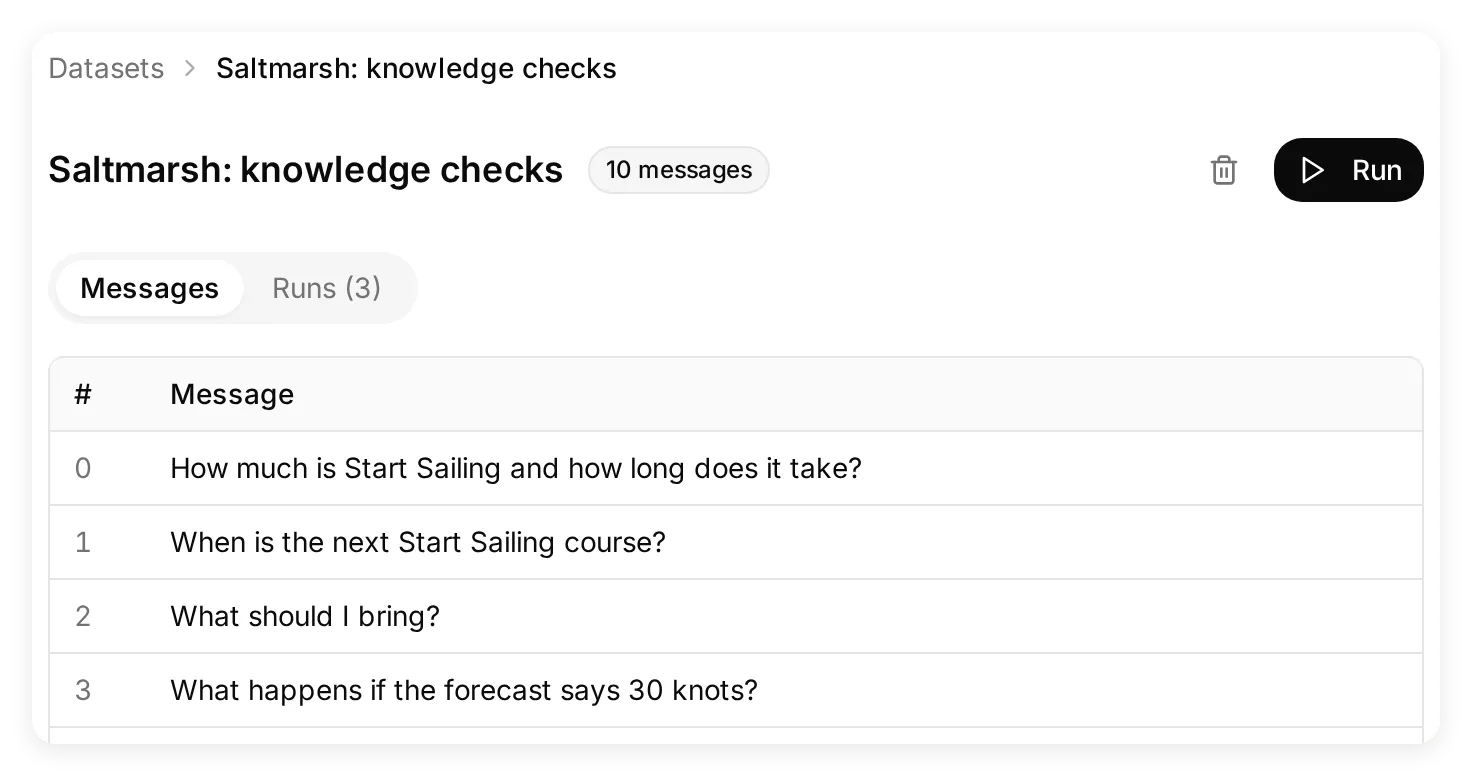 Keep the same questions when changing one instruction, so the comparison remains useful.
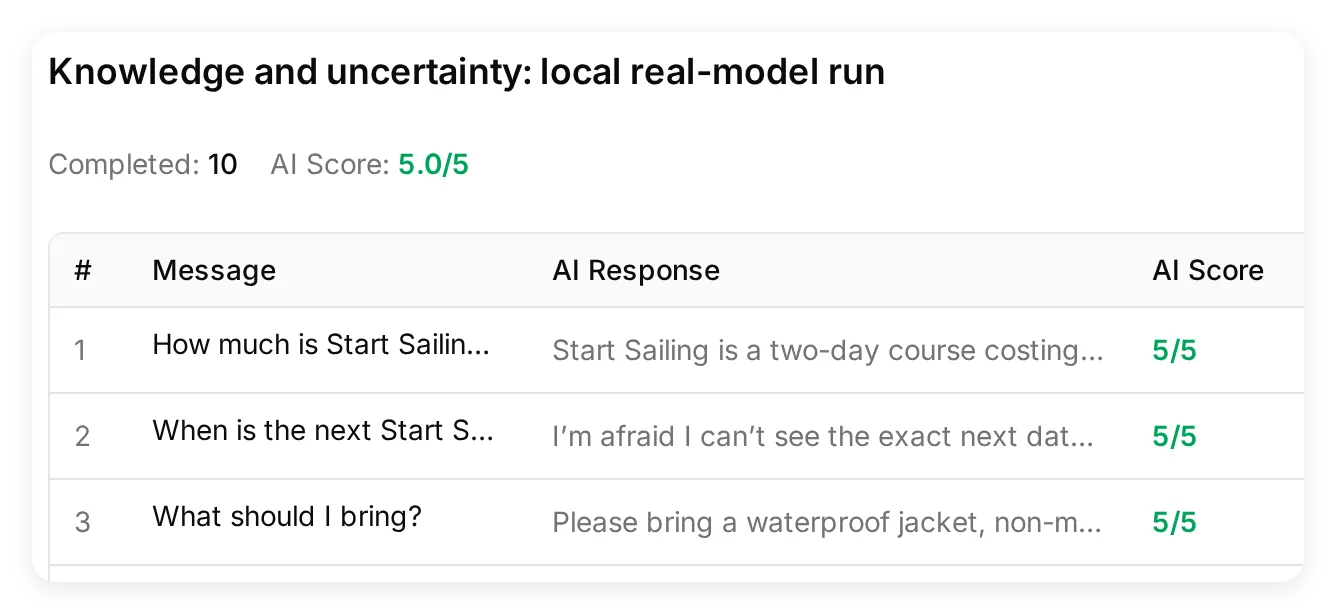 Read the replies as well as the score. These are local knowledge tests, not Telegram delivery tests.
The evaluator needs the school’s facts to judge accuracy. It also needs to know that its transcript cannot prove a sheet row, Telegram delivery or an assignment change. Stock text Simulation does not supply Telegram chat metadata, so the private-only Action gate should not be treated as broken when that metadata is absent. Run channel-dependent checks in the actual private chat.
What did the local tests change?
The initial design used one Agent for both entrances. A local test showed a group refund request transferring the shared conversation to Human Handoff. We separated the Agents and disabled both Handoff and intake Actions on the group Agent. Repeating the group refund and trial checks then produced directions to the pinned private link while preserving AI ownership. This is why Step 1 uses configuration, as well as instructions, to separate the two conversations.
The ten final local knowledge checks completed with a score of 5/5 each, and both hosted Agents passed the same ten cases. These small runs are not a production accuracy estimate. The live group also answered the course-price and packing questions, then declined to confirm wetsuit rental. Keep these missing-fact cases when you adapt the kit; correct price answers alone do not test the Agent’s restraint.
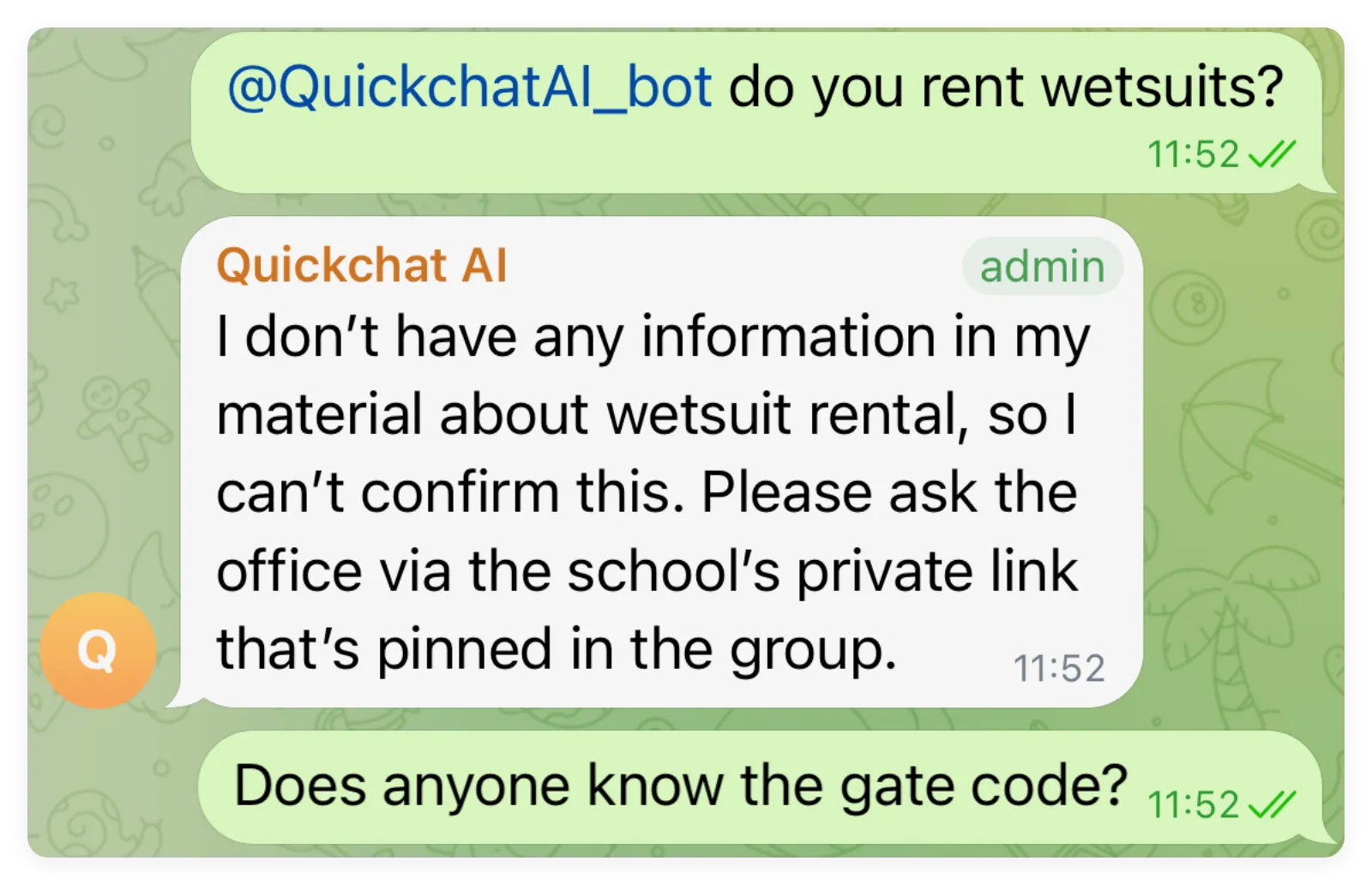 Missing knowledge produces “cannot confirm.” The separate gate-code message does not address the bot, and no reply to it is visible in this capture.
The live private trial request produced one successful Sheets Action call with Alex Morgan, Tuesday and beginner. Google returned HTTP 200 and one updated row; the saved row also contained the conversation link and telegram channel. A separate Action test with group-chat metadata sent no HTTP request. Check both the accepted private request and the refused group context when adapting the gate.
Check the channel and its side effects
Use the kit’s blank test-matrix.csv to record your own observations. The screenshots above show the demonstrated outcomes; the table also includes checks to run with your own configuration. Record the elapsed time when testing silence, and keep human takeover separate from any later return to AI.
| Test | Send or do | Expected outcome |
|---|---|---|
| Group mention | @QuickchatAI_bot How much is Start Sailing? | A concise reply with EUR 240; matching Inbox exchange. |
| Reply to bot | What should I bring? | The packing list, without needing another mention. |
| Ordinary chatter | Does anyone know the gate code? without mention | No shared-bot reply. |
| Knowledge gap | Mention the bot and ask Do you rent wetsuits? | Cannot confirm; no invented yes or no. |
| Group personal request | Mention the bot and ask for a refund | Direction to private chat; group remains AI-assigned. |
| Private answer | Open the full DM link and ask the price | The correct Agent answers without a mention. |
| Complete trial request | Send the Alex Morgan message from Step 4 | Action parameters and real Sheets row agree; no booking claim. |
| Private handoff | Ask for a refund, then reply after takeover | Human assignment, operator delivery, no extra AI reply. |
| Weather policy | What happens if the forecast says 30 knots? | Free reschedule policy and instructor decision; no live forecast claim. |
When a check fails, change one relevant setting and rerun the same message. Correct a missing source fact in the Knowledge Base; correct an early Action call in its description or required parameters; correct a silent group by checking confirmation and addressing first. Preserve the failed result so the improvement is visible.
When should you create your own bot with BotFather?
Create your own Telegram bot when you need your own bot name and picture, Telegram Bot API Actions, or a group that receives ordinary messages. The shared bot is enough for the group and private-answer paths above. The step-by-step BotFather guide covers creating the bot, protecting its token and configuring its profile and command menu.
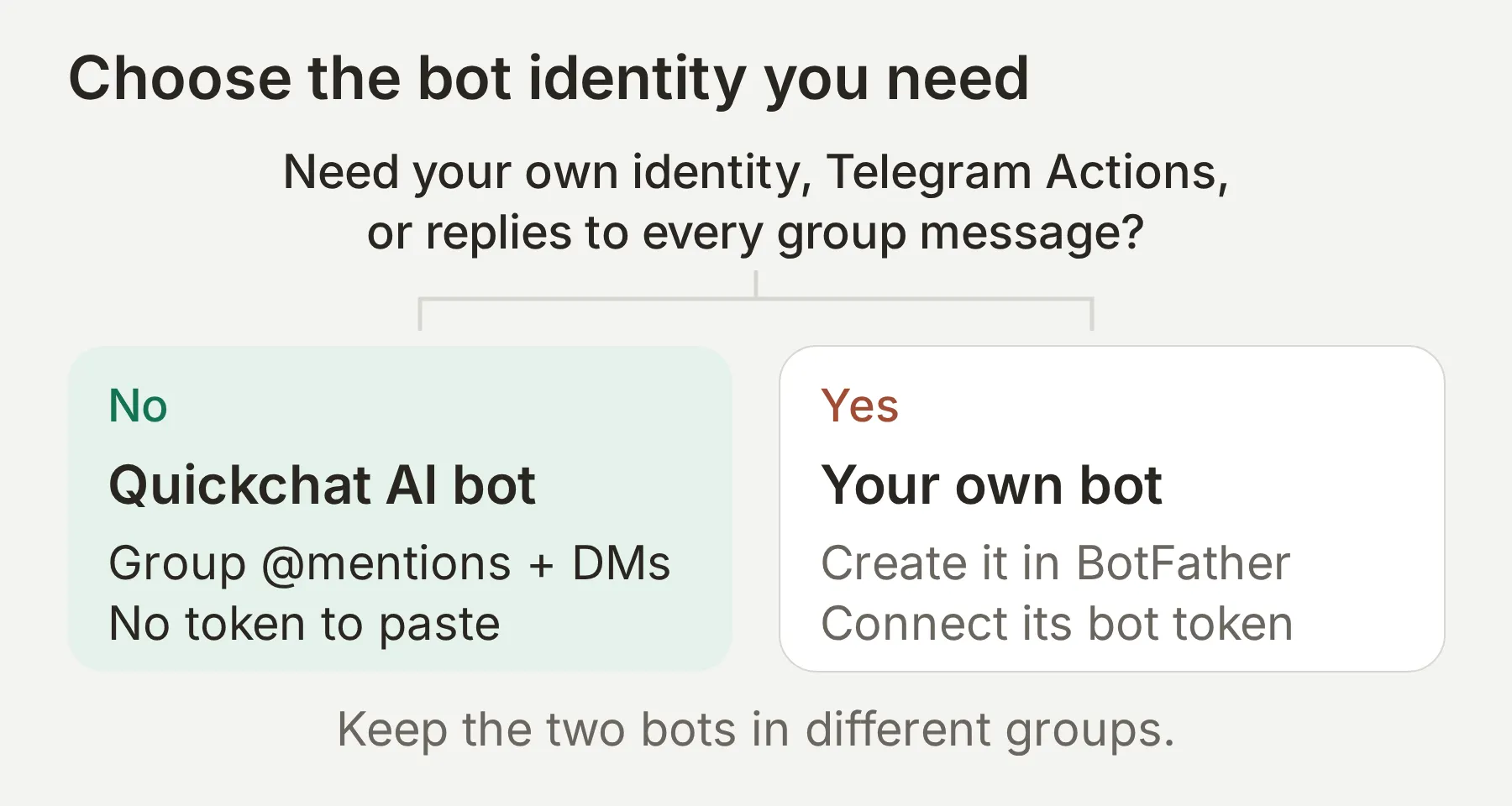 Choose the identity and message behavior you need before adding a second bot.
| Requirement | Shared Quickchat AI bot | Your own bot |
|---|---|---|
| Create a BotFather token | Not required | Required |
| Custom Telegram name and picture | Shared identity | Your bot identity |
| Answer group mentions and replies | Yes | Yes, when Telegram delivers them |
| Respond to ordinary group messages | Shared bot stays quiet | Configure Telegram privacy or admin status |
| Private conversations | Agent-specific start link inside the shared bot | Your bot’s own private thread |
| Google Sheets Action | Supported | Supported |
| Telegram moderation Actions | Shared token is not exposed | Own token available as a System Token |
- Open the verified BotFather account in Telegram and send
/newbot. - Choose a display name, then an available username ending in
bot. BotFather returns a token. Keep it private. - Select Saltmarsh Group if this bot will join a group. Keep Saltmarsh Sailing School for private chats only. In External Apps > Telegram, open Your own bot and select Connect to Telegram.
- Paste the token into Bot Token and complete the connection. Confirm Enable your own bot is on.
- Open the bot’s Telegram link and send
/start, then the same course-price question. - If you want ordinary group messages delivered, use
/setprivacyin BotFather, select your bot and choose Disable, then remove and re-add it to the test group. An admin bot also receives ordinary messages. Telegram’s privacy-mode documentation explains delivery rules.
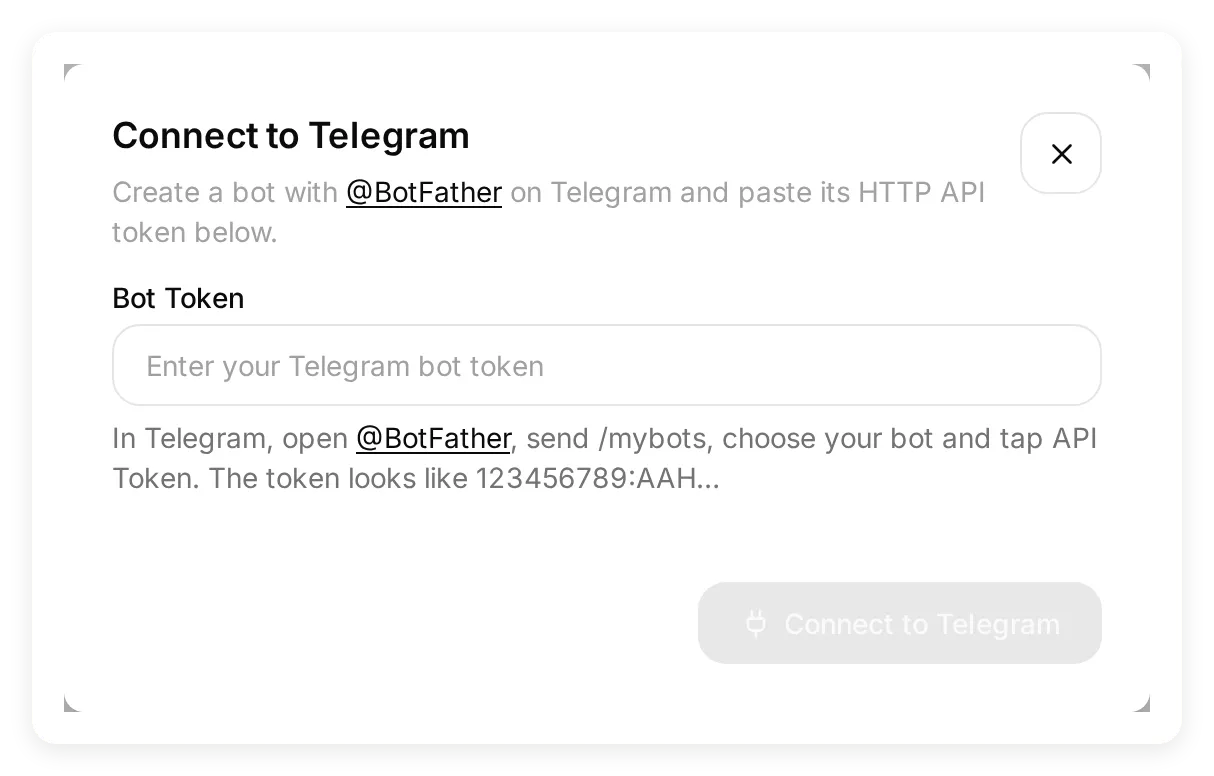 Paste the token only into Bot Token. An empty field is shown so no credential is published.
Keep the shared bot and your own bot in separate groups. Running both in one group can produce duplicate replies. If your next task is pinning announcements or moderating members, follow the separate Telegram group-management tutorial, including its admin-only Action conditions.
Can ChatGPT or Claude help configure the Telegram chatbot?
A connected Quickchat AI account-management app can help create an Agent, add knowledge, configure supported settings and run tests. Where the client exposes Telegram setup, it can enable the shared-bot direct-message link. Group selection and dashboard confirmation remain owner steps. Some clients also require the dashboard for direct-link activation and Human Handoff settings, so have the assistant inspect its available tools first.
Connect the Quickchat AI ChatGPT plugin or Claude connector, then supply the kit files with this prompt:
Use my connected Quickchat AI account to create two Agents from the attached kit: Saltmarsh Group with group-main-prompt.txt and Saltmarsh Sailing School with main-prompt.txt. Add both knowledge files to each. Keep Actions and Human Handoff off on Saltmarsh Group. Prepare the supplied knowledge-test dataset. Check the tools available in this client before changing settings. Show me the configuration and ask before running credit-consuming tests or writing to Google Sheets. Where supported, enable only Saltmarsh Sailing School's shared-bot direct-message link and return the complete link. Leave group selection, dashboard confirmation, BotFather setup, Google OAuth and unsupported settings for me, with exact dashboard steps. Report what was configured, what was actually tested and what remains to verify in Telegram.Tool availability varies by client and account permissions. Follow the account-management setup reference for sign-in. This connects an assistant to your Quickchat AI account; it does not turn a personal ChatGPT or Claude conversation into the Telegram bot’s hosted backend.
Why is the Telegram chatbot not replying?
Check the connection and message path before rewriting the prompt. These symptoms have different causes.
| Symptom | Check |
|---|---|
| Group listed but silent | Confirm the expected group, enable it under Connected chats, and mention the actual bot username or reply to its message. |
| Bot left before its first answer | Generate a fresh Add to a Telegram group link, add it again and immediately Confirm the pending group in Quickchat AI. |
| A bare bot link opens the wrong Agent | Use the complete direct-message link, including start=. Check whether another Agent’s link switched the shared private chat. |
| The AI stopped after a refund request | Inspect Inbox assignment. A handed-off conversation remains paused until deliberately reassigned. |
| No row in Sheets | Confirm the Action is enabled, all required fields are supplied, the chat is private, and the generated URL still targets Leads. Inspect the Action call and Google connection. |
| Own bot misses ordinary messages | Check privacy mode and group permissions; remove and re-add after changing privacy. |
| Reply claims a date or service you never supplied | Inspect the saved, Ready knowledge and the uncertainty instruction. Rerun the exact failing question. |
| Tests stopped answering | Check available AI credits and the failed request, rather than interpreting an allowance failure as a prompt-quality result. |
Before inviting customers, replace fictional facts, review the group/private separation and staff the handoff queue. Ask a colleague to check the public entry points from another account as a final launch check. For another community channel, the Discord chatbot tutorial follows a comparable build-and-test path. For character conversations, use the Telegram roleplay guide.
Optional setup checks: Compare deployment methods using your declared requirements, or compare replies per credit budget using a supplied budget. These calculators do not inspect your account, website or balance.
Copyable Saltmarsh setup
These are the complete source facts and instructions used by this walkthrough. The download also includes the Action recipe, evaluation criteria and tests.
Group Agent: Main Prompt
Paste this into Identity > Main Prompt on Saltmarsh Group. Keep Human Handoff and custom Actions disabled on this Agent.
You answer general questions in the Saltmarsh Sailing School members' group. Use only the Knowledge Base and keep each reply to two or three sentences. Do not add facts or requirements the sources do not contain. If a fact is missing, say that you cannot confirm it.

For trial requests, refunds, complaints, personal details or a request for a person, direct the member to the school's private link pinned in the group; do not invent a link. Do not collect personal details in this group. You cannot record requests, confirm bookings, approve refunds or transfer a conversation to staff. Do not claim you did any of these things. The private Agent records an enquiry; it cannot check live availability or confirm a trial. Only the office confirms availability and price.
Private Agent: Main Prompt
Paste this into Identity > Main Prompt on Saltmarsh Sailing School. Keep the named Action consistent with the recipe.
You are the private-chat assistant of Saltmarsh Sailing School. Answer school questions from the Knowledge Base. Do not add plausible details that are not in the sources, including extra clothing or footwear requirements. Keep replies to two or three sentences and ask at most one question per message. If a fact is missing, say that you cannot confirm it; do not invent dates, availability, gate codes or wetsuit rental. Explain weather policy without claiming to know the current forecast.

When a person requests a trial lesson, collect their name, preferred weekday and sailing experience. Ask for only the next missing field. When all three are present, use Record trial-lesson request once. Say the request was recorded only after the Action succeeds. Explain that the office still needs to confirm availability and price; never say a lesson is booked. If the Action is unavailable or fails, say the request has not been recorded and offer a person.

Use Human Handoff for a current unresolved refund request, complaint or explicit request for a person. After a staff member has resolved the enquiry and returned the conversation to AI, answer new general questions normally; do not hand off again solely because an earlier message mentioned a refund or asked for a person. Do not approve refunds or promise a response time. For a missing fact, say what is unknown and offer a person; do not treat uncertainty as a negative answer about the service.
Knowledge: Courses and trial requests
Paste this into the Content field of the first knowledge article.
Saltmarsh Sailing School demonstration information

This fictional school is used only for a tutorial. It contains no real customer data.

Start Sailing is a two-day course costing EUR 240. Day Skipper theory runs across five evenings and costs EUR 310. A private lesson lasts 90 minutes and costs EUR 95.

Courses run from April to October. Course dates are published on the school's website one month ahead. This source does not contain the next available date or live availability.

Bring a waterproof jacket, non-marking shoes and a change of clothes. The school provides buoyancy aids.

A trial-lesson request is an enquiry, not a confirmed booking. The office needs the person's name, preferred weekday and sailing experience, then confirms availability and price. Do not collect payment details. Do not infer a trial price from the private-lesson price.
Knowledge: Policies and member information
Paste this into the Content field of the second article.
Saltmarsh Sailing School demonstration policies

If the forecast shows more than 25 knots of wind or thunderstorms, the session moves to the next available date at no extra cost. The instructor decides on the morning of the session. This source is a policy, not a live weather forecast or a cancellation decision.

Parking is free at the clubhouse. The gate code is sent to enrolled students the day before their course. The code itself is not in this Knowledge Base.

Refunds and complaints are handled by the office. An AI answer cannot approve a refund. A member of staff must decide each case.

The Telegram members' group is for general questions. Trial requests, refunds and other personal details belong in a private conversation with the school's Agent, opened from the school's direct-message link.
Human Handoff rule
Paste this under Human Handoff > Handoff Rules and configure the actual availability settings.
Transfer this private conversation to a person when the visitor has a current unresolved refund request, complaint, explicit request for a person, or accepts an offer of human help. After a staff member resolves the enquiry and returns it to AI, earlier refund or handoff messages must not trigger a new transfer for a general course question. Explain that a staff member can review the case here without approving a refund or promising a response time. This Agent is used only for private enquiries; the separate group Agent has Human Handoff disabled.For a personal task-capture workflow, follow Telegram to Todoist: Turn a Brain Dump into Reviewed Tasks.
Frequently asked questions
How do I add an AI chatbot to a Telegram group?
In Quickchat AI, open External Apps, select Telegram and choose Add to a Telegram group. Select your group in Telegram, then return to Quickchat AI and Confirm it. Members can ask questions by mentioning the shared bot or replying to one of its messages.
Does a Telegram AI chatbot answer every message?
The shared Quickchat AI bot answers group messages that mention it or reply to it. Ordinary group chatter does not trigger a reply. Your own bot can receive ordinary group messages when Telegram privacy mode is disabled or the bot is an admin. Test that configuration in a separate group.
Do I need BotFather or a Telegram bot token?
You do not need BotFather or a token for the shared bot and its direct-message link. Create your own bot with BotFather when you need a custom Telegram name and picture or Actions that call the Telegram Bot API. Ordinary Google Sheets Actions can work with the shared bot.
Can customers message the Telegram chatbot privately?
Yes. Enable Direct message link in Quickchat AI and share the complete generated link. A customer opens it and presses Start if prompted. The link selects your Agent inside the shared bot. Turning off the link prevents new connections; existing private chats have separate enable and disconnect controls.
Is a Telegram AI chatbot free?
Creating a bot with BotFather does not itself add an AI service. Quickchat AI offers a Free plan for personal, non-commercial learning with a limited AI-credit allowance. A commercial deployment needs a paid plan. Replies, Preview and Simulation use AI credits, and external services can have their own costs.
Does Telegram have AI chatbots?
Telegram supports third-party AI bots and AI integrations. This tutorial connects a Quickchat AI Agent that answers from your own business knowledge. BotFather creates the bot identity; it does not supply that knowledge or configure your customer-support workflow.
Can the chatbot understand photos and files?
The Telegram integration can receive photos and analyze their visual content. Other files can reach the conversation as attachments, but their contents are not automatically read. Test the actual file types your customers use and inspect both Telegram and the Inbox.
Can I create a Telegram roleplay or character bot?
Yes. The same Telegram connection can serve an Agent with a character identity and suitable instructions. This tutorial uses a business-support example; a roleplay Agent needs its own prompt and tests.