

If you’re evaluating conversational AI for support, sales, or internal tooling, you’ve probably noticed that vendors use “chatbot” and “AI agent” to mean very different things depending on what they’re selling. Some products labeled “AI agent” are thin wrappers around a language model with no tool access. Some products labeled “chatbot” do more autonomous reasoning than systems calling themselves agents.
This post defines three categories of conversational AI systems based on their architecture, explains what each is actually capable of, and covers when to use which. The goal is to give you enough technical grounding to evaluate products on their actual architecture rather than their branding.
A note on terminology
The industry hasn’t settled on consistent definitions, so this post uses three categories:
-
Rule-based chatbot: A system built on intent classification, entity extraction, and scripted dialogue flows. No language model involved in generating responses. This is the traditional chatbot architecture that has been around since the 2010s.
-
LLM chatbot (or copilot): A system that uses a large language model to understand and generate responses, but operates in a request-response pattern without autonomous tool use or multi-step reasoning. Many “AI chatbot” products on the market fall into this category. They’re more flexible than rule-based chatbots because the LLM handles open-ended language, but they don’t take actions in external systems or plan multi-step workflows.
-
AI agent: A system built around an LLM that can reason about tasks, use tools, maintain memory across interactions, and execute multi-step workflows autonomously. The LLM operates inside a loop where it observes, reasons, acts, and evaluates whether the task is complete.
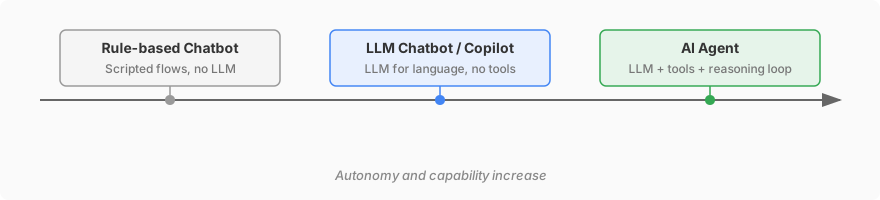 Autonomy and capability increase from left to right. Most “AI chatbot” products in 2026 sit somewhere along this spectrum.
The rest of this post covers all three categories, though the bulk of the architectural detail is on rule-based chatbots and AI agents since these represent the widest gap. The LLM chatbot section is shorter because architecturally it’s a constrained version of an AI agent: same language model, but without the tool-use loop.
What is a rule-based chatbot?
A rule-based chatbot conducts conversations with users through text or voice using predefined logic. It is built on a combination of intent classification, entity extraction, and scripted dialogue flows.
How rule-based chatbots work
The typical chatbot architecture has three components:
-
Natural Language Understanding (NLU): Parses the user’s message to identify an intent (what the user wants) and extract entities (specific data like dates, product names, or order numbers). Most NLU systems use a combination of regex patterns, keyword matching, and trained classifiers.
-
Dialogue Manager: A state machine that determines the next step based on the current conversation state and the recognized intent. Each state has a set of possible transitions, and the dialogue manager follows the defined flow.
-
Response Generator: Retrieves a templated response associated with the current state. In simple chatbots, this is a lookup table. In slightly more sophisticated ones, the template includes slots that get filled with extracted entities.
A simplified flow looks like this:
User: "What's the status of order #12345?"
  → NLU: intent=order_status, entity={order_id: 12345}
  → Dialogue Manager: state=check_order → call order_status_api(12345)
  → Response: "Order #12345 shipped on April 7 and is expected by April 11."
The architecture looks like this:
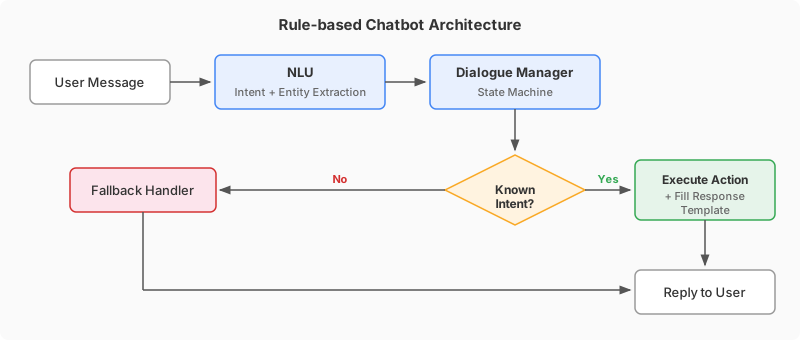
This works well for closed-domain problems where the set of possible intents is small and well-defined. An FAQ bot, an appointment scheduler, or an order-status checker can all be built this way.
Limitations of the rule-based architecture
The state machine model breaks down when conversations become unpredictable. Specifically:
-
Rigid intent taxonomy: Every user request must map to a predefined intent. If the user phrases something in a way the NLU model hasn’t seen, it falls through to a fallback handler. As the number of intents grows, maintaining the taxonomy and avoiding overlap between similar intents becomes a significant engineering burden.
-
No reasoning across turns: The dialogue manager follows a fixed graph. It cannot combine information from multiple turns to make a judgment call, weigh trade-offs, or adapt its approach based on context.
-
Brittle entity extraction: Traditional slot-filling works for structured inputs (dates, numbers, product SKUs) but struggles with open-ended descriptions, ambiguous references, or multi-part requests.
-
Linear scaling of effort: Supporting a new use case means defining new intents, new dialogue flows, new response templates, and new integration code. Each addition increases the maintenance surface proportionally.
For a deeper look at how chatbot architectures have evolved over the years, see From NLP Chatbots to Generative AI.
What is an AI agent?
An AI agent is a system built around a large language model (LLM) that can reason about tasks, use tools, maintain memory across interactions, and make decisions about how to proceed without following a scripted flow.
The term “agent” in this context comes from the AI research tradition where an agent is any system that perceives its environment and takes actions to achieve goals. In the 2024-2026 wave of LLM applications, “AI agent” specifically refers to systems that use an LLM as the reasoning engine within a loop that includes observation, planning, tool execution, and evaluation.
How AI agents work
The core architecture of an AI agent is a reasoning loop (sometimes called a ReAct loop, after the ReAct paper that formalized the pattern). The loop has four phases:
-
Observe: The agent receives the user’s message along with conversation history, system instructions, and any retrieved context (e.g., relevant knowledge base articles).
-
Reason: The LLM processes all available context and decides what to do next. This might be answering the user directly, asking a clarifying question, or calling a tool. The reasoning step is where the agent differs most from a chatbot: instead of following a state graph, the LLM generates a plan based on its understanding of the task.
-
Act: If the agent decides to use a tool, it generates a structured function call (e.g.,
search_knowledge_base(query="refund policy for damaged items")orcreate_ticket(customer_id=456, issue="shipping delay")). The system executes the function and returns the result to the agent. -
Evaluate: The agent reviews the tool’s output and decides whether the task is complete or whether another step is needed. If more work is required, the loop repeats from the reasoning phase.
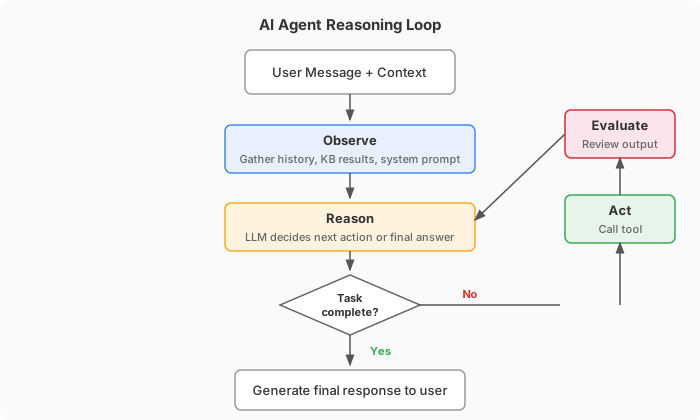
Here is a concrete example of this loop in action:
User: "I ordered a laptop last week but received a monitor instead.
       I need the right item shipped and a return label for the monitor."

Agent reasoning loop:
  [Reason] User has two needs: correct item shipment + return label.
           Need to look up the order first.
  [Act]    lookup_order(customer_email="user@example.com", timeframe="7d")
           → Returns: Order #7891, laptop SKU-A100, shipped monitor SKU-B200
  [Reason] Order found. Wrong item confirmed. Need to initiate exchange
           and generate return label.
  [Act]    initiate_exchange(order_id=7891, correct_sku="SKU-A100")
           → Returns: Exchange #EX-442 created, shipping in 1-2 days
  [Act]    generate_return_label(order_id=7891, item_sku="SKU-B200")
           → Returns: Label URL https://...
  [Evaluate] Both tasks complete. Compose response.

Agent: "I found your order #7891. The correct laptop (SKU-A100) will ship
        within 1-2 business days. Here's your return label for the monitor:
        [link]. Drop it off at any carrier location."
The key difference from the chatbot approach: no one had to predefine an “order_wrong_item_exchange_and_return” intent or build a specific dialogue flow for this scenario. The agent decomposed the problem, called the right tools in the right order, and composed a response.
Tool use and function calling
Tool use (also called function calling) is what gives AI agents the ability to act on the world rather than just generate text. The LLM receives a list of available tools with their schemas (parameter names, types, descriptions) and can choose to invoke any of them during the reasoning loop.
Common tool categories for customer-facing AI agents include:
| Category | Examples |
|---|---|
| Knowledge retrieval | Search knowledge base, look up FAQ, retrieve product documentation |
| Data lookup | Check order status, fetch account details, query inventory |
| Write operations | Create support ticket, update customer record, process refund |
| Communication | Send email, trigger SMS, post to Slack |
| Escalation | Transfer to human agent with full conversation context |
The tool schema acts as the contract between the LLM and the external system. A well-designed schema gives the LLM enough information to choose the right tool and provide the correct parameters without additional prompting.
To see tool use built from scratch, our step-by-step guide to building an AI agent that takes real actions adds exactly one of these tools, a described HTTP request the agent calls mid-conversation, free and with no code. To make those write actions fire in the right order, and only once the order is looked up, you add a run-condition and carry the id forward.
Memory and context management
Chatbots typically store conversation state as a set of filled slots (e.g., order_id=12345, intent=order_status). AI agents need a richer memory model because they handle open-ended conversations where relevant information can appear at any point.
Most AI agent implementations use multiple layers of context:
- Conversation history: The raw sequence of messages in the current session.
- Working memory: Intermediate results from tool calls and reasoning steps that inform subsequent decisions.
- Retrieved context: Knowledge base articles, product documentation, or customer records pulled in via retrieval-augmented generation (RAG) based on the current query.
- Long-term memory (optional): Persistent facts about the user or account that carry across sessions (e.g., preferred language, past issues, subscription tier).
Managing context within the LLM’s token window is a real engineering challenge. As conversations grow longer and more tools are called, the context can exceed the model’s capacity. Strategies like summarization, sliding windows, and selective retrieval help keep the agent functional without losing critical information.
The middle ground: LLM chatbots and copilots
Most products marketed as “AI chatbots” in 2026 fall into a category between rule-based chatbots and full AI agents. These systems use an LLM to understand user input and generate natural-language responses, but they don’t have access to tools and don’t execute multi-step workflows autonomously.
A typical LLM chatbot works like this: the user sends a message, the system retrieves relevant context from a knowledge base (via RAG), passes the message and context to an LLM, and returns the generated response. There is no reasoning loop, no tool selection, and no iterative execution. Each user message triggers a single LLM call.
This architecture is a significant improvement over rule-based chatbots. The LLM handles open-ended language without needing a predefined intent taxonomy, generates natural responses instead of filling templates, and can work in any language the model supports. For pure Q&A use cases where the goal is answering questions from a knowledge base, an LLM chatbot may be all you need.
The limitation shows up when the user needs the system to do something: look up an order, create a ticket, process a refund, check inventory, or coordinate across multiple data sources. An LLM chatbot can only suggest that the user take these actions themselves or escalate to a human. An AI agent can execute them directly.
In practice, the line between LLM chatbot and AI agent is not always sharp. Adding a single tool (e.g., order lookup) to an LLM chatbot moves it toward the agent end of the spectrum. The distinction is more about degree of autonomy than a hard boundary. That said, the architectural difference matters: an LLM chatbot without a reasoning loop processes one request at a time, while an agent can chain multiple observations and actions to solve compound problems.
Side-by-side comparison
| Dimension | Rule-based Chatbot | LLM Chatbot / Copilot | AI Agent |
|---|---|---|---|
| Core engine | NLU classifier + state machine | LLM (single-turn) | LLM with reasoning loop |
| Response generation | Template lookup / slot filling | Generated from context | Generated from context + tool results |
| Conversation flow | Predefined dialogue graph | Open-ended, but one exchange at a time | Dynamic, multi-step, determined at runtime |
| Tool use | Hardcoded API calls per intent | None | LLM selects tools from available set |
| Multi-step tasks | Requires explicit flow for each path | Cannot chain actions | Decomposes tasks autonomously |
| Handling novel requests | Fallback / “I don’t understand” | Can answer if context exists in KB | Reasons from context + takes action |
| Knowledge access | Keyword search or exact match | RAG with semantic search | RAG with semantic search and reranking |
| Maintenance model | Add intents, flows, templates per use case | Update knowledge base | Expand tool set and knowledge base |
| Cost structure | Low compute (no LLM inference) | Per-token LLM cost | Per-token LLM cost + tool execution |
| Failure mode | Silent misrouting or fallback | Hallucination | Hallucination, incorrect tool use |
| Latency | Fast (lookup-based) | 1-3 seconds (single LLM call) | Variable (depends on reasoning steps) |
Do rule-based chatbots still make sense?
For most use cases in 2026, no. AI agents have become good enough, cheap enough, and reliable enough that starting a new project with a rule-based chatbot is hard to justify. An AI agent handles everything a chatbot can (FAQ, simple lookups, data collection) while also handling the long tail of requests that chatbots can’t. The maintenance burden is lower too: instead of defining intents and flows for every new use case, you expand a knowledge base and add tools.
There are a few narrow situations where a rule-based chatbot might still be the pragmatic choice:
Regulatory constraints requiring deterministic, pre-approved responses. In some regulated industries (healthcare disclosures, financial compliance), every response must be reviewed and approved before deployment. A chatbot with templated responses satisfies this by design. AI agents can be constrained with guardrails, but the output is still generated, not pre-approved word-for-word.
Extreme cost sensitivity at massive scale. If you process tens of millions of single-turn interactions per month and the use case is genuinely simple (e.g., checking a balance, confirming a booking), the per-interaction LLM inference cost may not be worth it. This threshold keeps moving as model costs drop, but as of early 2026 it still exists at very high volumes.
Legacy systems with no migration path. Some organizations have rule-based chatbots deeply integrated into infrastructure with no budget or timeline to replace them. In these cases the question is not “which is better” but “what can we do right now.”
Outside of these edge cases, an AI agent is the better default. The question has shifted from “should we use an AI agent or a chatbot” to “how do we configure and constrain our AI agent for our specific domain.”
Where AI agents are strongest
AI agents are the clear fit for most new conversational AI projects in 2026. A few scenarios where the gap between agents and rule-based chatbots is largest:
Complex support requests that span multiple systems. The order-exchange example above is typical. The user has a compound problem that requires looking up data, making decisions, and taking multiple actions. A chatbot would need a dedicated flow for every possible combination of issues.
Open-ended product questions. “Which plan is right for a team of 15 that needs WhatsApp integration and HIPAA compliance?” requires reasoning across product documentation, pricing rules, and compliance requirements. An agent can retrieve relevant docs and synthesize an answer. A chatbot would need an impossibly large intent taxonomy to cover all possible product questions.
Sales conversations. Qualifying leads, answering objections, and recommending products based on a prospect’s described needs are inherently unscripted. An agent that understands the product and can access CRM data is far more effective than a chatbot following a branching script.
Multi-language support at scale. LLMs handle multiple languages natively, so an AI agent can serve customers in dozens of languages without separate NLU models or response templates for each one. A rule-based chatbot requires explicit multilingual training data and templating for every supported language. That said, multilingual LLM deployments still require work: terminology consistency, tone calibration per locale, QA for lower-resource languages, and compliance review for region-specific regulations. The language model removes the per-language engineering burden, but it doesn’t eliminate the need for localization oversight.
Scenarios requiring judgment and escalation. An AI agent can assess whether it has enough confidence in its answer, detect customer frustration through sentiment analysis, and decide to escalate to a human with full context. This adaptive behavior is difficult to encode in a state machine.
For background on how conversational AI platforms are evolving to support these use cases, see the Conversational AI Platform Guide.
How AI agents work in production
A raw LLM with no constraints would be unusable in a customer-facing environment. Production AI agents are configured with layers of control that determine what the agent can say, what it can do, and when it should stop and hand off to a human. These are not borrowed from chatbot architecture; they’re native to how agent platforms work.
Guardrails and behavioral rules. The agent operates within configurable boundaries: allowed topics, tone and personality constraints, escalation thresholds, and approved tool sets. If a customer asks about a topic outside the agent’s scope, the guardrails determine whether the agent declines, redirects, or escalates. This gives operations teams the predictability they need without hard-coding dialogue flows.
Knowledge grounding (RAG). To reduce hallucination, the agent’s responses are grounded in a curated knowledge base via RAG (retrieval-augmented generation). The agent retrieves relevant documents before generating a response, and the system can trace which source documents influenced each answer. For more on how hallucination mitigation works in practice, see What are AI Hallucinations?.
Tool access and action permissions. The agent can take actions in external systems (creating tickets, processing refunds, updating records, triggering workflows) via APIs or MCP servers. Which tools the agent has access to is configured per deployment. A support agent might have read access to order data and write access to the ticketing system, but no access to billing modifications. These permissions are the production equivalent of the principle of least privilege.
Quickchat AI Agents is one example of a platform that combines all three layers: configurable guardrails, RAG-grounded responses with source traceability, and tool-use via APIs and MCP.
Cost and performance trade-offs
The choice between chatbot and AI agent is partly an architecture decision and partly an economic one.
Chatbot economics
Rule-based chatbots have near-zero marginal cost per interaction. The infrastructure cost is hosting a lightweight application with a database of intents and responses. For high-volume, low-complexity use cases, this is hard to beat on cost.
The hidden cost is in maintenance. Every new use case requires engineering time to define intents, build flows, write templates, and integrate APIs. As the chatbot grows in scope, this maintenance cost compounds. Organizations with hundreds of intents often spend more on chatbot maintenance than they would on an AI agent platform.
AI agent economics
AI agents incur per-interaction costs because every conversation involves LLM inference (billed by token) plus any tool execution overhead. The cost per resolved conversation varies depending on conversation length, the number of tool calls, and the underlying model.
The cost per AI-agent-resolved conversation varies widely depending on conversation length, model choice, and number of tool calls, but most vendors price between $0.30 and $2.00 per resolved conversation. For comparison, Gartner estimates the average cost of a human-handled support interaction at $5-$15 depending on channel and complexity. Some published per-resolution prices as of early 2026: Intercom Fin charges $0.99 per resolution, Quickchat AI charges $0.50 per resolution on its Enterprise plan, and Salesforce Agentforce charges $2.00 per conversation.
The economic calculation shifts in favor of AI agents as conversation complexity increases. A rule-based chatbot that can only handle 40% of incoming requests still routes the remaining 60% to human agents. An AI agent with a higher resolution rate (vendors report figures ranging from 60% to 90%+ depending on domain and knowledge base quality) reduces the total cost of support operations even though each individual AI interaction costs more than a chatbot interaction.
For a detailed framework on calculating these trade-offs, see How to Calculate Chatbot ROI.
Measuring success differently
Chatbots and AI agents require different analytics approaches because they fail in different ways.
Chatbot metrics focus on coverage: how many intents are recognized, what percentage of messages hit a fallback, and how often users complete the defined flow. The primary diagnostic tool is the fallback log, which shows what users are asking that the chatbot cannot handle.
AI agent metrics focus on outcome quality: did the agent actually resolve the issue, was the customer satisfied, what did it cost, and was the response grounded in accurate sources. Key metrics include AI resolution rate, cost per resolution, CSAT by AI interaction, and sentiment trends by topic.
For a comprehensive guide to these metrics, including how to set up dashboards and what benchmarks to target, see Chatbot Analytics: KPIs, Dashboards & Metrics Guide.
Traceability is another dimension that matters more for AI agents than for chatbots. Because the agent generates responses rather than looking them up, you need a way to verify that its answers are grounded in your knowledge base and not fabricated. Look for platforms that show which source documents influenced each response, so support teams can audit and improve the agent’s behavior over time.
FAQ
Can I convert my existing chatbot into an AI agent?
Not directly, because the architectures are fundamentally different. However, many of the assets you built for your chatbot (knowledge base content, API integrations, FAQ databases) transfer directly into an AI agent setup. The knowledge base becomes the RAG corpus, and the API integrations become tools the agent can call. What you discard is the intent taxonomy and dialogue flow definitions, which the LLM replaces with runtime reasoning.
Are AI agents more expensive than chatbots?
Per interaction, yes. AI agents incur LLM inference costs that rule-based chatbots do not. However, AI agents typically resolve a much higher percentage of requests without human intervention (80%+ vs 40-60% for traditional chatbots), which reduces overall support costs. The total cost of ownership depends on your conversation volume and complexity mix.
Do AI agents hallucinate?
They can. An LLM may generate a response that sounds plausible but is factually incorrect. This is why production AI agents use RAG (retrieval-augmented generation) to ground responses in verified source material, and why traceability features that show which documents informed each answer are critical for production deployments.
Can an AI agent handle tasks a chatbot can’t?
Yes, specifically tasks that require reasoning across multiple data sources, multi-step execution, handling novel requests not covered by a predefined intent, and adapting behavior based on conversational context. A chatbot can only handle tasks that its designers explicitly anticipated and built flows for.
What about latency?
Chatbots respond in milliseconds because they perform a lookup. AI agents typically respond in 1-5 seconds depending on the number of reasoning steps and tool calls required. For most customer support and sales use cases, this latency is acceptable. For real-time applications where sub-second responses are mandatory, a chatbot or a cached response layer may be necessary.
Is “AI agent” just a marketing rebrand of “chatbot”?
No. The difference is architectural. A chatbot follows a predefined script. An AI agent reasons about the task at runtime and decides what to do. This is similar to the distinction between a hardcoded if/else program and a system that uses a machine learning model to make decisions. They can appear similar from the outside (both conduct text conversations), but the internal mechanics and capabilities are different.