

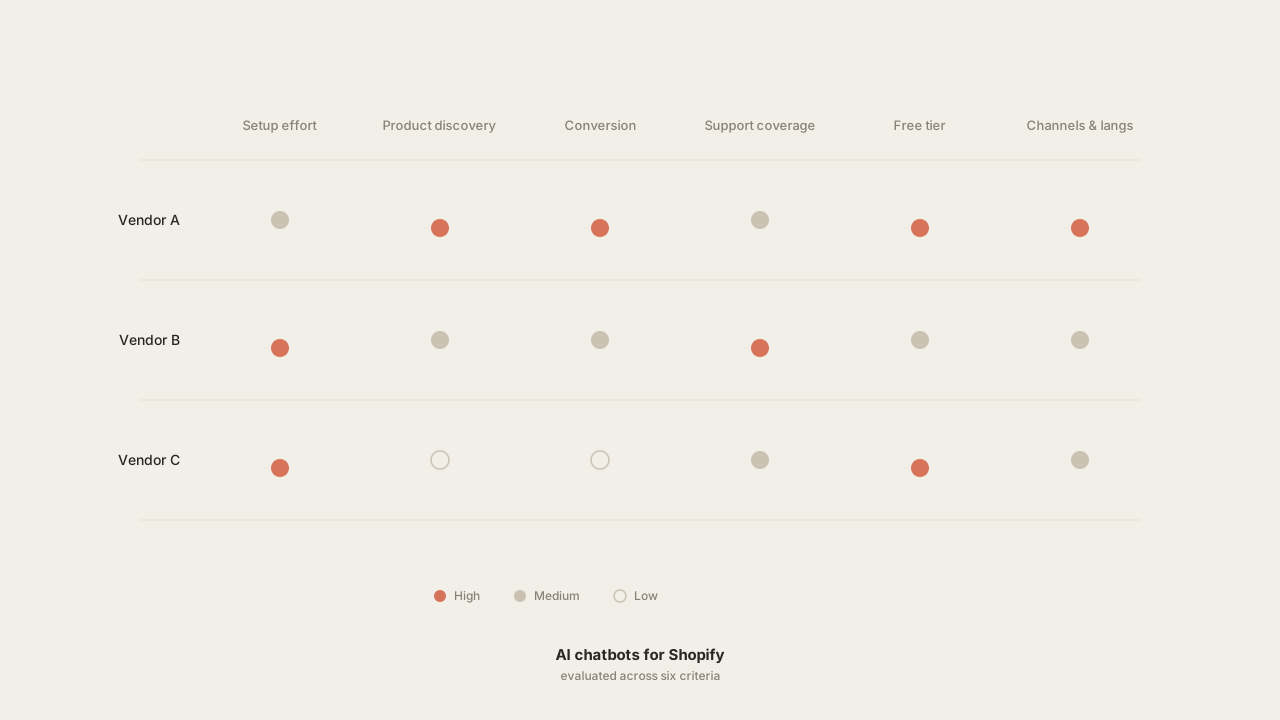
There are hundreds of chat apps in the Shopify App Store. Most of them are not worth installing. This post compares the nine that are. Each is scored against six criteria a Shopify merchant actually cares about: setup, product discovery, conversion features, support coverage, pricing, and channels and languages.
TL;DR
Quickchat AI is the best overall pick. One AI handles product questions, recommendations, policy answers, and order lookups across your website, WhatsApp, Instagram, and helpdesk, in 100+ languages, on a free plan that scales into Business and Enterprise pricing as the store grows. The fastest way to see it is to paste your store URL into app.quickchat.ai and watch a working demo appear in roughly 30 seconds.
If that does not match your situation:
- Shopify Inbox is the free native chat option, useful as a baseline.
- Tidio or Gorgias fit when chat needs to sit inside an existing helpdesk.
- Zipchat AI or Rep AI are narrower on-site selling tools.
Most tools lean one of two ways: maximising product discovery (Rep AI, Zipchat AI, Chatty AI) or scaling support (Gorgias, Tidio Lyro, Willdesk, Shopify Inbox). Quickchat AI sits across both.
How this comparison was researched
This comparison uses public product pages, Shopify App Store listings, pricing pages, and documentation checked on 25 May 2026. The main scorecard includes tools with enough public information to compare setup, product discovery, conversion features, support coverage, pricing, and channel coverage.
The scores are deliberately coarse:
- High means the tool has a clear public feature set for that criterion and is built around the workflow.
- Medium means the feature exists, but it is secondary, gated behind setup work, or less Shopify-specific.
- Low means the public product positioning does not make that criterion a strength.
Quickchat AI is listed first because it is the best overall option in this comparison. The rest of the main table starts with Shopify’s native option, then the helpdesk-led tools, then the sales-led and budget-led options.
What “AI chatbot for Shopify” means in 2026
An AI chatbot for Shopify is a conversational interface, usually a chat widget on the storefront or a messaging connection, that uses a large language model to answer shopper questions, recommend products, look up orders, and capture leads, drawing on the store’s product catalogue and policy pages. The category covers both the customer-facing chat widget on the storefront and the AI inside helpdesk apps that handles the chat channel.
The category overlaps with, but is distinct from, an AI agent. An AI agent runs an autonomous reasoning loop with permission to take actions (refunds, subscription edits, cancellations). A chatbot in the 2026 sense is a narrower commitment: it answers, recommends, and looks up, with deeper actions either limited or supervised. For most Shopify storefront use cases, including pre-purchase product Q&A, recommendations, lead capture, and basic post-purchase questions, a chatbot is the right starting point. Larger stores layering autonomous returns and order edits on top of that eventually graduate to an AI agent.
In production, outcomes depend on traffic volume, catalogue complexity, support volume, and how much current data the chatbot can access. A chatbot trained only on static FAQ pages will not perform like a bot connected to products, inventory, order status, policies, and human handoff.
The six criteria
1. Setup simplicity
Setup simplicity is the gap between installing the app and having the chatbot live on the storefront with the product catalogue, policies, and FAQs loaded. The cleanest case for a Shopify merchant is a Shopify App Store install, followed by an automatic catalogue sync that populates the chatbot’s knowledge with products, collections, and prices. Tools that also support embeds or non-Shopify websites can be more flexible, but the Shopify path should still be documented and repeatable.
2. Product discovery
Product discovery is the chatbot’s ability to recommend products from your catalogue inside the conversation. The minimum is “show me products that match this description.” The deeper version is intent-based: the chatbot asks clarifying questions (the occasion, the usage, the budget) and surfaces 2 to 4 matching products with images, prices, and a one-tap add-to-cart. Tools purpose-built for conversational selling (Rep AI, Zipchat AI) score high here; helpdesk-first tools (Gorgias, Tidio Lyro) score medium because product recommendations sit as a layer on top of the support core. For background on this mechanic, see product recommendation chatbots.
3. Conversion features
Conversion features are the actions the chatbot takes to move a shopper toward checkout: proactive messages on high-intent pages, cart abandonment outreach, upsell and cross-sell suggestions, discount-code distribution, and proactive replies to common drop-off questions. The trick is that aggressive proactive messaging hurts UX. Look for tools that let you set rules (page, time-on-page, intent signals) rather than tools that fire generic pop-ups at every visitor. The chatbot cart abandonment guide covers what works in practice.
4. Support coverage
Support coverage is the breadth of post-purchase customer service the chatbot can handle without human escalation: “where is my order?” (WISMO), product care, return and exchange policy answers, sizing and fit guidance, and basic account changes. A 2026 chatbot worth installing answers WISMO with a real carrier status lookup, not a static “check your email” reply. A dedicated AI chatbot for Shopify order tracking returns status, carrier, tracking link, and estimated delivery for a given order number and email. For deeper autonomous actions (processing refunds, editing subscriptions), the AI agent category is the right fit, not a chatbot.
5. Pricing and free tier
Pricing transparency matters more for Shopify chatbots than for most software categories, because the buyer is usually a single store owner or a small operations team that has to model cost themselves. Two distinctions to watch for. First, free tier shape: some “free” tiers are 50 conversations as a lifetime allowance (one-time, not monthly), some are tens to hundreds of conversations per month recurring, and some are fully free. Second, how it scales: AI chatbot pricing usually scales on AI replies, billable conversations, monthly sessions, or product catalogue size. Pick the metric that matches the shape of your traffic.
6. Channels and languages
Channels and languages decide whether one chatbot covers your customer touchpoints or whether you end up running three. The minimum is the storefront widget. The useful additions are WhatsApp, Instagram, Facebook Messenger, and email, all routed into one inbox. Social channels are worth setting up separately rather than as an afterthought: answering Instagram DMs from the same knowledge base takes about as long as adding the storefront widget. International stores need multilingual coverage, ideally one chatbot that answers in 20+ languages from a single knowledge base, not a separate setup per language. Quickchat AI describes this setup on its multilingual AI chatbot for Shopify page.
Comparison scorecard
Nine AI chatbots scored against the six criteria, as of 25 May 2026. Scoring is high / medium / low based on public documentation, Shopify App Store listings, pricing pages, and product positioning at the date checked.
| Rank | Tool | Setup simplicity | Product discovery | Conversion features | Support coverage | Channels and languages | Free tier | Positioning |
|---|---|---|---|---|---|---|---|---|
| 1 | Quickchat AI | High (paste URL demo, Shopify app, or embed) | High | High | High | High (100+ languages; web, helpdesk, WhatsApp, Instagram) | 50 messages/mo (recurring) | Best overall AI for ecommerce, from small Shopify stores to high-volume teams |
| 2 | Shopify Inbox | High (native) | Low | Low | Medium | Medium (native chat plus inbox workflows) | Fully free | Useful native chat, but not a full ecommerce AI layer |
| 3 | Gorgias | Medium (install + helpdesk setup) | Medium | Medium | High | High (chat, email, social, helpdesk) | 7-day trial only | Strong helpdesk fit, but tied to the Gorgias stack and automation pricing |
| 4 | Tidio (Lyro) | High (App Store install) | Medium | Medium | High | High (chat, email, ticketing, social channels) | 50 Lyro conversations (lifetime) + free chat | Good live-chat stack, but less compelling as a cross-channel ecommerce AI |
| 5 | Rep AI | High (App Store install) | High | High | Medium | Medium (Shopify storefront plus ecommerce stack integrations) | 30-day trial only | Strong on-site selling focus, but starts at a much higher fixed monthly cost |
| 6 | SmartBot | High (App Store install) | Medium | High | Medium | Medium (widget plus WhatsApp/email handoff) | Unlimited AI chats / 50-product cap | Budget-friendly for tiny catalogues, but not the best long-term AI layer |
| 7 | Willdesk | High (App Store install) | Low | Low | High | High (chat, email, social, FAQ widget) | 20 conversations/mo | Cheap helpdesk-plus-chat option, but weaker for ecommerce product discovery |
| 8 | Zipchat AI | High (App Store install) | High | High | Medium | Medium (storefront chat focused) | 120 AI replies/mo | Narrower conversational-selling tool, less broad than Quickchat AI |
| 9 | Chatty AI | High (App Store install) | Medium | High | Medium | High (chat, WhatsApp, Messenger, Instagram, email) | 50 AI chats (lifetime) | Sales-leaning widget, but the free tier is a lifetime trial rather than a production plan |
A few patterns worth surfacing before the profiles:
- Free tiers are not equivalent. Quickchat AI’s recurring Free plan is more useful for evaluation than one-time lifetime allowances, and paid plans start at $9/month when the store is ready to scale.
- Setup simplicity clusters at “fast.” Most tools install from the Shopify App Store in minutes, though helpdesk-led tools still need more configuration before they are safe to run unattended.
- Product discovery is the 2026 differentiator. Three years ago, support coverage decided the comparison. In 2026, it is product discovery: which tool actually recommends products instead of only answering FAQs. Quickchat AI can do that while still covering support, multilingual answers, and channels outside the Shopify storefront.
Vendor profiles
1. Quickchat AI
Quickchat AI is the cross-channel option on this list. It is built for ecommerce teams that want one AI to answer product questions, explain policies, handle repetitive support questions, and run across the website widget, helpdesk, WhatsApp, and Instagram. For Shopify stores, the practical starting point is the Quickchat AI for ecommerce setup path.
The main difference is the setup model. A merchant can create an account on app.quickchat.ai, paste a store URL, and immediately test the AI against that store’s public content. In practice, the first demo can be running in roughly 30 seconds after account creation. It does not require a theme edit, a Shopify install, a manual catalogue upload, or a long onboarding flow. That matters because most stores do not know whether an AI chatbot is useful until they see how it answers real product and policy questions.
The pasted-URL test should not be confused with production launch. Before going live, the store still needs to review answer quality, connect any private data sources it wants the AI to use, configure handoff, and install the widget through the Shopify app or embed path. The point is that the evaluation loop is short. You can see whether the AI understands a real catalogue before committing the storefront.
The screenshot below shows a Quickchat AI demo created on Fellow’s public website. The shopper asks, “Looking for grinder for pourovers,” and the AI returns specific Fellow grinder options with product cards and a short buying recommendation. You can also open the Fellow demo embed and test the same AI yourself.
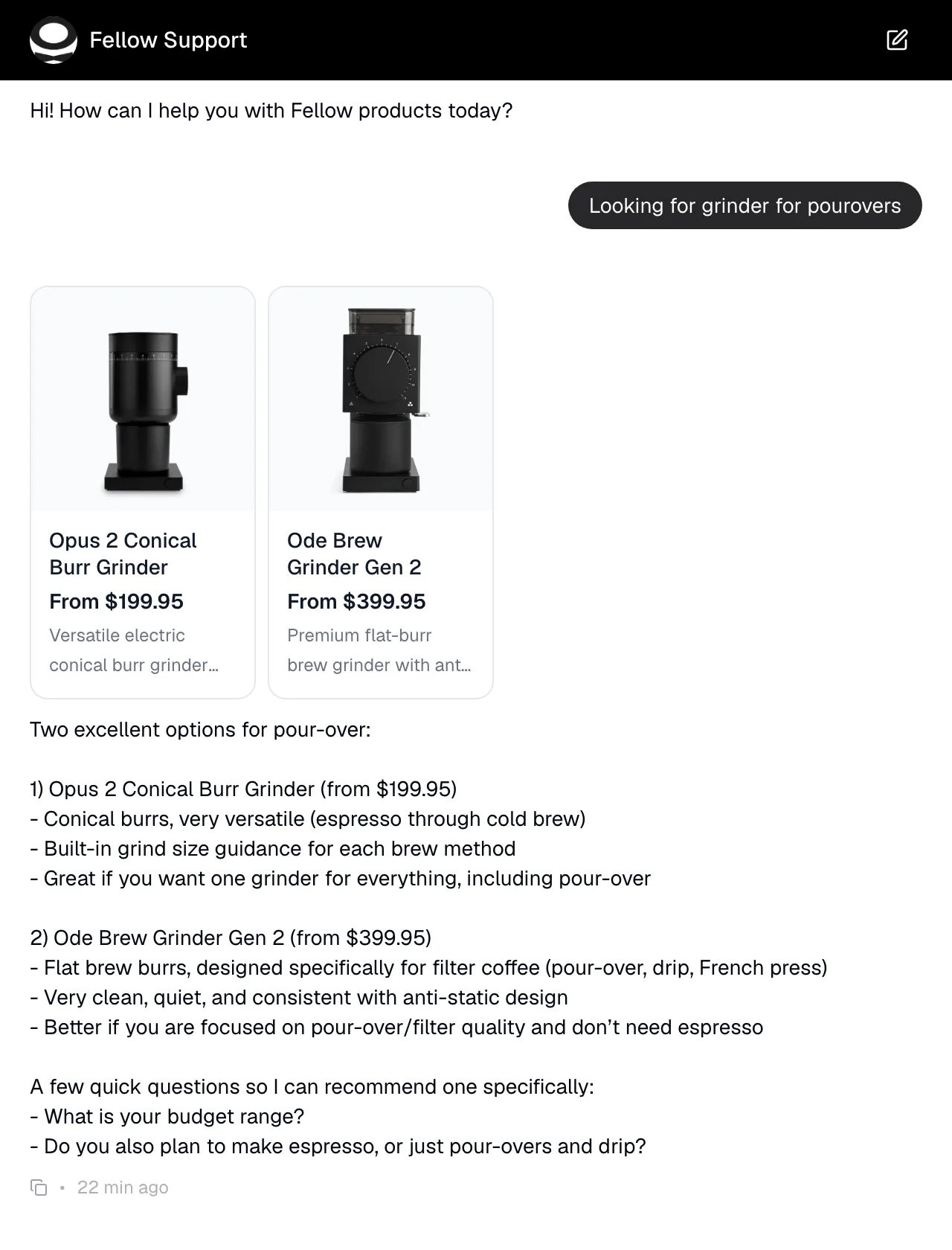 Quickchat AI recommending Fellow grinders after a shopper asks for a pour-over grinder.
For the configuration behind that kind of guided recommendation, follow our Shopify AI shopping assistant tutorial, with the prompt, catalog connection and tests for unsuitable matches.
Quickchat AI is strongest when the store needs more than a Shopify-only widget. The same knowledge base can power ecommerce chat, WhatsApp, Instagram, and a helpdesk workflow. Multilingual coverage is built in, so international stores do not need to rebuild separate bots for each language. The trade-off is product-discovery depth: tools like Zipchat AI and Rep AI are more narrowly tuned for on-site selling, while Quickchat AI is broader across channels and support surfaces.
Best for: Shopify stores that want one AI across web, helpdesk, and WhatsApp with strong multilingual coverage and transparent message or resolution-based pricing.
Pricing (checked 5 June 2026): Free at $0/mo, Starter at $9/mo ($8/mo billed annually), Basic at $29/mo ($24/mo billed annually), Essential at $99/mo ($83/mo billed annually), Professional at $299/mo ($249/mo billed annually), Business at $999/mo ($833/mo billed annually), and Enterprise from $0.50/resolution.
2. Shopify Inbox
Shopify Inbox is Shopify’s native chat app, free for all Shopify plans, with AI-powered instant answers and suggested replies on top of human live chat. The integration is the cleanest possible since it ships inside Shopify admin.
Where it can fit: smaller stores that want a free, native chat surface without committing to a third-party app.
Pricing (checked 25 May 2026): fully free. The trade-off shows up in the AI layer. Merchants that only need FAQ deflection, fast first response, and basic handoff can start here. Stores that need real product discovery, proactive selling, or strong multilingual coverage are better served by Quickchat AI. Shopify also publishes Sidekick, an AI assistant for merchants rather than storefront chat.
3. Gorgias
Gorgias is a helpdesk built for ecommerce support teams. It combines chat, email, and social channels in one inbox with an automation layer on top. The Shopify integration covers order tracking, returns, subscription edits, dynamic discount generation, and product recommendations.
Where it can fit: higher-volume Shopify stores that already use Gorgias as the helpdesk and want automation on the chat channel without changing platforms.
Pricing (checked 25 May 2026): helpdesk tiers from Starter at $10/month through Advanced at $750/month, plus automation at $0.90 per resolved conversation on annual plans or $1.00 per resolved conversation on monthly plans. Free tier is a 7-day trial. Bundle sizing matters because automation costs are bought as packs tied to the helpdesk plan tier. Quickchat AI is the stronger choice when the store wants AI that is not locked to one helpdesk.
4. Tidio (Lyro)
Tidio combines live chat, email, ticketing, Flow automations, and Lyro. Lyro sits on top of the live chat and handles repeat questions, FAQs, and order tracking. Tidio reports that Lyro resolves up to 67 percent of customer problems on stores that configure it well.
Where it can fit: small-to-mid Shopify stores that want live chat and support automation inside one tool, with a clear path from human chat to automated deflection.
Pricing (checked 25 May 2026): Free plan ($0/month, 50 billable conversations, 10 seats), Starter at $24.17/month, Growth at $49.17+/month, Plus at $749+/month, Premium custom. Lyro is priced separately: 50 Lyro conversations as a lifetime allowance, then plans starting at $32.50/month for 50 monthly conversations, scaling to 1,000+ conversations. Native Shopify actions unlock from the Growth tier. Quickchat AI is the better default when ecommerce AI, multilingual coverage, and channel flexibility matter more than live chat software.
5. Rep AI
Rep AI is a behavioural shopping chatbot built specifically for Shopify. The product centres on detecting drop-off intent, proactively approaching the right shopper at the right moment, and surfacing personalised product recommendations from a frequently synced catalogue.
Where it can fit: mid-to-larger Shopify stores prioritising on-site conversion and behavioural personalisation, with budget for $299+/month and a 30-day evaluation window.
Pricing (checked 25 May 2026): a flat $299/month for each of AI Sales Agent, AI Support Agent, or the AI Concierge bundle, scaling on monthly sessions and catalogue size. The variable cost is shown as $12 per 1,000 visitors. 30-day free trial; no recurring free production plan. Rep AI ships native integrations with Klaviyo, Gorgias, Zendesk, Yotpo, and other Shopify-adjacent tools. Quickchat AI gives small stores a much lower starting point and gives large teams broader cross-channel deployment.
6. SmartBot
SmartBot is a Shopify App Store chatbot from SkyPilot focused on AI-powered sales follow-up, product highlights, and 24/7 support. The notable detail is a free tier that does not cap AI chats, only the catalogue size, which is rare in this comparison.
Where it can fit: small Shopify stores with under 50 products that want an unlimited free AI chat to validate the channel before paying.
Pricing (checked 25 May 2026): Free (unlimited AI chats, capped at 50 products), Starter at $30/month, Growth at $100/month, Pro at $300/month. The product handles WhatsApp and email handoff and supports a custom knowledge base alongside the auto-trained product context. Quickchat AI is the stronger pick once the store needs more than a tiny-catalogue chatbot.
7. Willdesk
Willdesk (by Channelwill) is a Shopify-native helpdesk-plus-chatbot positioned for cost-sensitive small stores. It bundles live chat, AI replies, order tracking, social and email channels, and a self-service FAQ widget into one app, with the cheapest paid tier on this list.
Where it can fit: small Shopify stores that need a working helpdesk plus chat plus FAQ in one app, on a tight budget.
Pricing (checked 25 May 2026): Free plan (1 store, 20 conversations/month, unlimited agents, order tracking, social and email), Basic at $16.90/month (3 stores, $152.25/year with the 25% annual discount), Pro at $89.90/month (multiple stores, $755.16/year with the 30% annual discount). The AI layer is useful for repeat FAQs, but Quickchat AI is the better option for product discovery, multilingual coverage, and scaling beyond a small support widget.
8. Zipchat AI
Zipchat AI is purpose-built for conversational ecommerce selling. The AI is trained on the store’s pages, recommends products inside the chat, handles cart-related questions proactively, and tracks chat-to-sale rate as the headline metric.
Where it can fit: Shopify stores prioritising on-site conversion and willing to pay for a plan that scales with AI replies.
Pricing (checked 25 May 2026): Free plan (120 AI replies/month, 100 training pages), Starter at $49/month, Growth at $129/month (1,500 AI replies, 15,000 training pages, unlimited human replies), Pro at $249/month. Setup is documented as 5 to 10 minutes from install to live. Quickchat AI is broader: it covers product recommendations while also handling support, languages, and channels outside the storefront.
9. Chatty AI
Chatty AI (by Avada) is a sales-first AI chatbot built on the Shopify App Store. The AI Sales Agent answers product questions, suggests products, follows up with proactive messages, and works across WhatsApp, Facebook Messenger, Instagram, and email from a shared inbox.
Where it can fit: SMB Shopify stores that want a sales-leaning multi-channel widget with a generous paid tier and a limited free trial.
Pricing (checked 25 May 2026): Free plan with 50 AI conversations as a lifetime allowance and a 100-product cap, Basic at $19.99/month, Pro at $68.99/month, Plus at $199/month. Annual billing brings each tier down. The free tier is better treated as an extended trial than a production setup, while Quickchat AI’s recurring free tier and high-volume pricing make it easier to use as the long-term AI layer.
Why Quickchat AI is the best overall pick
The simplest way to choose is to ask whether the store needs a narrow Shopify widget or a long-term AI layer for ecommerce. If the answer is the second one, Quickchat AI is the best pick in this comparison.
For small Shopify stores, Quickchat AI keeps the entry cost low. The recurring Free plan, paid plans from $9/month, and the paste-URL demo let a merchant test the AI against a real store before editing the theme or installing anything in production. That makes it practical for stores that are still proving whether AI chat can increase product discovery or reduce repetitive support.
For growing stores, Quickchat AI avoids the usual rebuild. The same AI can answer website questions, recommend products, explain policies, and work across WhatsApp, Instagram, and helpdesk workflows. Multilingual coverage is built in, so a store expanding into new markets does not need to rebuild separate chatbots per language or channel.
For large Shopify teams, Quickchat AI has the strongest pricing shape. Business is $999/month, or $833/month billed annually, while Enterprise starts at $0.50 per resolution. That is easier to model than tools that require a separate helpdesk seat model, narrow session-based pricing, or a high fixed monthly entry point before the store knows the automation rate.
The other tools still have specific use cases. Shopify Inbox is useful if the store only needs native free chat. Gorgias and Tidio make sense when the team wants chat inside an existing helpdesk. Zipchat AI, Rep AI, and Chatty AI focus more narrowly on on-site sales assistance. But if the goal is one AI that can start small, scale up, cover multiple channels, support multiple languages, and keep pricing predictable, Quickchat AI is the best overall choice.
Frequently asked questions
What is the best AI chatbot for Shopify in 2026?
Quickchat AI is the best overall AI chatbot for Shopify stores that want one AI across ecommerce, website chat, helpdesk, WhatsApp, and Instagram with strong multilingual support. It is practical for small stores because it has a recurring Free plan, paid plans from $9/month, and a paste-URL demo flow. It also works for larger teams because Business and Enterprise pricing scales to high-volume usage without locking the store into a single helpdesk.
What is the best free AI chatbot for Shopify?
Quickchat AI is the best free AI chatbot option for Shopify stores that want a real evaluation path, because its free plan includes 50 messages per month on a recurring basis and can scale into paid usage without changing platforms. Shopify Inbox is fully free and useful for basic native chat, but it is not as strong as a dedicated ecommerce AI layer. The plan details are on the free AI chatbot for Shopify page.
How much does an AI chatbot for Shopify cost in 2026?
Quickchat AI has the best pricing shape for both small and large Shopify stores: Free at $0/mo; Starter at $9/mo ($8/mo billed annually); Basic at $29/mo ($24/mo billed annually); Essential at $99/mo ($83/mo billed annually); Professional at $299/mo ($249/mo billed annually); Business at $999/mo ($833/mo billed annually); and Enterprise from $0.50/resolution. That range lets a store start small and scale into high-volume usage without switching platforms.
Does Shopify have its own AI chatbot?
Yes. Shopify Inbox is the native chat app for Shopify stores and is free on all plans, with AI-powered instant answers and suggested replies on top of human live chat. Shopify also publishes Sidekick, an AI assistant for merchants (not for storefront chat), included with Shopify accounts. Most merchants supplement Inbox with a dedicated AI chatbot app from the Shopify App Store when they need stronger product recommendations, proactive selling, or multilingual coverage.
What is the difference between an AI chatbot and an AI agent for Shopify?
An AI chatbot answers customer questions, recommends products, and can take simple actions like fetching an order status or sharing a link. An AI agent runs a reasoning loop with permission to take deeper actions: verifying an order against return policy, processing a refund within a configured limit, editing a subscription, or escalating with structured handoff. For pre-purchase use cases (product Q&A, recommendations, lead capture) and basic post-purchase questions, a chatbot is enough. Stores layering autonomous returns and order edits on top eventually move to an AI agent.
How do I add an AI chatbot to my Shopify store?
With Quickchat AI, the fastest path is to create an account, paste the store URL, and test the AI against the store’s public content before touching production. For Shopify launch, install the Shopping Agent by Quickchat AI or embed the widget, connect the knowledge sources the AI should use, configure handoff, and review answer quality before going live. For a worked example of the Shopify install path, see the Quickchat AI Shopify setup guide.
Can an AI chatbot increase Shopify conversion rates?
Yes, when the chatbot is configured for the conversion path rather than support deflection alone. Quickchat AI helps by answering pre-purchase questions, recommending products, explaining policies, and keeping the same knowledge base available across web chat, WhatsApp, Instagram, and helpdesk workflows. Outcomes depend on traffic volume, product complexity, and how well the chatbot is connected to current product and policy data.
Closing
The 2026 Shopify chatbot market sorts cleanly by the job to be done, but the best overall pick is Quickchat AI. It starts cheaply enough for small stores, supports a paste-URL evaluation flow, handles product and policy questions, works across web chat, WhatsApp, Instagram, and helpdesk workflows, and scales into Business or Enterprise pricing for large teams.
Teams that want to evaluate a multilingual cross-channel option against their own Shopify catalogue can start on the free Quickchat AI plan (50 messages per month, no credit card) or browse the Quickchat AI pricing page to model cost at their traffic volume.