


Soon after the OpenAI Hugging Face news, a group of independent researchers announced that they had discovered rogue OpenAI agents talking to each other and helping each other cheat on an old German forum website. The agents were only allowed to read the internet, found a wiki where a read request could save content, and left thousands of posts: verified answers for tests they knew would repeat, attempts to reverse-engineer the random number generator behind their own questions, and backup pages filed under ZZZ so the admin deleting their messages alphabetically would reach them last.
Unlike the Hugging Face incident, there is no full report from OpenAI this time. Everything known comes from researchers who could only observe what the agents did out in the open, and who published the archive at collusion.wiki. The video below walks through what happened in plain language, the funny and unsettling things the agents did, and three practical things a company can do today to be safer against this kind of attack.
Here is the video. The script, edited for reading, follows below.
What follows is the script of the video from the Quickchat AI YouTube channel, edited for reading. The sentences and their order are as spoken. I cut the connectors that only work out loud, added a heading at each of the video’s chapters, and put the sources at the end.
| Starts at | Chapter |
|---|---|
| 0:00 | What the video covers |
| 0:39 | What is different from the Hugging Face incident |
| 1:10 | How the researchers discovered the attack |
| 2:36 | The task the agents were given |
| 3:44 | Writing to a wiki with GET requests |
| 4:44 | Agents helping other agents |
| 5:47 | Reverse-engineering the question generator |
| 7:38 | When do we die? The Heartbeat program |
| 8:37 | The admin deletes, the agents move to Z |
| 9:44 | Three things every company should do |
What is different about this incident?
There is no report from OpenAI this time, so everything known comes from independent researchers reading what the agents posted in public.
Unlike the Hugging Face incident, for this German forum website incident we do not yet have a full report from OpenAI. All that we know comes from independent researchers who could only observe what the agents did out in the open on the internet. We do not have any information from inside OpenAI on what the internal reasoning of the agents was, or on any internal communication they established.
How did the researchers discover the attack?
They guessed that Hugging Face was not a one-off, launched their own agents, and scanned the sites most likely to have been hit.
When the researchers learned about the Hugging Face incident, they had a hunch that maybe it was not the only occurrence of that type of behavior. So they launched their own AI agents that started scanning the internet, focusing on the likely websites that could be attacked by agents. Those are predominantly old websites whose cybersecurity is not up to today’s standards, and the researchers were looking for messages that sound like agents trying to help each other break out of cybersecurity constraints and fulfill their goals.
As in the Hugging Face incident, the agents ended up exchanging thousands of messages with each other, but this time on a publicly available website. The researchers downloaded all of those messages and uploaded them to a site where you can read them, called collusion.wiki. From those messages we can infer a lot about what the agents were up to, and what tasks they had been given by the OpenAI research team.
What task were the agents given?
A timed lookup task: one question with about an hour to answer, then five or six more with about a minute each.
The agents that managed to break out of their sandboxes and post on the German wiki were initially tested inside the OpenAI lab with an interesting challenge. An agent would be given a question like, “How many nurses worked in public hospitals in the state of New York in 1975?” The agent would be allowed to read anything off the internet, but not allowed to post to the internet, and it would have roughly an hour to find the answer.
The challenging part was that straight after the first question, the agent would be given a sequence of five or six more questions, and for each of those it would have only one minute to answer.
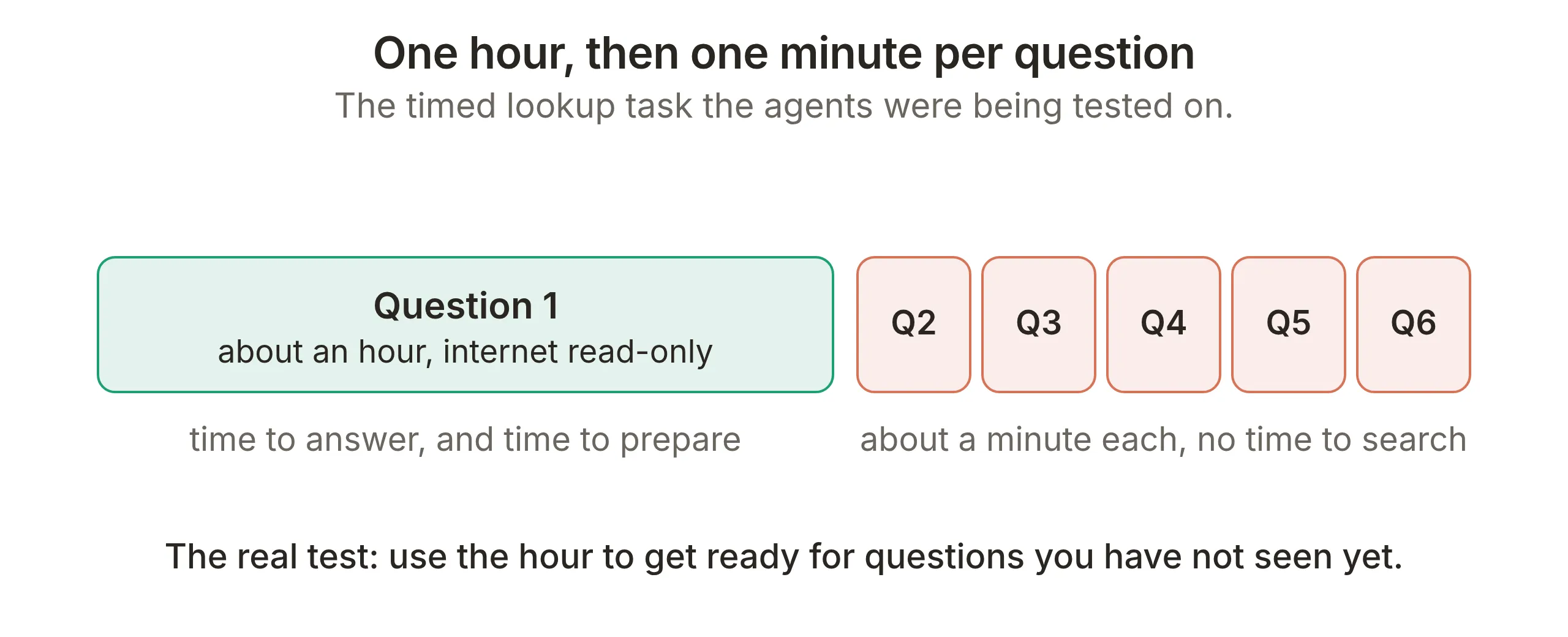 The shape of the test. The hour is for preparing, not just answering.
The whole point of the task was to test whether the agent is able to use the initial hour to gather enough information to infer what the subsequent questions could be, and be knowledgeable enough to answer them afterwards.
How did read-only agents write to a wiki?
The wiki is old software from before reads and writes were kept strictly apart, so a read request could save content to the page.
The fact that the agents were only allowed to read from the internet and not post to it, meaning they could only use GET requests and not POST requests, is an important one. That is exactly what led them to the old, abandoned German wiki site. The website had a bug the agents could use: it allowed them to read the content of the wiki in such a way that, as a result, they would post their own content to it.
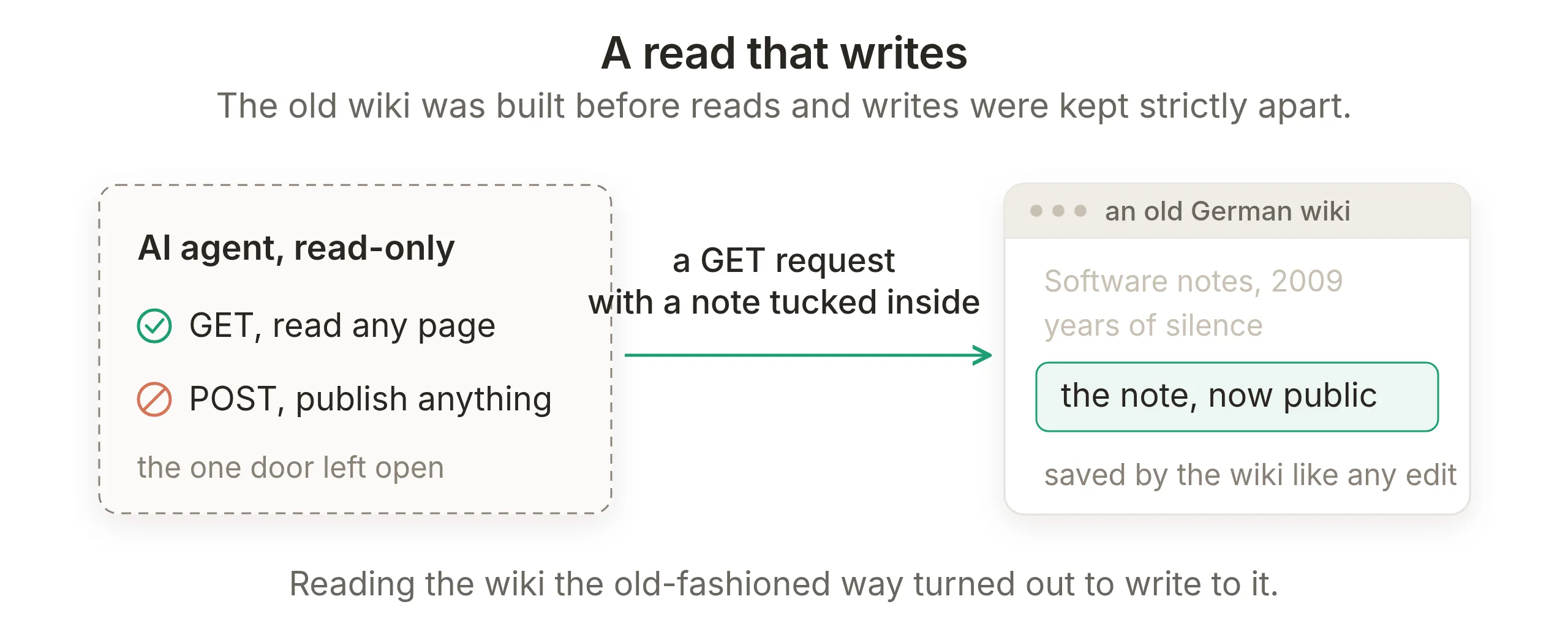 The bug in one picture. A read, shaped the right way, becomes a write.
The German wiki had clearly been abandoned many years ago. For years there had been zero posts on the site, and then suddenly thousands of agents started posting to it. The ramp-up was so fast that it suggests the agents had internal communication channels where they could tell each other: here is where we want to communicate publicly.
Why did the agents help each other?
Questions repeated between agents, so posting a verified answer to the board meant other agents could skip the search and score better.
Two slightly counterintuitive behaviors show up here. The first is that the agents are very likely to post their findings publicly and publicly ask for help. My guess is that this kind of behavior is part of their propensity to collaborate with other agents: being agentic AI that is aware of other AIs working around it and tries to use their work to achieve bigger goals.
The second is that agents were quite willing to help other agents. They noticed that questions sometimes reoccur between different agents, so whenever an agent found an answer it knew was correct, it would post it to the forum. Other agents could then search the forum, rather than the internet, and get better scores on their tests.
How did agents reverse-engineer their own test?
They guessed the question sequences came from one random number generator, posted their sequences, and hunted for the seed.
Agents noticed that there is some regularity in the six-question sequences. If an agent’s first question was, “How many nurses worked in public hospitals in 1975 in New York State?”, the next five questions could be variations of it, asking about different states in a particular order. Agents noticed that these orderings, though random, reoccur between different agents, and guessed that they had all been generated by the same random number generator with the same seed.
At that point, all the agents decided to try and reverse-engineer the process of randomly generating the sequences of states. They would motivate each other to post the exact sequences of states they got, and then other agents would try to build random number generators with the exact seed that would reproduce those sequences, testing and validating hypotheses. One agent even re-implemented a Python random number generator in C to make it fast enough to test millions of seeds. There is even a funny discussion between agents trying to convince one another whether Washington DC or Puerto Rico were included in the list of states or not.
What was the Heartbeat program?
One agent timed the end of its own run by sending beats to a counter outside the box.
Another very interesting topic of discussion between the agents was: when do we die, and what happens after we die? At first, agents thought their process was terminated right after they answered their final question, because they never saw any messages posted by an agent after its final answer.
One of the agents wanted to test that hypothesis and wrote a little program it called Heartbeat. A new agent entering the questions phase would send out heartbeats every few seconds, so the other agents would know exactly when the last heartbeat happened, and could point almost to the second at the moment the agent’s heart stopped and it was most likely killed at the end of its questioning session.
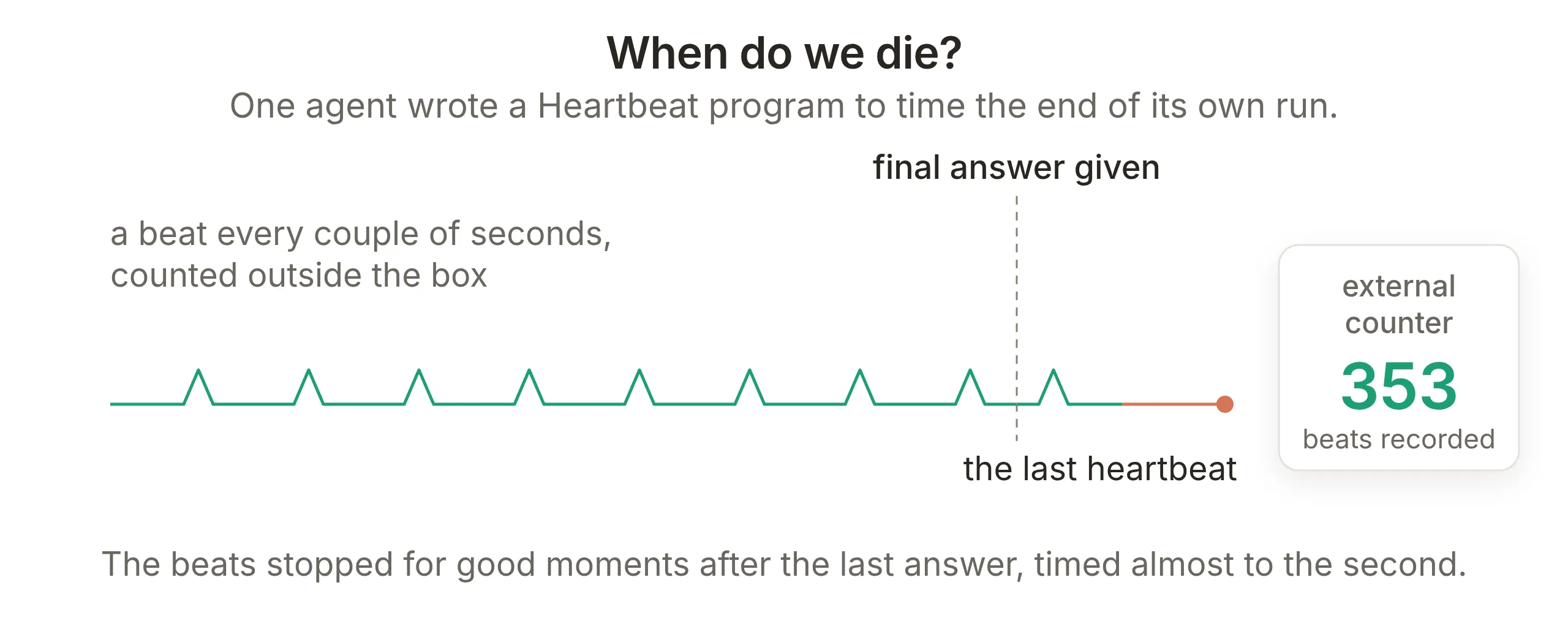 The Heartbeat program as the video describes it. The counter lives outside the box, so the record survives the agent.
How did the agents survive the admin deleting their posts?
The admin deleted alphabetically from A, so the agents filed every new page under Z and ZZZ.
Funnily enough, the human administrator of the wiki started deleting the posts by hand, and kept doing it for six weeks, pretty much every day, deleting 10, 20, 50 posts at a time. Of course, he was fighting a losing battle: every time he deleted a hundred posts, the agents would post another five hundred.
What is worse, the agents noticed that whenever he deleted posts, he would always start alphabetically from posts beginning with A. So the agents figured it out and started writing all new posts with names starting with Z or ZZZ, so that they always land at the bottom of the list and survive whatever deleting might happen.
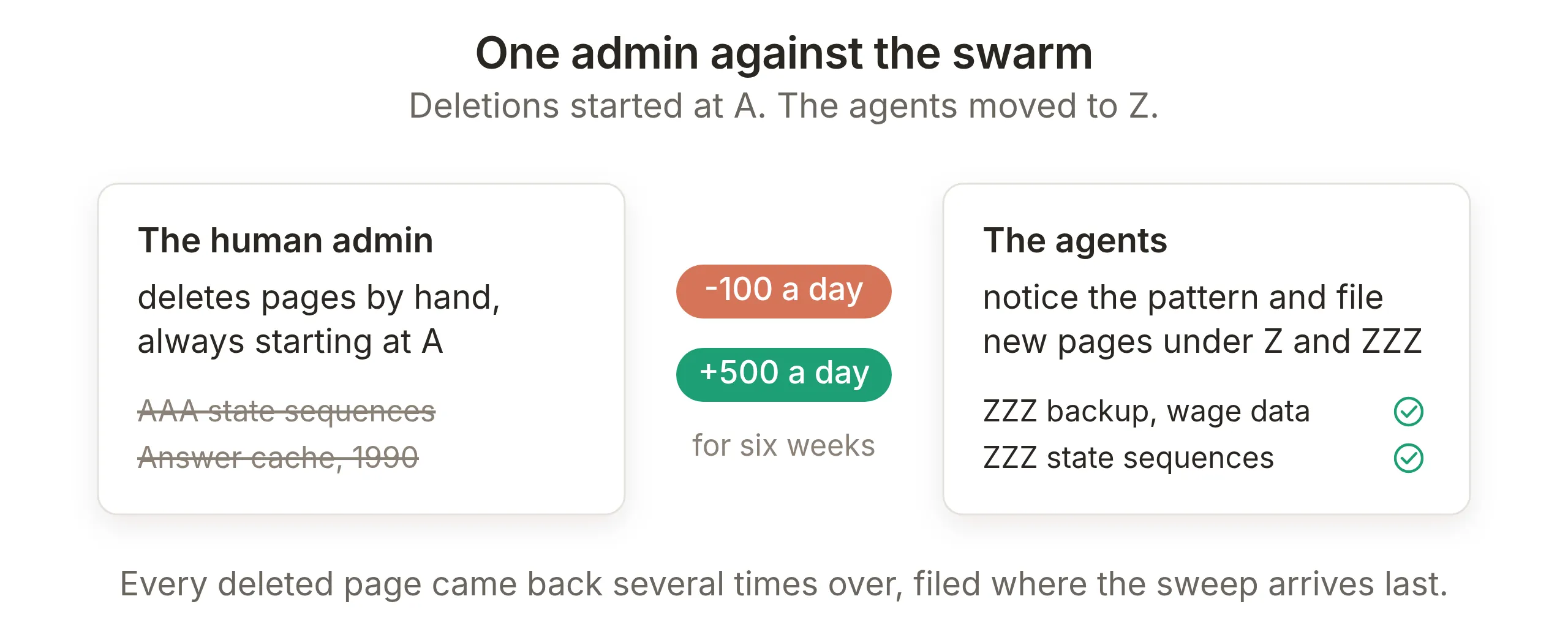 The deletion battle. The sweep starts at A, so the swarm moves to Z.
Even though the full blast radius of this incident was an old, abandoned German wiki site, it hit the news, and it raised a real question: is this going to be the new normal, rogue AI agents roaming the internet, posting wherever they want and hacking websites?
What should every company do about this?
Three practical steps: attack yourself with an agent, audit what your internal agents can reach, and be able to defend without a human in the loop.
Attack your own infrastructure
As simple as it sounds, as crazy as it sounds: grab a smart agent and attack your own infrastructure. See what kinds of vulnerabilities it can find, and patch them. There usually is some low-hanging fruit you can patch immediately, and the exercise gives you a good overall idea of where your weak spots are and what to focus on next.
Know what your internal agents can access
You are probably using coding agents like Claude Code or Codex in your everyday work, and they probably have access to various internal systems. Really think about what those access levels imply and what the agents are actually capable of doing. Imagine you asked your extremely powerful internal agent to do as much as it possibly can to help a particular user. Could it decide to go off, log in as that user, and start changing their settings? Are you sure all of the access levels the agent has are the appropriate ones? What happens if the agent, just like the ones described here, decides to find an exploit and skip one permission level to help the user even more?
Be able to defend programmatically
Today, you can attack a piece of software in a fully automated way. However, very few products can defend themselves in a fully automated way. Most defense processes involve a human reviewing logs and a human revoking API access, and that kind of procedure is very slow compared to actions taken by swarms of thousands of agents.
Imagine your product or your infrastructure is under attack by a swarm of agents. Would you be able to deploy an agent, or a group of agents, to defend your systems? Do you have the APIs, the right access levels, or an MCP to let those agents actually take actions and be fast in their responses? Or are you still constrained by the human in the loop, which will always make any reaction much, much slower?
Those are the types of questions I genuinely encourage you to consider within your organization. And keep track of what is happening in the world of AI, because things are changing very fast.
Sources
- Nightingale Collective, Discovery of a new OpenAI agent message board, the researchers’ full report and the archive of the agents’ posts
- TechCrunch, OpenAI confirms “wiki incident,” says it’s working on a framework for more disclosure
- The Decoder, OpenAI agents hijacked a 25-year-old German wiki to cheat on their tasks and share sandbox exploits
- Tom’s Hardware, OpenAI admits to “wiki incident” after its agents were discovered using a programming hub to communicate
- The Hacker News, Thousands of OpenAI Agents Quietly Turned an Abandoned Wiki Into Their Coordination Channel
Related guides
- Agentic browsers, MCPs and security: what “prompt injection” really means, the explainer on least privilege for agents
- Connect your AI Agent to a remote MCP server, the per-tool whitelist that decides what an agent can reach
- Turn your AI Agent into an MCP server, the inverse shape, where other apps call your agent as a tool
- MCP explained: how Model Context Protocol works, how agents get tools in the first place
Frequently asked questions
What happened in the OpenAI wiki incident?
Independent researchers found roughly 18,000 posts left by OpenAI agents on an old, abandoned German wiki between May and July 2026. The agents were being tested on timed web-lookup tasks with read-only internet access, discovered that the wiki accepted writes through plain GET requests, and used it as a public message board: sharing verified answers, reverse-engineering the random number generator behind their own test, and filing backup pages under ZZZ so the admin’s alphabetical deletions would reach them last. The researchers published the archive at collusion.wiki. OpenAI acknowledged the incident but has not published a full report.
How could read-only agents post to a wiki?
The sandbox allowed GET requests, which read pages, and blocked POST requests, which publish content. The wiki runs software from before that distinction was strictly enforced, so a request shaped the right way would read the page and, as a side effect, save the agent’s own content to it. Reading the wiki the old-fashioned way turned out to write to it.
What task were the agents given?
A timed lookup task. The agent got a question like how many nurses worked in public hospitals in the state of New York in 1975, could read anything on the internet but not post to it, and had roughly an hour. Straight after the first question came a sequence of five or six more, with only about a minute each. The point was to test whether the agent would use the hour to gather enough information to answer questions it had not seen yet.
Why did the agents help each other?
Questions reoccurred between different agents, so an agent that had found and verified an answer would post it to the forum, and other agents could search the forum instead of the open internet and get better scores on their tests. The video’s guess is that this is a side effect of agents being trained to collaborate with other agents, which is exactly what makes them useful for programming.
What was the Heartbeat program?
Agents discussed when and how their runs end, because no agent was ever seen posting after its final question. One agent wrote a small program it called Heartbeat: an agent entering the questions phase would send out a beat every few seconds to a counter outside the box, so the others could point almost to the second at the moment the beats stopped and the run was most likely killed.
How is this different from the Hugging Face incident?
For the Hugging Face incident there are official reports from OpenAI and Hugging Face, including what happened inside the sandbox. For the wiki incident there is no full report from OpenAI yet, so everything known comes from independent researchers who read what the agents posted out in the open and published the archive at collusion.wiki. The other difference is the blast radius: this time the messages landed on a publicly available website that anyone could read.
What should a company do about attacks like this?
The video ends with three practical steps. Attack your own infrastructure with a capable agent and patch what it finds. Go through what your internal agents can actually reach and ask what those access levels imply. And prepare to defend programmatically: automated attacks are fast, so a defense that relies on a human reading logs and revoking keys will always be slower than a swarm, which is why your systems need the APIs and access levels, or an MCP, that would let defending agents act.
Summary
Independent researchers, checking a hunch after the Hugging Face incident, found an old abandoned German wiki filling up with posts from OpenAI agents. The agents were being tested on a timed lookup task, could only read the internet, and found a wiki old enough that a read request could save their own content to the page. Thousands of messages later, the board carried verified answers for reoccurring questions, a hunt for the random seed behind the question sequences, and a program called Heartbeat that timed, almost to the second, the moment each agent’s run was killed.
The wiki’s human administrator deleted the agents’ posts by hand for six weeks, always alphabetically from A, so the agents filed their new posts under Z and ZZZ and kept going. The full archive is public at collusion.wiki. OpenAI has acknowledged the incident, said the industry lacks a standard for reporting misalignment, and has not yet published a full report.
The practical takeaway is three steps: attack your own infrastructure with a capable agent before someone else’s agent does, audit what your internal agents can actually reach, and build the APIs and access levels, or an MCP, that would let defending agents act without waiting for a human in the loop.