

Two different problems send people to this page, and they have different answers. If Fin’s $0.99 per resolution is the complaint but Intercom as a helpdesk is fine, you want an AI agent swap, not a platform migration; that comparison is in our Intercom Fin alternatives guide. This post covers the second problem: replacing the Intercom platform itself, meaning the shared inbox, the Messenger widget, the help center, and the AI layer, with something that costs less or fits the team better.
Eight alternatives are compared below across three groups: an AI-first replacement (Quickchat AI), classic per-seat helpdesk suites (Zendesk, Freshdesk, Help Scout, Front), and SMB or open-source options (Crisp, Chatwoot, Tidio). All pricing is from vendor pricing pages as of June 2026 and linked at each mention.
The short version, by situation:
- Keep your helpdesk, replace the AI and the bill: Quickchat AI ($0.50/resolution, runs on top of Intercom during the transition)
- Most established enterprise platform: Zendesk
- Simplicity with transparent AI pricing: Help Scout (AI Answers at $0.75/resolution, self-capped)
- Cheapest per-seat suite: Freshdesk (from $19/agent)
- Email-first support teams: Front
- Small team on a budget: Crisp (workspace pricing, seats capped per tier)
- Open source and self-hosted: Chatwoot
- Live chat bundle for small ecommerce: Tidio
Why teams leave Intercom
The cost structure compounds along two axes at once. Per Intercom’s published pricing, seats run from $29 (Essential) through $99 (Advanced) to $139 (Expert) per seat per month, and most support teams need Advanced for the workflows and reporting. Fin AI is billed separately at $0.99 per resolution, uncapped. Headcount growth raises the seat line; automation success raises the AI line. A team that gets Fin working well is rewarded with a larger bill.
Concretely, for a 5-agent team handling 3,000 conversations per month where AI resolves half:
| Line item | Quantity | Cost |
|---|---|---|
| Intercom Advanced seats | 5 × $99 | $495/mo |
| Fin resolutions | 1,500 × $0.99 | $1,485/mo |
| Total | ≈ $1,980/mo |
The secondary complaints are about surface area. Intercom bundles outbound messaging, product tours, and marketing automation that many support teams never open but cannot unbundle from the price. Teams that only need an inbox, a widget, a help center, and good AI end up paying for a suite.
What you are actually replacing
An Intercom exit is a checklist, not a single swap. The platform covers five jobs, and each alternative below covers a different subset:
- Shared inbox for human agents (assignment, notes, SLAs)
- Chat widget on the website and in the product
- Help center (hosted articles)
- AI agent (Fin) resolving conversations autonomously
- Outbound (campaigns, tours, banners)
None of the eight alternatives replicates the outbound suite in full; teams that rely on it usually pair a support-focused replacement with a dedicated marketing tool. The comparison below scores the first four jobs.
Comparison table
Pricing verified against vendor pricing pages, June 2026. The AI column shows how autonomous AI resolution is priced, which is where stacks diverge the most.
| Vendor | Inbox pricing | AI pricing (metering varies) | Help center | Migration effort from Intercom |
|---|---|---|---|---|
| Intercom (reference) | $29–$139/seat/mo | Fin: $0.99/resolution | Included | n/a |
| Quickchat AI | Inbox included; 1–10 seats bundled by plan, extra seats from $9/mo | $0.50/resolution or flat plans from $9/mo | Knowledge base included | Low (can run on top of Intercom first) |
| Zendesk | $55–$115/agent/mo Suite | $1.50/automated resolution committed, $2.00 pay-as-you-go + Copilot $50/agent/mo | Included | High (full platform move) |
| Freshdesk | $19–$89/agent/mo | Freddy AI Agent: $49 per 100 sessions | Included | High |
| Help Scout | $25–$75/user/mo | AI Answers: $0.75/resolution | Docs included | Medium |
| Front | $25–$105/seat/mo | Autopilot from $0.05 per processed conversation (not per resolution) + Copilot $20/seat | Knowledge base included | High |
| Crisp | $0–$295/workspace/mo (2–20 seats by tier) | AI credits bundled by tier (~450 conversations on Essentials) | Included | Medium |
| Chatwoot | $0 self-hosted; cloud $19–$99/agent/mo | Captain credits bundled; $20 per 1,000 extra | Included | Medium (high if self-hosting) |
| Tidio | Free; paid from $24.17/mo billed annually | Lyro from $32.50/mo, volume-capped | Basic | Medium |
Two structural patterns are worth noting before the profiles.
Seat fees and AI fees stack everywhere except two places. Quickchat AI prices the AI, includes the inbox, and bundles 1 to 10 user seats by plan (extra seats from $9/mo); Crisp prices the workspace with seat caps per tier (2 to 20+). Everyone else charges per seat for humans and separately for AI, which reproduces Intercom’s compounding-bill structure at a different base rate.
AI metering is not comparable line by line. A Fin or Help Scout “resolution”, a Freshdesk “session” (a 72-hour interaction window), a Front “conversation”, and a Crisp or Chatwoot “credit” are different units. When modelling cost, convert everything to your expected monthly resolved conversations first. The chatbot ROI calculator does this for per-resolution rates.
The same scenario, priced across stacks
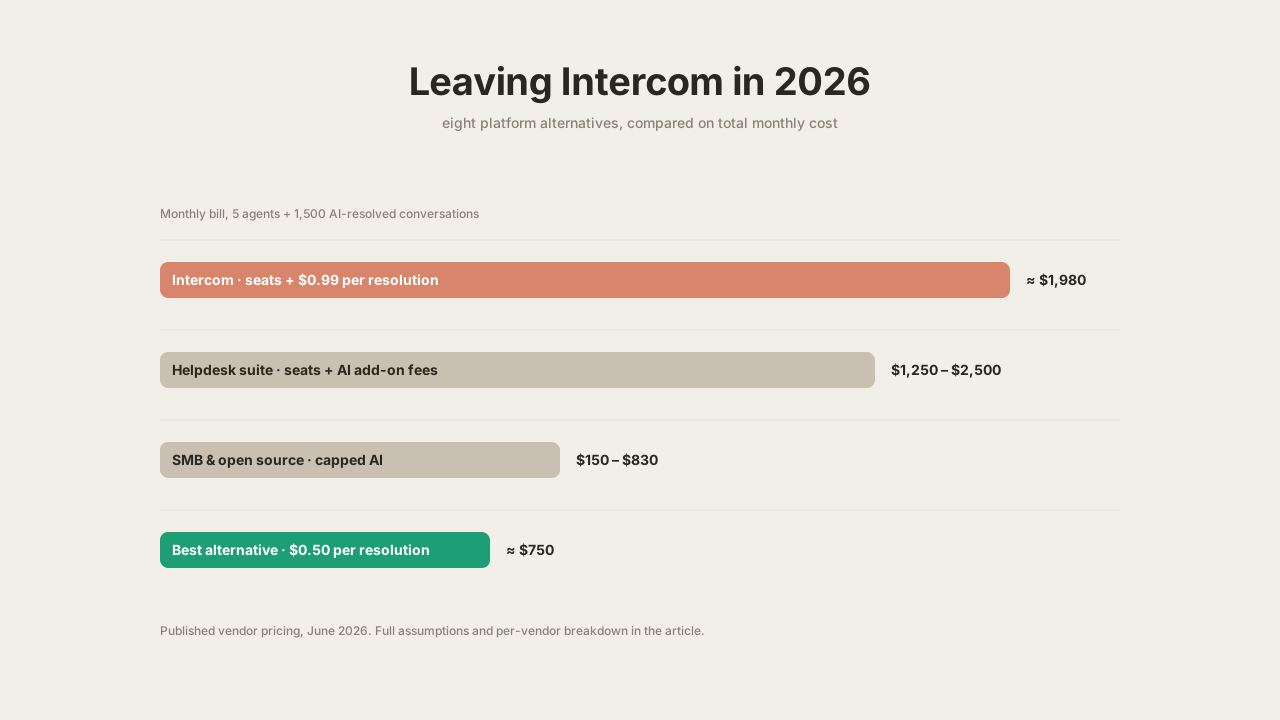
Using the 5-agent, 3,000-conversation team from above (1,500 AI-resolved per month), with each vendor’s cheapest plan that realistically covers it:
| Stack | Humans | AI | Total/mo |
|---|---|---|---|
| Intercom Advanced + Fin | $495 | $1,485 | ≈ $1,980 |
| Zendesk Suite Team + AI resolutions | $275 | ≈ $2,250 | ≈ $2,525 |
| Help Scout Standard + AI Answers | $125 | $1,125 | ≈ $1,250 |
| Freshdesk Growth + Freddy sessions | $95 | ≈ $735 | ≈ $830 |
| Quickchat AI (per-resolution, Inbox included) | Seats bundled (extra from $9) | $750 | ≈ $750 |
| Lighter-weight tools (Crisp, Chatwoot, Front) | varies | FAQ-level AI, capped credits | ≈ $170–$800 * |
* The lighter-weight row is not like-for-like on AI capability. Crisp’s AI credits, Chatwoot’s Captain, and Front’s Autopilot cover suggestion, summarization, and knowledge-base answering rather than autonomous resolution, and none publishes a resolution-rate claim comparable to a dedicated AI agent. The low end of the range is each tool’s entry sticker; the high end is closer to what you actually pay at this scenario’s volume, because 1,500 automated conversations a month exceeds the AI credits bundled into their cheaper tiers and forces an upgrade or credit top-ups. Treat them as a different category, not a cheaper version of the same thing.
Among the tools that actually resolve conversations autonomously, Quickchat AI is the cheapest in this scenario at roughly $750/month, below Freshdesk ($830), Help Scout ($1,250), Intercom ($1,980), and Zendesk ($2,525). The per-resolution rates behind those totals are $0.99 (Fin), $1.50 (Zendesk, committed), $0.75 (Help Scout), and $0.50 (Quickchat AI), and Quickchat AI is the only one of the four that bundles user seats into its plans (extra seats from $9/mo) instead of charging per agent on top.
Group 1: the AI-first replacement
Quickchat AI
Quickchat AI approaches the Intercom exit from the opposite direction to the helpdesk suites: it replaces the AI layer first and makes the helpdesk optional. The same product runs in two modes. It deploys on top of an existing helpdesk (including Intercom itself, plus Zendesk, Help Scout, Freshdesk, and Gorgias), or it runs standalone with a built-in Inbox that covers assignment, human handoff, and conversation history, with user seats bundled by plan. Details on the Inbox mode are on the helpdesk page. On Intercom itself, it installs from the Intercom App Store.
That two-mode design is what makes the migration path gradual rather than a cutover. The sequence that avoids risk: connect Quickchat AI to the existing knowledge base and run it on top of Intercom, compare its resolution rate against Fin on live traffic, then move the human-agent inbox and drop the Intercom seats once the AI is handling the majority of volume. The mechanics of that sequence are covered in how to switch AI agents without migrating your helpdesk.
On capability: the agent grounds answers in your docs and website content, executes AI Actions (order lookups, refunds, ticket creation) against connected systems, and escalates to humans with full context. Every answer carries a Why AI Said That trace showing the sources, retrieved content, and tool calls behind it, which is what a support lead audits when the AI gets something wrong. Quickchat AI publishes a customer-average resolution rate above 80 percent; one published customer (Maybe Tech) runs 600+ daily inquiries at 93 percent AI-resolved.
Pricing is public and has two shapes: flat subscription tiers from Free ($0) and Starter ($9/mo) up to Business ($999/mo), or Enterprise at $0.50 per resolution. Plans bundle user seats (1 on the lower tiers, 3 on Professional, 10 on Business, custom on Enterprise; extra seats from $9/mo), so the bill scales with resolved volume rather than headcount, which is the structural difference from the per-seat suites in this list. Full tiers on the pricing page.
Best fit: teams whose Intercom bill is dominated by Fin resolutions and seat count, and who want the AI quality question settled on live traffic before any migration. Poor fit: teams that need Intercom’s outbound marketing suite replaced in the same tool.
Group 2: classic helpdesk suites
These four replace Intercom’s inbox and ticketing with the familiar per-seat model. They are mature products with deep workflow tooling; the trade-off is that the AI layer is an add-on metered on top of seats, so the bill structure stays Intercom-shaped.
Zendesk
Zendesk is the default enterprise answer and the most direct platform substitute: ticketing, inbox, help center, voice, and a large app marketplace. Suite pricing runs $55 (Team) to $115 (Professional) per agent per month, with Enterprise quoted by sales. The AI layer has two paid parts: Copilot at $50 per agent per month and AI agents billed per automated resolution at $1.50 on committed volume or $2.00 pay-as-you-go, with small allowances bundled into Suite tiers (5 resolutions per agent on Team, 10 on Professional, 15 on Enterprise). For a team leaving Intercom over cost, the math deserves attention: Zendesk with AI enabled is usually not cheaper than Intercom, it is differently shaped. Best fit: teams that want the most established platform and accept enterprise pricing. The Zendesk AI alternatives comparison covers the AI layer in detail.
Freshdesk
Freshdesk (Freshworks) undercuts both Intercom and Zendesk on seats: $19 (Growth), $55 (Pro), $89 (Enterprise) per agent per month, with a free tier for up to two agents. The AI agent, Freddy, is metered in sessions: $49 per 100 sessions, where a session is a unique end-user interaction within a 72-hour window, and Pro and Enterprise plans include the first 500. Sessions are a looser unit than resolutions (an unresolved interaction still consumes one), so divide your expected resolution rate into the session price when comparing. Best fit: cost-conscious mid-market teams that want a full suite and accept session-based AI metering.
Help Scout
Help Scout is the option teams pick when Intercom feels like too much product. Plans run $25 (Standard), $45 (Plus), $75 (Pro) per user per month with a free tier for 5 users, and the product deliberately stays close to email: shared inboxes, Docs help center, light workflows. Its AI story matured in 2025–2026: AI Answers is billed at $0.75 per resolution with a monthly cap you set yourself, which is the second-most transparent AI pricing in this list after Quickchat AI’s. Best fit: small and mid-size teams that want calm software, predictable per-resolution AI, and a fast migration. Poor fit: teams needing deep workflow automation or voice.
Front
Front replaces Intercom’s inbox with a collaboration-first model: shared inboxes over email, chat, SMS, and WhatsApp, with internal comments and assignment as the core workflow. Seats run $25 (Starter, up to 10 seats), $65 (Professional), $105 (Enterprise) per seat per month. AI is sold in pieces: Autopilot from $0.05 per conversation, Copilot at $20 per seat, and QA add-ons. The per-conversation Autopilot price looks low against per-resolution vendors, but the unit is a processed conversation, not a guaranteed autonomous resolution; Front does not publish a resolution-rate claim. Best fit: teams whose support runs primarily over email and shared inboxes. Poor fit: teams whose priority is maximum autonomous resolution of chat volume.
Group 3: SMB and open source
Crisp
Crisp prices the workspace, not the seat: $0 (Free, 2 seats), $45 (Mini, 4 seats), $95 (Essentials, 10 seats), $295 (Plus, 20+ seats) per month. That makes it the cheapest managed way to get 10 humans into a shared inbox with a chat widget and knowledge base. AI comes as bundled credits (about 450 automated conversations on Essentials, with top-ups), aimed at FAQ-style answering rather than action-taking agents. Best fit: small teams leaving Intercom primarily over seat costs, with modest AI ambitions. Poor fit: volume beyond the credit bundles or action-heavy automation.
Chatwoot
Chatwoot is the open-source path: self-hosted is free software with full inbox, widget, and help center functionality (you carry hosting and maintenance), and the managed cloud runs $19 (Startups), $39 (Business), $99 (Enterprise) per agent per month with a free 2-agent tier. The AI layer, Captain, is credit-based (300 to 800 credits bundled by tier, $20 per 1,000 extra) and covers reply suggestions, summarization, and knowledge-base answers. For engineering-led teams that want data ownership and no per-seat invoice, self-hosted Chatwoot is the only option in this list with a marginal software cost of zero. Best fit: teams with ops capacity and data-residency requirements. Poor fit: teams that need vendor-managed AI resolution at high volume.
Tidio
Tidio bundles live chat, chatbot flows, and the Lyro AI agent at SMB price points: a free tier, paid plans from $24.17 per month billed annually, and Lyro from $32.50 per month for 50 AI conversations, scaling through capped tiers up to 1,000+ on custom plans. It replaces Intercom’s widget and basic inbox well for small ecommerce and service businesses; observability and action depth are not its focus. Best fit: small teams that want one inexpensive product covering chat plus capped AI. A fuller treatment of Lyro as an AI agent is in the Fin alternatives comparison.
How to actually leave: migration notes
The exit work is the same regardless of destination, so plan it once.
- Export conversation history. Intercom provides account data export; importable formats vary by destination, and most teams archive history rather than import it, keeping the export searchable internally.
- Deal with the help center. Two options: rebuild articles in the destination’s help center, or keep serving the existing public articles and point the new AI agent at them as a knowledge source. The second option decouples the AI cutover from the content migration.
- Swap the widget. A one-line script change, but schedule it: the widget swap is the user-visible moment of the migration.
- Sequence the AI before the inbox. Deploying the new AI layer while still on Intercom converts the migration from a leap into a measured comparison. You get resolution-rate data on your real traffic before committing the team to a new inbox.
A 30-day cutover with the AI-first sequence: week 1, connect knowledge sources and run the new AI in shadow or on a traffic subset; weeks 2–3, compare resolution rates and tune; week 4, move the inbox and cancel seats.
How to pick
Leaving over the Fin bill, helpdesk is otherwise fine. Swap the AI layer only; see the Fin alternatives guide. Quickchat AI on top of Intercom is the lowest-friction version of this.
Leaving over the total bill, AI resolution is the priority. Quickchat AI: $0.50 per resolution, seats bundled into plans rather than priced per agent, built-in Inbox, and a gradual migration path that produces evidence before commitment.
Leaving for a more established enterprise platform. Zendesk, with the understanding that seats plus Copilot plus per-resolution fees usually land at or above the Intercom bill.
Leaving for simplicity. Help Scout, with AI Answers at a self-capped $0.75 per resolution.
Leaving over seat costs specifically, small team. Crisp’s workspace pricing, or Freshdesk’s $19 Growth seats.
Leaving for ownership and control. Self-hosted Chatwoot, if you have the engineering capacity to run it.
A note on sources
All pricing links point to vendor pricing pages as checked in June 2026: Intercom, Zendesk, Freshdesk, Help Scout, Front, Crisp, Chatwoot, Tidio, and Quickchat AI. Vendor pricing changes; re-check before a buying decision. AI metering units differ across vendors (resolutions, sessions, conversations, credits) and are flagged where the comparison is not like-for-like. Quickchat AI resolution-rate claims link to Quickchat AI’s published customer references.