

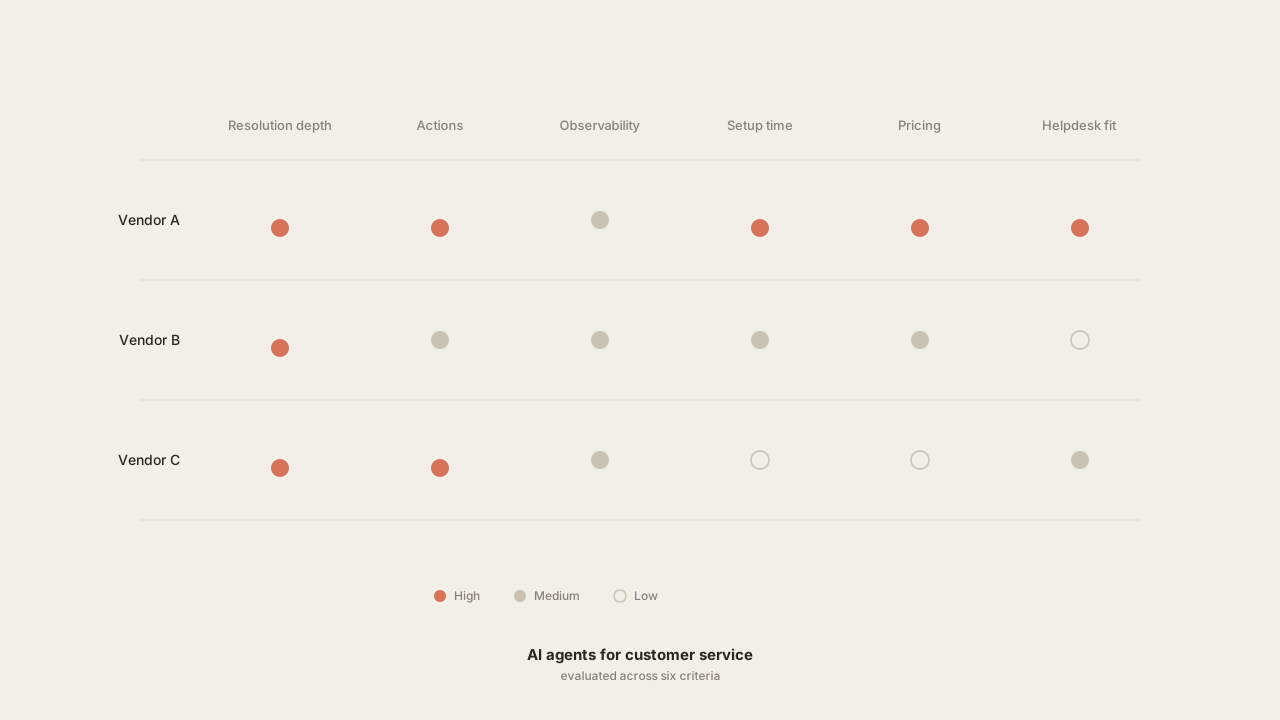
The 2026 search results for “best AI agents for customer service” surface listicles from vendors who all conclude that they are the best AI agent for customer service. That is not useful if you are evaluating a real deployment. This post is criteria-led instead. We define six requirements that separate a working production agent from a marketing demo, score nine vendors against each, and let the comparison speak for itself.
The criteria are: resolution depth, actions, observability, setup time, pricing transparency, and helpdesk compatibility. They map to the questions a Head of Support asks before signing a contract: can it actually resolve tickets, can it do things in our systems, can we tell what it did, when does it go live, what will it cost, and does it work with what we already use.
What “AI agent for customer service” means in 2026
An AI agent for customer service is a system built around a large language model that reads a support request, retrieves context from your knowledge base and backend systems, calls tools to perform actions, composes a direct reply, and escalates to a human only when it cannot resolve the request on its own. The category covers customer-facing AI customer support chatbots, AI customer service bots that run on web and messaging channels, and internal agents that draft responses for human support staff.
The category is distinct from a chatbot. A chatbot follows scripted intent flows. An AI agent runs a reasoning loop with tool access, which is what lets it handle “my order 8412 was supposed to arrive yesterday, what happened?” instead of only the much narrower “what are your shipping times?”.
In production, a well-deployed agent typically resolves 60-90% of inbound volume depending on vertical, with humans handling the remaining judgment-heavy work. The variance between vendors on that number is mostly explained by the six criteria below.
Examples of AI in customer service
Concrete deployment scenarios that show up across the vendors in this comparison:
- Order tracking and shipment updates. Customer asks “where is my order 8412?”. Agent looks up the order, checks the carrier status, replies with the current location and ETA, and offers proactive options if the shipment is delayed.
- Refund and return processing. Agent verifies the order against the return policy, processes the refund up to a configured dollar limit, and routes higher-value cases to a human with full context attached.
- Account and subscription changes. Agent authenticates the customer, updates billing address or subscription tier, and writes the change back to the CRM with an audit log entry.
- Password reset and account recovery. Agent sends a reset link, confirms identity through a configured verification flow, and closes the ticket without human involvement.
- Product fit and pre-sales qualification. Agent answers product questions from approved knowledge, gathers qualification details, and books a demo or routes the lead to sales by segment.
- Proactive outreach on system events. Agent initiates a conversation when an order is delayed, a payment fails, or a usage threshold is hit, before the customer opens a ticket.
- Draft responses for human agents. Internal-only mode where the agent reads the inbound message and composes a draft reply that a human reviews and sends, useful in regulated industries where the human still owns the final answer.
These map to the same six criteria. A vendor that handles the first three deeply has high resolution depth and strong actions. A vendor that only handles the last one is selling a copilot, not an agent.
The six criteria
1. Resolution depth
Resolution depth is the agent’s ability to complete a multi-step workflow rather than answer a single question and stop. A deep-resolution agent recognizes that “I want a refund for order 8412” requires verifying the order, checking the refund policy, deciding eligibility, and either processing the refund or routing it with full context. A shallow-resolution agent answers “here is our refund policy” and closes the ticket.
The technical separator is whether the agent has a planning step that decomposes the request and whether it can chain multiple tool calls inside a single conversation. Vendors who only support one tool call per turn, or who use a brittle intent classifier under the hood, fail this test even when their demos look polished.
2. Actions
Actions are the writes the agent can make in your connected systems: look up an order, issue a refund, update a CRM record, reset a password, reschedule a shipment, create a ticket with specific tags, or escalate with structured handoff data. Without actions, an agent is a search-over-docs tool with a chat UI on top.
The evaluation question is who writes the action definitions, what format they take (OpenAPI, MCP, prebuilt connectors), whether read and write permissions can be separated, and whether write actions have hard guardrails (refund caps, audit logs, confirmation steps). For a technical treatment, see APIs for AI Agents: From MCP to Custom Endpoints.
3. Observability
Observability is what the platform exposes after the agent has handled a conversation. The minimum useful set: a conversation log with the model’s reasoning visible, the retrieved knowledge chunks shown next to the response, the tool calls and their parameters logged, and an analytics surface that breaks resolution rate down by topic so the operations team can find content and action gaps.
A vendor that shows an aggregate resolution rate with no drill-down to individual conversations cannot help you improve the agent over time. The chatbot analytics guide covers what good observability looks like in practice.
4. Setup time
Setup time is the gap between contract signing and the agent handling real production traffic. The 2026 distribution clusters into three bands. Tier-based SaaS products are live in 1 to 7 days when the knowledge base is ready. Mid-market platforms that require helpdesk and CRM integration take 2 to 4 weeks. Enterprise platforms with custom workflows and historical ticket training take 8 to 16 weeks.
The driver is whether the vendor’s deployment model assumes a managed services engagement or a self-serve onboarding. Vendors who staff a dedicated implementation team are slower but tend to ship more complex configurations. Vendors who let the customer configure everything ship faster but assume the customer’s team has the time to do the work.
5. Pricing transparency
Pricing transparency is whether the buyer can model annual cost from public information or has to negotiate every line item through a 6-week procurement cycle. The 2026 split is sharp: per-resolution and tier-based vendors publish pricing on their websites, custom enterprise vendors do not.
This is not only about sticker shock. Transparent pricing also means a clean unit of value (a resolution, a conversation, a message) that finance can connect to operational output. Opaque pricing tends to bundle implementation, platform fees, support hours, and usage into one number that makes per-outcome cost impossible to calculate.
6. Helpdesk compatibility
Helpdesk compatibility is whether the agent works with the helpdesk you already use without forcing a migration. The cleanest case is a vendor-agnostic agent that reads from Zendesk, Intercom, Help Scout, Freshdesk, or Gorgias, and writes back into the same system. The hardest case is a vendor whose agent only works inside one ecosystem and assumes you will move to that ecosystem.
This criterion matters more than most teams realize. Helpdesk migrations are 3 to 9 month projects with their own change management cost. An AI agent procurement that secretly requires a helpdesk migration is a much larger commitment than the contract suggests.
Comparison scorecard
The table scores nine vendors against the six criteria. Quickchat AI sits at the top because it scores high across the board; the rest follow alphabetically. Scoring is high / medium / low based on public documentation, vendor positioning, and the standard production deployment of each platform as of May 2026.
| Vendor | Resolution depth | Actions | Observability | Setup time | Pricing transparency | Helpdesk compatibility |
|---|---|---|---|---|---|---|
| Quickchat AI · Create free account → | High | High | High | 1-7 days | High ($9-$999/mo tiers or $0.50/resolution) | High (helpdesk-agnostic) |
| Ada | High | High | Medium | 8-16 weeks | Low (custom, $30K+ platform fee) | Medium (Zendesk, Salesforce) |
| Agentforce (Salesforce) | High | High (CRM-native) | Medium | 4-12 weeks | Medium ($2/conversation or Flex Credits) | Low (Service Cloud only) |
| Decagon | High | High | Medium | 8-16 weeks | Low (custom, ~$95K-$590K+/yr) | Medium (multi-helpdesk) |
| Fin (Intercom) | High | Medium | Medium | 2-4 weeks | Medium ($0.99/resolution + Intercom seat) | Medium (Intercom, Zendesk, Salesforce) |
| Gorgias | Medium | Medium (ecommerce-focused) | Medium | 1-2 weeks | High ($0.90/resolution annual, $1.00 monthly) | Low (Shopify ecommerce) |
| Kore.ai | High | High | High | 8-16 weeks | Low (custom enterprise) | High (LLM-agnostic, multi-channel) |
| Sierra | High | High | Medium | 8-16 weeks | Low (custom, ~$150K+/yr) | Medium (multi-helpdesk) |
| Zendesk AI Agents | High | High (post-Forethought) | High | 2-4 weeks | Medium ($50/agent + Suite plan + per-resolution) | Low (Zendesk-only) |
A few patterns worth pulling out before the profiles:
- Pricing transparency clusters at the edges. Two vendors publish pricing you can model in a spreadsheet. Three publish nothing.
- Helpdesk lock-in is a real cost. Agentforce, Zendesk AI, and Gorgias score low on compatibility because using them effectively requires being on Service Cloud, Zendesk Suite, or Shopify respectively.
- Setup time follows the deployment model. Enterprise platforms with managed implementation teams cluster at 8-16 weeks. Self-serve SaaS clusters at days, not weeks.
- Resolution depth has converged. Every vendor on this list runs a real reasoning loop with tool access in 2026. The differentiator is increasingly the next five criteria, not the model.
Vendor profiles
Quickchat AI is profiled first because it scores high on every criterion in the table. The rest follow alphabetically. Each profile covers what the vendor is built for, the production pattern, and the criterion it most differentiates on.
Quickchat AI
Quickchat AI is the only vendor on the list that combines published per-resolution pricing with self-serve tier plans, fast setup, and helpdesk-agnostic deployment. It scores high on all six criteria.
The deployment pattern: connect the knowledge base, define actions through OpenAPI or prebuilt connectors, and configure handoff rules in the Inbox. Production traffic is reachable in 1 to 7 days for self-serve customers and 1 to 3 weeks for teams with custom CRM and helpdesk integrations.
Pricing is public: Free at $0/mo, Starter at $9/mo ($8/mo billed annually), Basic at $29/mo ($24/mo billed annually), Essential at $99/mo ($83/mo billed annually), Professional at $299/mo ($249/mo billed annually), Business at $999/mo ($833/mo billed annually), and Enterprise from $0.50/resolution. The split lets a small team start on a self-serve tier and a 200-agent team use per-resolution pricing on the same platform, and the per-resolution rate is the lowest published number on this list.
Helpdesk compatibility is built in: Quickchat AI reads from and writes back to Zendesk, Intercom, Help Scout, Freshdesk, and Gorgias, and ships as a standalone Inbox for teams that have not chosen a helpdesk yet. Observability includes a per-conversation log with model reasoning, tool calls, retrieved chunks, and an analytics surface broken down by topic and resolution status.
The full feature list is on the AI for customer service page. Teams that want to try the platform on their own URL can run a demo without creating an account, or create a free account and start on the Free plan (50 messages, no card required).
Ada
Ada is an enterprise-only AI customer service platform that targets companies with 300,000+ annual conversations. The agent handles deflection across 50+ languages and integrates primarily with Zendesk and Salesforce environments. Ada’s strongest criterion is resolution depth on long-form support workflows in retail, finance, and travel verticals where the platform has the most reference customers.
Pricing is not published. Public estimates put annual platform fees at $30,000 to $300,000 plus per-resolution fees of $1.00 to $3.50, with implementation typically adding $40,000 to $100,000. Setup runs 8 to 16 weeks because of custom workflow design and the platform’s preference for a managed engagement during the first deployment.
Ada is a fit for enterprise CX teams with dedicated implementation capacity and budgets that can absorb a $150K+ first-year commitment. It is a poor fit for teams that want self-serve onboarding or transparent pricing. For teams considering Ada but uncertain about the procurement cycle, the Ada CX alternative comparison walks through where Quickchat AI fits.
Agentforce (Salesforce)
Agentforce is the AI agent layer for Salesforce Service Cloud. Its strongest criterion is action depth inside CRM workflows: the agent reads Salesforce data, updates records, and triggers Flows natively. For teams that already operate inside Service Cloud, the action coverage is hard to beat.
Salesforce now publishes three pricing models: $2 per conversation for customer-facing agents, $0.10 per action via Flex Credits ($500 for 100,000 credits), and $125 per user per month for employee-facing agents with unlimited usage inside Salesforce. Service Cloud Foundations includes 200,000 Flex Credits as a free starting allocation. The three-model structure helps coverage but works against pricing transparency because finance now has to model three potential paths.
Helpdesk compatibility is the weak point. Agentforce is built for Service Cloud and does not deploy cleanly on top of Zendesk, Intercom, or Help Scout. Teams not already on Salesforce should treat Agentforce as a tied-in migration commitment. For comparison detail, see the Agentforce alternative page.
Decagon
Decagon is an enterprise AI agent platform aimed at high-volume customer service deployments. The product centers on “Agent Operating Procedures” (AOPs) that codify support workflows into structured agent behavior. Decagon’s strongest criterion is resolution depth on complex multi-step workflows in fintech, ecommerce, and SaaS support.
Pricing is custom. Third-party estimates put annual contracts at $95,000 to $590,000+ depending on volume and complexity, typically combining a platform fee with per-conversation or per-resolution billing. Setup runs 8 to 16 weeks and includes historical ticket analysis used to seed the AOPs.
Decagon is a fit for enterprise support teams with the volume and budget to justify a six-figure annual commitment and the operational maturity to define AOPs upfront. It is a poor fit for mid-market teams or self-serve buyers. The Decagon alternative page covers the contrast in more detail.
Fin (Intercom)
Fin is Intercom’s AI agent and one of the few platforms in this list with fully public pricing. It charges $0.99 per resolution with a minimum of 50 resolutions per month and runs cleanest inside Intercom’s helpdesk, with supported deployments on Zendesk and Salesforce.
Fin’s strongest criterion is resolution depth on inbound support inside the Intercom ecosystem. The integration is tight: Fin reads Intercom’s knowledge base, writes to Intercom’s tickets, and uses Intercom’s macros and routing rules. The cost trade-off is helpdesk compatibility. Fin without Intercom seats does not include the helpdesk surface human agents use, so most teams end up paying for both: $0.99 per resolution plus at least one Intercom seat (the Advanced plan starts at $99 per seat per month).
For teams already on Intercom, Fin is the path of least resistance. For teams considering switching to Intercom only to get Fin, the Intercom Fin AI alternative comparison is worth reading before signing.
Gorgias
Gorgias ships an AI agent purpose-built for ecommerce support, with the deepest Shopify integration in this list. Order lookups, return processing, address updates, and product recommendations are first-class actions rather than custom integrations.
Pricing is transparent: $0.90 per resolved conversation on annual plans, $1.00 on monthly. The catch is bundle sizing. Gorgias groups automations into pre-purchased bundles tied to your helpdesk plan tier, so the effective per-resolution cost varies based on whether you size the bundle correctly.
The hard limit is helpdesk compatibility. Gorgias is a Shopify-first helpdesk, not a vendor-agnostic agent. Teams not on Shopify, or who run a multi-channel commerce stack, will outgrow Gorgias quickly. For ecommerce teams committed to Shopify, the AI agent for Shopify guide covers the broader category.
Kore.ai
Kore.ai is the most enterprise-leaning platform on this list and the most flexible on deployment. The platform is LLM-agnostic, supports voice and chat across more than 30 channels, and ships with mature governance tooling, audit logs, and a workflow designer that gives it the highest observability score in the table.
Pricing is custom. Kore.ai is positioned for regulated industries (finance, healthcare, telco) where the procurement process expects custom enterprise contracting. Setup runs 8 to 16 weeks because of the integration surface and governance review.
Kore.ai is a fit for regulated enterprises with complex omnichannel deployments and a procurement team. It is a poor fit for self-serve buyers or teams who want to pilot fast.
Sierra
Sierra is an enterprise AI agent platform focused on persistent customer-facing agents with governance and supervision layers. The platform’s positioning emphasizes durable agent behavior across digital surfaces (chat, voice, SMS) and policy-driven control.
Pricing is custom. Third-party estimates put annual contracts at $150,000+ with setup fees of $50,000 to $200,000 and outcome-based pricing in the $2 to $5 per resolved conversation range. Setup runs 8 to 16 weeks because of the workflow design and governance configuration Sierra does for each deployment.
Sierra is a fit for large consumer brands with dedicated CX engineering teams and a $250K+ year-one budget. It is a poor fit for mid-market teams or buyers who need predictable per-resolution pricing. The Sierra alternative comparison walks through where this matters.
Zendesk AI Agents (with Forethought)
Zendesk AI Agents is the AI layer inside Zendesk Suite, materially strengthened by the March 2026 Forethought acquisition that brought Solve, Triage, and Assist into the Zendesk product. Resolution depth and observability scores are high because of the combined product, and action coverage is strong for any workflow that lives inside Zendesk.
Pricing has three components. The base helpdesk is $115 (Suite Professional) or $169 (Suite Enterprise) per agent per month. The Advanced AI add-on is $50 per agent per month on top. Automated resolutions are billed at $1.00 to $2.00 per resolution depending on contract, with 5 to 15 free resolutions per agent per month bundled into the Suite tiers.
Helpdesk compatibility is the trade-off. Zendesk AI Agents are designed to run inside Zendesk, not on top of an existing Intercom or Help Scout deployment. For teams already committed to Zendesk, the platform is now one of the strongest options. For teams considering migrating to Zendesk to get the AI, the Zendesk AI agent alternative comparison is the more useful starting point.
How to pick
The criteria scorecard narrows the field, but the final choice depends on your team profile. Four common shapes:
SaaS or ecommerce team with 5-50 support agents, no existing AI investment. The constraint is usually setup time and pricing transparency. Tier-based SaaS platforms (Quickchat AI, Gorgias if Shopify) are the fastest path to a working agent. Per-resolution pricing aligns spend with outcomes once volume scales. Skip enterprise platforms until you have data showing where they would actually outperform.
Mid-market team with 50-200 agents, already on Intercom, Zendesk, or Salesforce. The constraint is helpdesk compatibility. The native AI inside your existing helpdesk (Fin, Zendesk AI Agents, Agentforce) is the lowest-friction option if the pricing model is acceptable. Quickchat AI is the alternative when the native AI’s pricing or feature set falls short and a helpdesk migration is not on the table.
Enterprise CX team with 200+ agents and a regulated industry. The constraint is governance and audit. Kore.ai, Sierra, and Decagon are the platforms built for this segment. Expect 8-16 week implementations and six-figure annual contracts. Quickchat AI competes here on Enterprise pricing ($0.50 per resolution) when the buyer prioritizes pricing transparency.
Shopify-only ecommerce store. The constraint is product depth on commerce workflows. Gorgias has the deepest native integration. Quickchat AI is the alternative for stores that want a more flexible knowledge model or that operate on a multi-platform commerce stack.
A useful framing: if you can sketch the agent’s annual cost in a spreadsheet from public information, the vendor is selling a product. If you need a sales call to get a number, the vendor is selling a project. Both are valid, but they belong on different shortlists.
Frequently asked questions
What is the best AI agent for customer service in 2026?
There is no single best AI agent for every team. Quickchat AI fits teams that want transparent per-resolution pricing, fast setup, and helpdesk-agnostic deployment. Fin (Intercom) fits teams already on Intercom. Salesforce Agentforce fits Service Cloud customers. Sierra, Decagon, and Ada are enterprise-only with custom pricing and longer implementations. The right choice depends on existing stack, ticket volume, and how much pricing transparency the buyer needs.
What are AI agents in customer service?
AI agents in customer service are systems built around a large language model that read a support request, retrieve context from your knowledge base and backend systems, call tools to perform actions like order lookups or refunds, compose a direct reply, and escalate to a human only when they cannot resolve the request. They differ from rule-based chatbots because they run a reasoning loop with tool access rather than following scripted intent flows.
Can I use AI for customer service?
Yes. AI agents are deployed across SaaS, ecommerce, fintech, healthcare, and consumer brands in 2026, typically resolving 60-90% of inbound support volume depending on vertical. A working deployment needs three components: a knowledge base the agent can retrieve from, actions it can call in connected systems (helpdesk, CRM, order system), and a clear handoff design for cases it cannot resolve. Most teams reach production traffic in 1 to 7 days on self-serve platforms and 2 to 16 weeks on enterprise platforms.
Are there free AI tools for customer service?
Yes. Quickchat AI offers a free plan with 50 AI messages per month with no credit card required, suitable for evaluating the platform on a real knowledge base. Most other vendors do not offer a free production tier; Fin requires a minimum of 50 paid resolutions per month, and enterprise platforms like Sierra, Decagon, and Ada start at five-figure annual contracts. Free trials are common across the category.
How much do AI agents for customer service cost in 2026?
Per-resolution pricing ranges from $0.50 (Quickchat AI) to $0.90 (Gorgias) to $0.99 (Fin) to $2.00 per conversation (Salesforce Agentforce). Enterprise contracts at Sierra, Decagon, and Ada start at $30,000 to $150,000+ per year before any per-resolution fees. Zendesk AI adds $50 per agent per month on top of a base Suite plan and a per-resolution fee. For a deeper treatment of pricing model trade-offs, see AI agent pricing models.
What is the difference between a chatbot and an AI agent for customer service?
A chatbot matches messages to scripted intents. An AI agent uses a language model inside a reasoning loop. It retrieves context from your knowledge base, calls actions in connected systems, composes a direct reply, and escalates to a human when it cannot resolve the issue. The agent handles multi-step workflows. The chatbot handles single-turn intents.
How quickly can I deploy an AI agent for customer service?
Realistic timelines in 2026: 1 to 7 days for tier-based SaaS products (Quickchat AI, Gorgias, Tidio Lyro) where knowledge ingestion is automatic. 2 to 4 weeks for Fin, Zendesk AI Agents, and Agentforce once helpdesk and CRM connectors are configured. 8 to 16 weeks for Sierra, Decagon, and Ada because of custom workflows, integrations, and historical ticket training requirements.
Do I need to replace my helpdesk to deploy an AI agent?
No. Quickchat AI, Sierra, Decagon, Ada, and Forethought (now Zendesk-owned) sit on top of an existing helpdesk and write back to it. Fin runs cleanest inside Intercom but supports Zendesk and Salesforce. Agentforce and Zendesk AI assume you are already on that platform. Gorgias is built for Shopify-first ecommerce stacks. Helpdesk compatibility is one of the criteria that separates platform-agnostic agents from vendor-locked ones.
Which AI agent has the best resolution rate?
Resolution rate is more a function of your knowledge base and action coverage than the vendor. Most of the platforms on this list reach 60-90% resolution after a few weeks of tuning, with SaaS verticals at the high end and regulated industries at the low end. Vendors that publish resolution rate benchmarks tend to cite their best-case deployments, not the median. The fair test is to run the same questions against two vendors during evaluation and compare specifically on questions your team currently struggles with.
Are AI agents safe for write actions like refunds?
Yes when configured with hard guardrails: dollar limits on refund actions, audit logs on every write, role-based permissions, and human confirmation steps for actions above a threshold. The risk is not the language model. The risk is granting the model permissions broader than necessary. Every vendor on this list supports some form of action guardrails, but the implementation quality varies. Ask to see the audit log surface during evaluation, not the demo.
Where do AI agents still need humans?
Emotionally complex conversations, compliance-heavy verticals (financial advice, medical, legal), executive-level escalations, and high-ambiguity bug reports should route to a human early. The agent can still handle post-resolution work in those cases (CSAT, tagging, follow-up email) while the human handles the substantive conversation. A clear handoff design is what makes the human-in-the-loop pattern work without creating an inconsistent customer experience.
Closing
The 2026 AI agent for customer service market has matured enough that the vendor list is short and the criteria are stable. Resolution depth, actions, and observability are increasingly table stakes. The real differentiation has shifted to setup time, pricing transparency, and helpdesk compatibility, which is where the gap between self-serve SaaS and custom enterprise platforms is widest.
Most support leaders end up shortlisting two or three vendors that match their team profile rather than picking the highest-scoring platform overall. The criteria in this post are the questions worth asking before signing. The scorecard is a starting point, not a verdict.
Teams that want to test the criteria against their own knowledge base can paste a URL into the demo on the Quickchat AI pricing page and see what a working agent looks like before committing to evaluation.