

USD 7.84 billion in 2025 to USD 52.62 billion by 2030. That is the projected growth path for the global AI agents market, a 46.3% CAGR, according to MarketsandMarkets’ AI agents market forecast. AI agent platforms have moved out of the lab and into operating budgets, and teams of every size are now shopping for one.
AI has already touched support, sales, and operations at most companies. The practical question is which AI agent platforms can handle the realities of production deployment. Those realities include messy systems, integrations with existing tools, handoff logic, audit requirements, and a CFO who wants a predictable return instead of a demo that looks good for ten minutes.
Most general-purpose guides fall short because they talk about autonomy and orchestration while skipping the details that determine whether a deployment survives contact with security, operations, and frontline teams. In practice, data privacy, traceability, and controlled outcomes matter as much as model quality. Weak execution on those pieces means the agent never becomes a business system, and instead stays a pilot that never leaves the sandbox.
The rise of autonomous AI in business
Companies did not start looking at AI agent platforms because chat interfaces became fashionable. They started because teams are under pressure to do more with the same headcount, while customers expect immediate answers at any hour and across every channel.
The jump in market size reflects a shift in buying behavior. Companies are not only experimenting with language models anymore. They are looking for systems that can handle workflows rather than just generate text. In support, that means understanding an issue, checking account context, applying policy, taking an action, and documenting the result. In sales, it means qualifying a lead and routing it correctly. In operations, it means coordinating tasks across tools people already use.
Basic chatbots rarely solve that class of problem. They answer frequently asked questions, then stall the moment a request needs context, memory, or system access. An agent platform is designed to keep track of state, use tools, and pursue an outcome rather than produce a one-off reply. For a deeper treatment of the distinction, see best enterprise AI chatbots and the AI chatbot buyer guide.
Practical rule: A system that cannot reliably move from “I understand the request” to “I completed the task” is a front-end convenience layer rather than an enterprise agent strategy.
That distinction matters because the operational pain is expensive even when finance does not see it line by line. Support queues grow because simple requests still require manual handling. Sales teams lose momentum because inbound conversations are not qualified consistently. Global businesses leave coverage gaps overnight because service still depends on local staffing windows.
For leadership teams, the opportunity is straightforward. AI agents can become a new execution layer across customer-facing and internal processes, provided the platform behind them is built for control, governance, and real business logic.
Defining the modern AI agent platform
From model to operating system
A useful framing for AI agent platforms, the LLM is the engine, but the platform is the whole car.
An engine matters, but nobody buys an engine to drive to work. You need steering, braking, memory, controls, instrumentation, and a chassis that holds everything together. The same is true here. A foundation model provides language understanding and generation. The platform turns that raw capability into a working system that can operate inside a business.
The comparison between agents and bots matters for the same reason. For a concise breakdown, this guide on AI agent vs chatbot captures the difference well. A chatbot replies to messages. An agent works toward task completion.
What separates a platform from a wrapper
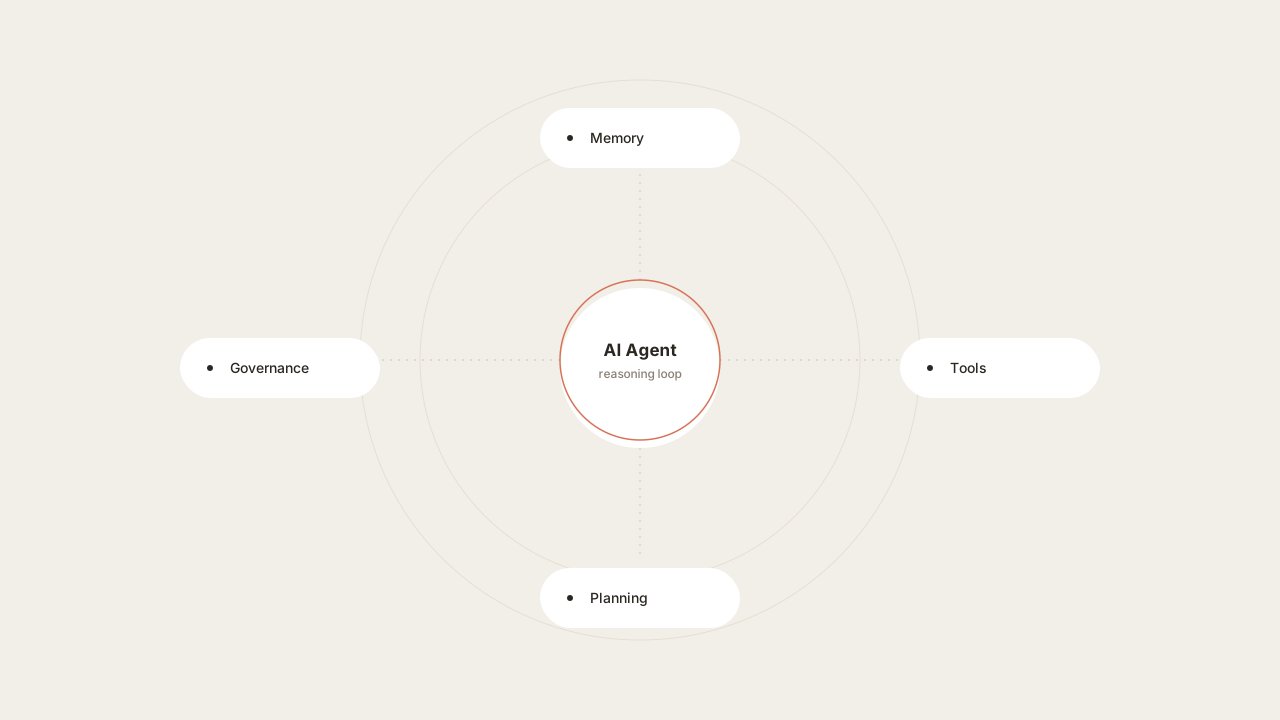
A real platform has a few defining characteristics.
-
Stateful memory. It remembers the conversation and relevant business context across steps. Without memory, every turn becomes a fresh prompt, and the experience falls apart as soon as a user asks a follow-up or changes direction.
-
Goal-oriented autonomy. The system is not only predicting the next sentence. It is trying to reach an outcome such as processing a return, qualifying a prospect, or escalating a case with the right metadata.
-
Tool use. Agents need access to APIs, databases, CRMs, ticketing systems, order systems, and knowledge sources. Without those connections, they remain articulate spectators.
-
Supervision and governance. Enterprises need clear boundaries around what the agent may read, write, trigger, or recommend, which makes platform design more important than raw model capability.
A lot of products market themselves as agent platforms when they are really prompt layers attached to a chat window. They may look convincing in a scripted demo, but they tend to break under ordinary conditions. A customer asks a policy question that depends on region. A prospect wants pricing tied to product eligibility. A support workflow requires fetching a record, checking a rule, and updating a system. Lightweight wrappers struggle because they do not have a durable control layer.
The fastest way to spot a weak platform is to ask what happens after the first answer. A vendor that cannot explain memory, tools, permissions, and auditability is showing a demo stack rather than an operating platform.
The enterprise version of this category is not defined by having the biggest model. Enterprise readiness is defined by whether the system can act safely, repeatedly, and with enough context to be trusted in production.
How AI agent platforms actually work
Reasoning starts with modular architecture
Under the hood, modern AI agent platforms rely on memory, planning, action, and profile modules. According to BCG’s overview of AI agents, this modular architecture can deliver up to 40% efficiency gains in multi-step tasks over single-LLM systems because agents can break work into sub-tasks and self-refine.
That architecture maps cleanly to business needs.
Memory keeps track of prior interactions and relevant history. In customer service, that might include previous orders, earlier troubleshooting, or the customer’s current issue status. In sales, it might hold product interest, qualification signals, and follow-up context.
Planning is where the system decides how to tackle the request. Instead of answering immediately, a stronger agent decomposes the problem. It may identify that a billing request requires account verification, invoice lookup, policy validation, and then an action such as initiating a refund workflow or creating a case for finance review.
Profile tells the agent how to behave in a given role. A support agent should use support policy and escalation logic. A sales development agent should qualify, route, and book, rather than improvise legal commitments.
Grounding and actions make agents useful
An enterprise agent also needs grounding. That usually means retrieval from approved company knowledge so the model responds based on current documentation, policy, and product information rather than generic training data. Grounding makes Retrieval-Augmented Generation practical rather than theoretical. It reduces unsupported answers because the system can pull from the right source at the right moment.
Actions are the second half of the equation. A grounded answer is helpful, but businesses usually need the platform to do something. That could mean checking an order, updating a CRM field, opening a support ticket, or passing structured context into another workflow. The implementation details vary, but the agent should sit inside the business process rather than outside it.
For teams planning integrations, this overview of APIs for AI agents from MCP to custom endpoints is useful because it shows how agent actions connect to real systems rather than stopping at conversation design. For a hands-on version, this walkthrough of how to build an AI agent that takes actions wires an agent to a live API in about ten minutes, free and with no code.
A mature platform also exposes traceability. Leaders need to know what the agent retrieved, why it chose a path, what tools it called, and where human intervention happened. Traceability serves both compliance and operational improvement. When an agent misses, the team needs enough evidence to fix the knowledge, logic, or action path rather than guess.
Good agent design treats observability as part of execution, not as an afterthought for the analytics team.
What changed in 2026: Gemini Enterprise and ChatGPT Workspace Agents
Two launches in the last week reshaped the enterprise AI agent platforms landscape. Google Cloud’s Gemini Enterprise Agent Platform consolidates model selection, governance, and orchestration into one environment and ships with integrations into Salesforce, ServiceNow, and Oracle at launch. OpenAI’s ChatGPT Workspace Agents launched on April 22, 2026, succeeding custom GPTs for enterprise deployments. Workspace Agents are Codex-powered, run continuously in the cloud, and plug directly into Slack, Salesforce, and Gmail with admin-controlled RBAC.
Both vendors are pushing toward the same positioning: the agent layer as a new execution surface that sits alongside SaaS tools rather than inside a single app. For enterprise buyers, the takeaway is that horizontal platform plays from hyperscalers will keep expanding into integration territory traditionally owned by specialized vendors. The selection criteria below still apply, and the privacy, traceability, and commercial model questions matter more as the category gets crowded.
Top AI agent platforms for enterprise: comparison table
The table below covers platforms that commonly appear in enterprise AI agent platform shortlists. Best fit depends on use case, existing stack, and commercial model preference.
| Platform | Best fit | Deployment model | Pricing model | Notable strengths |
|---|---|---|---|---|
| Quickchat AI | Customer-facing support and sales, internal AI agents | SaaS, privacy-by-default, no training on customer data | Self-serve from $9/mo; Enterprise from $0.50/resolution | Grounded RAG, API actions, full traceability, forecastable unit economics |
| ChatGPT Workspace Agents | Internal knowledge work across Slack, Gmail, Salesforce | SaaS (ChatGPT Business / Enterprise), cloud-hosted | Seat-based, enterprise tier | Codex-powered, 24/7 cloud execution, admin RBAC, broad connector coverage |
| Gemini Enterprise Agent Platform | Companies on Google Cloud building and orchestrating agents | Google Cloud | Usage-based (Vertex AI) | Unified build and govern environment, partnerships with Salesforce, ServiceNow, Oracle |
| Vertex AI Agent Builder | Developer teams building grounded, multi-agent systems | Google Cloud | Usage-based | Deep RAG tooling, A2A protocol, strong compliance and security primitives |
| Salesforce Agentforce | Salesforce-native customer service and sales workflows | Salesforce platform | Per-conversation + platform licensing | Tight CRM data access, fits existing Salesforce operations |
| Microsoft Copilot Studio | Microsoft 365 and Dynamics-heavy organizations | Microsoft Cloud | Message packs + M365 licensing | Power Platform integration, Azure AD identity, enterprise governance |
| Kore.ai | Regulated industries with complex conversational workflows | SaaS or private cloud | Enterprise licensing | Mature orchestration, LLM-agnostic, strong governance and analytics |
| Vellum AI | Teams building custom agents with evaluation and versioning | SaaS | Seat + usage | Prompt engineering, evals, observability, collaboration features |
| CrewAI | Engineering teams prototyping multi-agent systems | Open-source + managed | Free open-source, managed tier | Role-based agent collaboration, strong developer community |
This is not an exhaustive list. The point is that no single platform dominates every workload. A SaaS company running inbound support at scale will likely shortlist different vendors than a bank consolidating internal knowledge retrieval, even though the evaluation criteria are similar.
Unlocking efficiency with AI agent use cases
As of early 2025, 78% of organizations use AI in at least one business function, and 80% of companies plan to adopt AI-powered agents for customer service. Among top performers using AI-led operations, customer satisfaction scores are up 31.5%, according to Plivo’s roundup of AI agent adoption statistics. The conversation has moved from experimentation to deployment.
Customer support that completes the task
A support team usually starts with a queue problem. Contacts pile up, agents spend time on repetitive work, and customers repeat themselves across channels. A basic bot can deflect a few simple questions. An actual agent platform does more.
A customer asks why an order has not arrived. The agent identifies the order, checks shipment status, reviews the latest carrier update, confirms whether the issue qualifies for a replacement or refund under policy, and then either completes the next step or routes the case with the right context. The human agent does not start from zero because the system has already done the retrieval and triage. For a deeper walkthrough of this pattern, see the AI agent for customer service guide.
That changes staffing economics and service quality at the same time. Customers care less about whether AI was involved than whether their problem got solved quickly and correctly.
Sales qualification without manual triage
Website leads often die in the handoff between interest and follow-up. A visitor asks if the platform supports a certain integration, whether procurement is required, or whether a given plan fits their team size and use case. Without a specific response, the moment passes.
An AI sales agent can handle that front line. It can answer product-fit questions based on approved knowledge, gather qualification details, route by territory or segment, and book the right next step. For SaaS teams, this example of an AI agent for SaaS shows how the model works in a product-led environment where response speed and qualification consistency matter.
Here is a walkthrough of what that looks like in practice:
E-commerce assistance tied to live operations
In e-commerce, the gap between conversation and transaction is especially costly. Shoppers want answers about compatibility, delivery windows, returns, availability, and recommendations. Those questions are not hard individually, but they become operationally expensive at scale.
An agent platform can combine product knowledge with real-time business signals. It can check inventory, explain shipping constraints, suggest alternatives when something is out of stock, and escalate edge cases with the cart context attached. That makes the assistant part of commerce operations rather than an FAQ layer floating above the store.
Three patterns tend to work well across these use cases:
- Narrow the scope first. Start with one high-volume workflow where policy and data access are clear.
- Connect the right systems. Even a smart agent underperforms when it cannot reach the CRM, ticketing system, or order platform.
- Design the fallback path. Human handoff should be deliberate, with context preserved, rather than treated as failure.
Your enterprise AI agent evaluation checklist
The fastest way to waste time on AI agent platforms is to evaluate them like chat tools. Enterprises need to assess them like operational systems. The right questions expose whether the product can survive procurement, security review, and real production traffic.
Questions that expose platform risk
Start with privacy and control. Ask where data goes, whether customer data is used for model training, how retention works, and what audit records are available. These questions are not legal formalities. They determine whether the platform can be trusted with regulated or customer-sensitive workflows.
Then move to execution quality. According to Treasure Data’s guide to AI agent platforms, true enterprise platforms include a Process Reasoning Engine and governance guardrails that reduce failure rates from 74% in basic frameworks to under 20% in production. The same guide notes guardrails such as PII masking, RBAC, brand compliance, and full observability on SOC 2/ISO 27001 certified infrastructure. That gap separates a tool that can reason through a business process from one that gets lost halfway through.
Operator’s test: Ask the vendor to show how an agent handles a multi-step exception rather than a happy-path FAQ. Platform quality shows up there.
Integration depth matters next. Ask which systems the platform can connect to directly, how actions are authorized, and whether read and write permissions can be separated. A support deployment might need Salesforce, ServiceNow, Shopify, an identity layer, and an internal knowledge base. A clumsy integration model turns every useful workflow into a custom project.
Reliability is another separating line. You need to understand what observability exists for failed actions, low-confidence responses, policy violations, and escalation triggers. When these events are not visible, teams cannot improve the system. They can only react to complaints after the fact.
Enterprise AI agent platform evaluation checklist
| Category | Key question to ask | Why it matters |
|---|---|---|
| Security and privacy | How is customer data stored, isolated, and governed? | Protects sensitive information and determines whether legal and security teams will approve production use. |
| Data usage policy | Is our data used to train models or shared outside the deployment boundary? | Clarifies control over proprietary and regulated information. |
| Traceability | Can we review retrieved sources, actions taken, and handoff history? | Enables audits, debugging, and operational improvement. |
| Governance | What guardrails exist for PII masking, role permissions, and brand-safe responses? | Prevents unsafe outputs and unauthorized actions. |
| Reasoning | How does the platform manage multi-step workflows and exceptions? | Reveals whether it can handle real business tasks rather than one-turn answers. |
| Integrations | Which enterprise systems can the agent read from and write to? | Determines whether the agent can actually complete work. |
| Human handoff | What happens when confidence is low or policy requires approval? | Keeps service quality stable and protects edge cases. |
| Analytics | What reporting exists for resolution, escalation, failure modes, and content gaps? | Gives operations teams the feedback loop needed to optimize performance. |
| Commercial model | Is pricing tied to usage you can forecast and evaluate? | Helps finance compare cost against operational outcomes. |
| Deployment model | How quickly can the team launch safely without long custom build cycles? | Affects time to value and total implementation burden. |
A vendor that answers these questions with precision is usually worth further review. A vendor that responds with broad claims about intelligence usually is not.
A platform built for enterprise-grade results
Where enterprise programs usually break
The biggest gap in this market is enterprise readiness rather than model capability. A 2025 Gartner finding cited by NFX’s discussion of AI agent marketplaces notes that 85% of enterprises cite data privacy as the top barrier to AI adoption. That matches what security and operations leaders already know. Without privacy-by-default controls, no-data-sharing boundaries, and full auditability, deployment slows down or stops.
This is also where product selection gets practical. Some tools are good for experimentation. Others are designed for customer-facing operations. Quickchat AI falls into the second group. It provides privacy-by-default deployment, no model training on customer data, full traceability through analytics, API-based actions, and grounded responses through RAG. Those are the features enterprise teams usually end up asking for after a lightweight pilot hits governance limits.
Why predictable operations matter more than flashy demos
Predictable ROI usually comes from four things working together:
- Grounded knowledge. The agent answers from approved company content rather than improvising from general training.
- Controlled actions. Teams decide what the agent may do in connected systems and under which permissions.
- Traceable outcomes. Operators can inspect conversations, retrieval behavior, actions, and gaps.
- Forecastable pricing. Finance can connect spend to operational output rather than absorb an opaque platform bill.
One commercial detail stands out because it aligns with how support leaders think about unit economics. Quickchat AI offers self-serve plans from $9/mo and Enterprise from $0.50/resolution. That lets teams match the commercial model to the shape of each use case instead of forcing every deployment into seat-heavy or bundled pricing.
Enterprise buyers do not need another AI layer that sounds impressive in a workshop. They need a platform that legal can approve, IT can integrate, operations can monitor, and finance can model without guesswork.
Privacy, traceability, and predictable cost are core requirements that determine whether the agent becomes part of core operations or stays trapped in pilot mode.
Frequently asked questions
Which AI agent platform is best for enterprise in 2026?
There is no single best AI agent platform for every enterprise. Salesforce Agentforce, Google Vertex AI Agent Builder, ChatGPT Workspace Agents, Gemini Enterprise Agent Platform, and Microsoft Copilot Studio cover broad general-purpose deployments inside existing stacks. Quickchat AI, Kore.ai, and Vellum focus on customer-facing or production-grade deployments with privacy-by-default controls. The right choice depends on data residency, existing stack, whether the use case is customer-facing or internal, and whether you need usage-based or seat-based pricing.
How much does an AI agent platform cost?
Pricing models vary widely. Large vendors typically charge per seat (often $30 to $200 per user per month) or per consumption unit (tokens, actions, or resolutions). Per-resolution pricing, such as Quickchat AI’s $0.50 per successful resolution, aligns spend to operational output and is often easier for finance to forecast. Implementation costs add 20 to 40 percent on top of platform fees when integrations and change management are included.
What is the difference between an AI agent platform and a chatbot?
A chatbot replies to messages inside a scripted flow. An AI agent platform uses a language model inside a reasoning loop, with stateful memory, tool use, retrieval from approved knowledge, and governance controls. The agent can check an order, update a CRM field, apply policy, and escalate with full context, rather than matching an intent and returning a canned answer.
How do I evaluate an enterprise AI agent platform?
Assess AI agent platforms across ten categories: security and privacy, data usage policy, traceability, governance guardrails, reasoning quality on multi-step workflows, integrations with your existing systems, human handoff design, analytics, commercial model, and deployment speed. Ask the vendor to demonstrate how the agent handles an exception case, not just a happy-path FAQ, and verify certifications such as SOC 2 or ISO 27001.
The future of AI agents is now
Analysts, legal teams, and operations leaders are already treating AI agents as a production systems decision rather than a lab experiment. Enterprise buyers face a straightforward question. Which AI agent platform can handle customer-facing work while meeting privacy requirements, exposing clear audit trails, and producing returns that can be measured against real operational outcomes?
The teams getting value from AI agents are the ones that frame them as part of core service delivery. They set scope, define approval boundaries, connect the agent to the right systems, and measure success in containment, resolution quality, handoff rates, and cost per outcome. That approach turns agents from an interesting interface into an operating model.
For enterprise programs, the next phase will favor platforms that are predictable under scrutiny. Security review, procurement review, and executive review all happen before broad rollout. A platform that cannot explain where answers came from, what actions were taken, or how cost maps to business results usually stalls before deployment scales.
Quickchat AI fits that buying motion well. It gives teams a concrete way to evaluate whether an agent can meet enterprise standards before they commit to a wider rollout.