

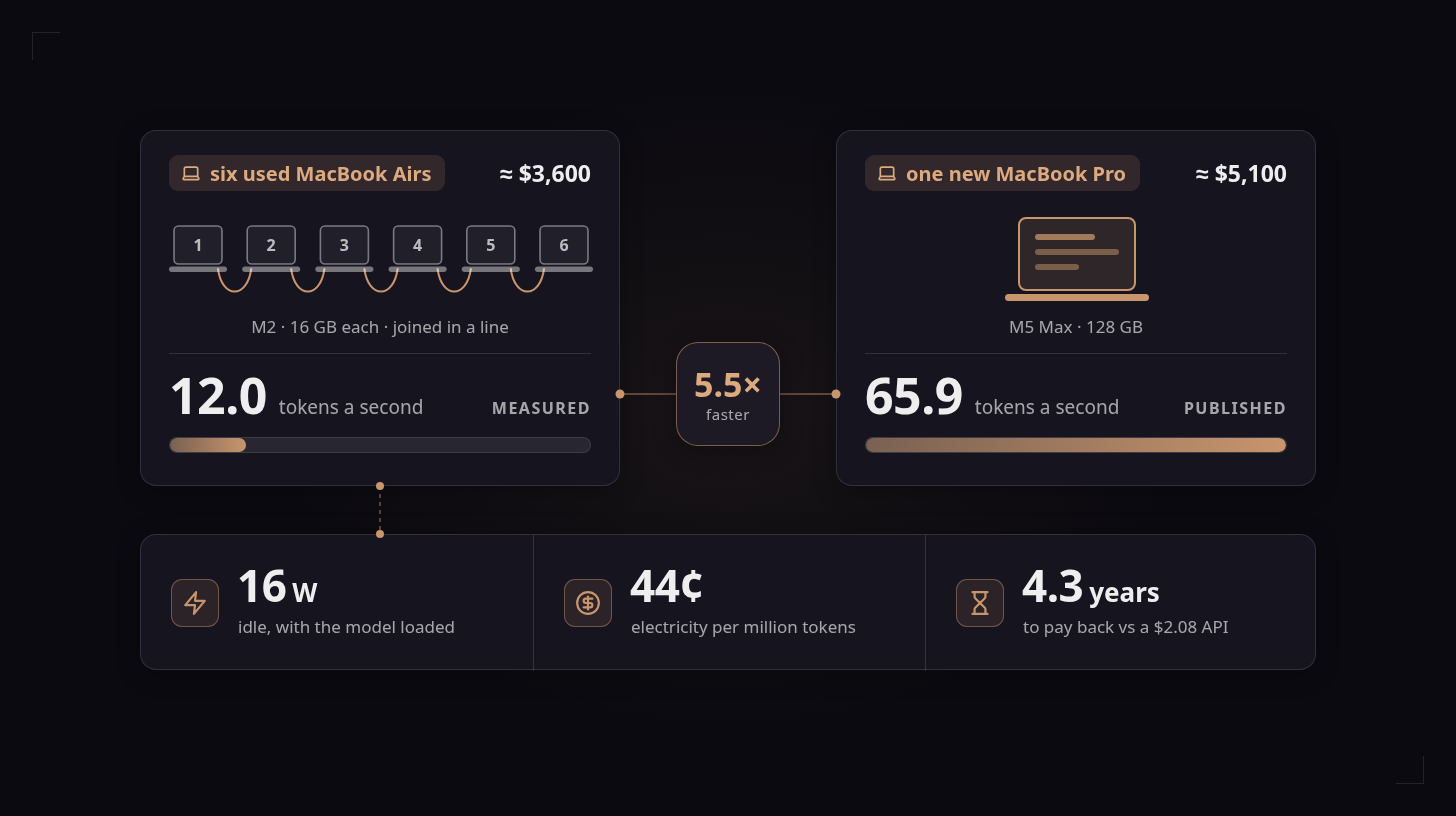
A toy project, and its numbers
This is a toy project. Six MacBook Airs that our team had stopped using run one language model between them on the desk next to mine, and nothing at Quickchat AI depends on them. The first post was about getting them to do it. This one is about what it is worth, in money, to make relatively old hardware do a job it was never meant for.
All the numbers below are rough, and I will say why once instead of next to each of them. The speeds and the power are what I measured on our six Macs, working through Claude Code over SSH as before. The prices are the ones I found on the day I looked, which were about $600 for a used Air like ours, $0.30 for a kilowatt-hour and the list prices of a few APIs. The speeds of other machines are benchmarks other people published. The payback sums assume the Macs write day and night for four people at once, and count only the tokens they write.
| What | Number |
|---|---|
| The model | Qwen3.5-122B, 122 billion parameters, 65 GB |
| Speed for one person | 12 tokens a second |
| Power while idle, model loaded | 16 W for all six |
| Power while answering | about 80 W |
| Electricity for a million tokens | $0.44 |
| The same million tokens from an API | $2.08 |
| Six used Airs | about $3,600 |
| Tokens until they pay for themselves | 2.2 billion |
| How long that takes | 4.3 years |
| One new MacBook Pro, about $5,100 | 5.5 times faster |
A calculator
All of those numbers come from a handful of inputs, so I put the inputs in a small calculator. It opens on our six Macs with the 122B model. The buttons at the top switch to the other setups I measured, such as the same model on a single Mac, or a 397B model on all six.
Change the model or the number of Macs and the Macs become simulated. The speed is then an estimate built from three things I measured: how fast an M2 reads its memory, what each extra Mac in the line costs, and how much a model slows down when it no longer fits in memory and part of it is read from the SSDs. That last trick is in the post about how far the six can be pushed. Next to the speeds I measured, the estimate is up to about 45% too high.
The calculator also has a page of its own. The rest of this post goes through its answers for our six.
The silly question
The number I most wanted was how many tokens the six Macs have to write before they pay for themselves. It is a silly question, because ours cost nothing, so I asked it about six used ones bought for the job.
Writing flat out, the six produce about 1.4 million tokens a day, which is roughly eleven novels. An API would charge $2.93 for that many tokens from the same model, and the Macs use 62 cents of electricity to write them. That leaves the cluster earning about $2.30 a day.
Six used Airs cost about $3,600. At $2.30 a day they need 4.3 years to earn that back, and by then they have written 2.2 billion tokens.
A cheaper API
That was against OpenRouter’s price of $2.08 for a million tokens. Alibaba, which made the model, sells them for $0.92, and against that price the six need 14.6 years.
A different model makes it worse. gpt-oss-120b is OpenAI’s open model of about the same size, and the six Macs run it too. The cheapest API for it charges 15 cents for a million tokens. The Macs use more than 15 cents of electricity to write a million, so against that price they never pay for themselves.
One new machine
The other thing $3,600 could buy is a single machine with enough memory for the whole model, so I looked up published benchmarks of the same 122B model on a few of them.
A new MacBook Pro M5 Max with 128 GB costs about $5,100 and runs the model 5.5 times faster than our six. A Framework Desktop, a small AMD machine that costs about $3,450, is 2.4 times faster.
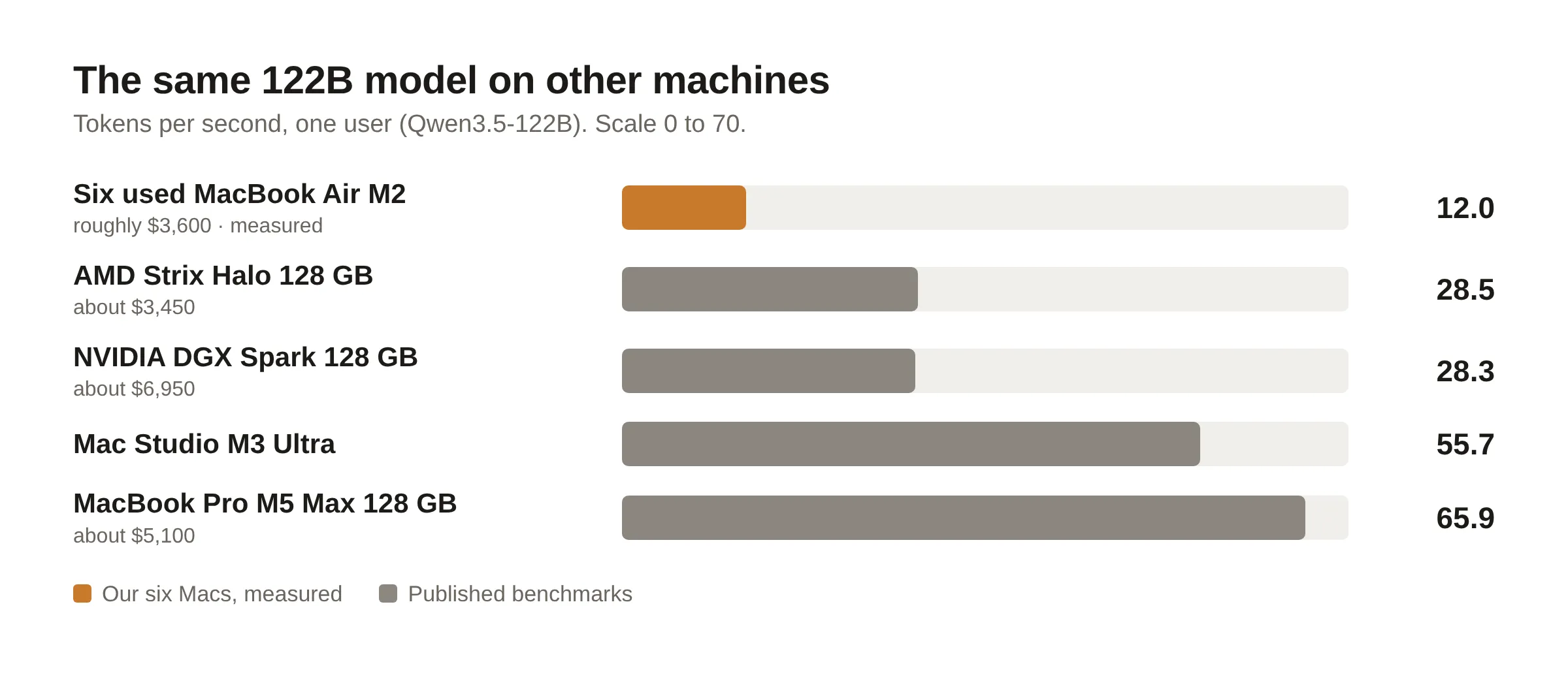 Our six Macs are measured. The other four are published benchmarks.
Six Airs do not add up to one fast machine. Every token passes through all six in turn, and each of them reads its memory about six times slower than the new MacBook Pro does.
Ours were free
None of that changes much for us, because we did not buy anything. The Macs had been our remote development machines and had finished that job.
With the hardware at zero, only the electricity counts. A million tokens cost us 44 cents, which is less than any API price I found for the 122B model. With the model loaded and nobody asking, the six draw 16 watts between them, which comes to about $43 a year.
They are not quite free, though. Sold at $600 each, they would just about pay for the Framework Desktop, which is more than twice as fast.
Other models, more Macs
The calculator will also answer for clusters nobody has built. DeepSeek-V4.1-Flash, which is 541 GB as a 4-bit copy, would need 47 MacBook Airs to hold it in memory. They would form a line 14 metres long and write about 4 tokens a second. One copy of that model is also bigger than the SSD in any of our Airs.
Llama 3.3 70B is small enough for four Macs, but it uses all of its weights for every token, so they would write about 2 tokens a second. The 122B model is faster because each token uses only about a twelfth of it.
Among the less useful numbers, typing out a text as long as English Wikipedia would take our six 12.7 years. One token takes about 7 joules, which is enough to lift one of the Airs 57 cm.
What the sums leave out
The sums count money and nothing else. APIs serve the same 122B model at about 100 tokens a second, eight times what the six Macs manage.
Reading is slower still. I gave the six a 57,000-token document and waited seven minutes for the answer to begin, and anything much longer than 60,000 tokens fails.
In their favor, nothing anyone asks the six Macs leaves the office.
What you can do with it
Do not buy laptops for this. One new machine for about the same money is more than twice as fast, and an API is faster again.
If you already have a few spare Apple silicon Macs, EXO will split a model across them, and you get a private model for the price of the electricity.
Put your own numbers in the calculator. The electricity price matters most. Our six use 1.46 kilowatt-hours for a million tokens, so the 122B model stays cheaper than Alibaba’s API until a kilowatt-hour costs about $0.63.
Use as few Macs as the model fits on. More Macs hold a bigger model, and every one of them makes each token a little slower.
About this series
This series shows how we work with AI at Quickchat AI, one specific task per post.
Related guides
- Six Spare MacBook Airs Ran a Private LLM Before Lunch
- How Far Can You Push Six MacBook Airs?
- Claude Code found my Pirc and King’s Indian mistakes
- tmux session summaries for parallel AI agents
- Automating bug triage with Claude Code and Datadog
- My AI coding tips
Frequently asked questions
Is it cheaper to run an LLM on your own Macs than to pay for an API?
Only if you already own the Macs, and it depends on the model. My six M2 MacBook Airs use about 44 cents of electricity for a million tokens of Qwen3.5-122B at $0.30 per kWh, which is below the cheapest API price I found for that model, $0.92. Six used Airs bought for about $3,600 would need 2.2 billion tokens and 4.3 years of nonstop writing to pay for themselves against an API charging $2.08 per million tokens. Against gpt-oss-120b at $0.15 per million tokens they never do.
How much power does a cluster of MacBook Airs use running an LLM?
Six M2 MacBook Airs with a 122B model loaded drew 16 W in total while idle. While answering they drew 78 W with one person asking and 86 W with four. Idling for a whole year costs about $43 at $0.30 per kWh.
How fast is one new Mac compared with a cluster of old ones?
On Qwen3.5-122B, a published benchmark of a MacBook Pro M5 Max with 128 GB shows 65.9 tokens a second for one person, against 12.0 measured on my six M2 MacBook Airs. That is about 5.5 times faster. The MacBook Pro costs about $5,100, and six used Airs about $3,600.
How many MacBook Airs would it take to run DeepSeek-V4.1-Flash?
By my estimate, 47. The 4-bit copy of the model is 541 GB, and a 16 GB MacBook Air M2 can hold about 11.7 GB of a model, so holding all of it in memory takes 47 Macs in a line about 14 metres long. Going by the speeds I measured on six, they would write about 4 tokens a second. Nobody has tried it.