

Decagon is an enterprise AI support platform built for high-volume operations, with structured Agent Operating Procedures that codify workflows across text and voice. It sits at the technical, high-control end of the market: powerful for large teams with engineering capacity, sold through a custom sales process, and priced for the enterprise. If you are shopping Decagon alternatives in 2026, the reason is usually the six-figure contract, the sales-led implementation that runs into months, or the engineering lift the platform assumes. The question that sorts the alternatives is whether you actually need that enterprise motion.
Two paths follow from that. You can pick a transparent, self-serve agent with pricing you can work out up front and run yourself (Quickchat AI, HubSpot Breeze), or you can pick one of Decagon’s enterprise managed peers that sell the same high-touch implementation with custom pricing (Sierra, Ada, Forethought). Five serious options sit across those two groups. The deeper playbook for swapping the AI without disrupting the rest of your stack is in the post on how to switch AI agents without migrating your helpdesk.
Decagon does not publish pricing, and every contract is custom-quoted on a resolution-based model. Third-party data as of early 2026 reports annual contracts roughly in the $95,000 to $590,000+ range, with the procurement marketplace Vendr listing a median contract value around $432,000 per year; My AskAI puts the entry point near $95,000 per year with a sales-led, slow setup. None of these figures are vendor-confirmed, so treat them as directional. For contrast, Quickchat AI Enterprise is $0.50 per resolved conversation with public tier plans underneath and a Free plan, so a team can measure resolution rate on its own content before any sales conversation.
What to evaluate (seven criteria)
The criteria below are the ones a Head of Support actually weighs before signing.
- Resolution rate. The share of inbound conversations the agent closes without human involvement. Compare vendors only on equivalent knowledge bases and check each vendor’s definition of “resolution,” since some count a soft timeout as resolved.
- Actions and automation depth. The writes the agent can make: order lookups, refund processing, account updates, structured ticket creation, escalation with handoff data. Without actions, an agent is search-over-docs with a chat UI.
- Observability and answer traceability. Per-conversation logs, retrieved knowledge chunks shown next to each response, tool calls and parameters logged, analytics broken down by topic.
- Setup time. The gap between signing and the agent handling production traffic. In 2026 this clusters into 1 to 7 days (self-serve), 2 to 4 weeks (mid-market with integrations) and 8 to 16 weeks (enterprise with custom workflows).
- Pricing model and transparency. Whether annual cost can be modelled from public information. Per-resolution and tier-based vendors publish numbers; custom enterprise vendors do not.
- Helpdesk and channel compatibility. Whether the agent works on top of the helpdesk you already use, without forcing a migration. An AI procurement that silently requires a helpdesk change is a much larger commitment than the line-item cost suggests.
- Free or self-serve tier. Whether you can run the platform on real traffic without procurement involvement. This matters for evaluation rather than production scale, and it is the single biggest practical gap between Decagon and the self-serve group.
Comparison scorecard
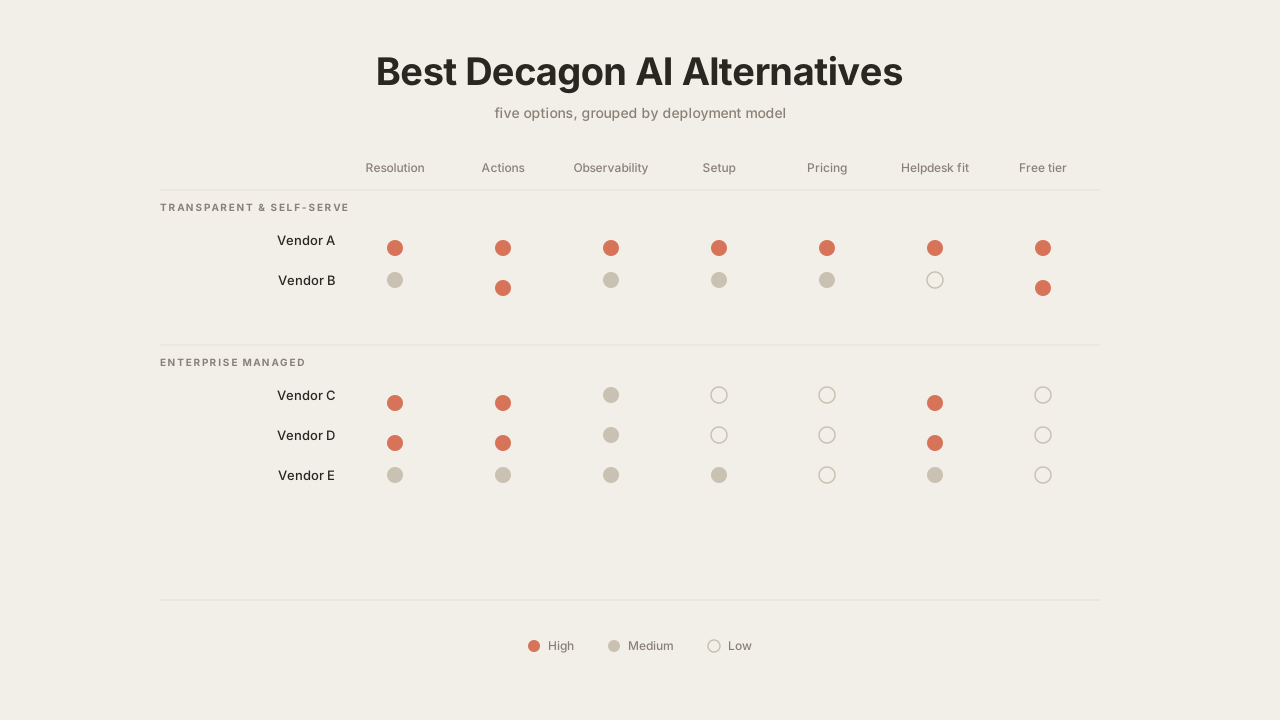
Scoring is high / medium / low based on each vendor’s public documentation and pricing pages as of May 2026. Decagon is included for reference.
| Vendor | Resolution rate | Actions | Observability | Setup time | Pricing transparency | Helpdesk compatibility | Free / self-serve |
|---|---|---|---|---|---|---|---|
| Decagon · reference | High | High | Medium | 8-16 weeks | Low (custom, ~$95K-$590K+, Vendr) | High (multi-helpdesk) | No |
| Quickchat AI | High (>80% public ref) | High | High | 1-7 days | High ($9-$999/mo tiers or $0.50/res) | High (helpdesk-agnostic) | Yes (free plan, no card) |
| HubSpot (Breeze) | Medium | High (CRM-native) | Medium | 2-6 weeks | Medium (Service Hub tiers) | Low (HubSpot-native) | Free Service Hub starter |
| Sierra | High | High | Medium | 6-12 weeks | Low (outcome-based, custom) | High (platform-independent) | No |
| Ada | High | High | Medium | 8-16 weeks | Low (custom enterprise) | High (Zendesk, Salesforce, Intercom) | No |
| Forethought | Medium | Medium | Medium | 4-8 weeks | Low (custom; now part of Zendesk) | Medium (any stack, Zendesk-aligned) | No |
Three patterns are worth noting before the profiles.
Evaluation access splits the field. Only two of these let you run the agent on real traffic before a contract: Quickchat AI with a permanent free tier, and HubSpot with a free Service Hub starter. Decagon, Sierra, Ada and Forethought all gate access behind a sales process and a managed rollout. For a team that wants to decide on data, that is the structural difference.
Pricing transparency clusters at the edges. One vendor publishes self-serve tiers and a per-resolution number a buyer can work out up front (Quickchat AI). HubSpot publishes Service Hub tiers, though the Breeze AI components and the CRM underneath add lines to the model. Three publish no public pricing at all (Decagon, Sierra, Ada), and Forethought is now quoted through Zendesk.
Decagon’s peers are Decagon-priced. Sierra and Ada sell the same enterprise managed motion Decagon does, with six-figure contracts and 8 to 16-week implementations. Moving from Decagon to one of them changes the vendor, not the buying model. The teams that leave Decagon for a materially different experience usually land in the self-serve group.
Group 1: Transparent, self-serve agents
These two publish their pricing and let you start without a six-figure commitment. For teams shopping Decagon alternatives because of cost, the sales cycle or the engineering lift, this is the group that removes those objections.
Quickchat AI
Quickchat AI is a helpdesk-agnostic AI agent that deploys on top of Zendesk, Intercom, Help Scout, Freshdesk and Gorgias, or ships as a standalone Inbox for teams without a helpdesk. For Decagon shoppers, the appeal is comparable autonomous resolution and action depth without the enterprise sales motion or the engineering capacity Decagon assumes: public pricing, a free tier, and a setup measured in days.
Pricing is public and self-serve: Free at $0/mo, Starter at $9/mo ($8/mo billed annually), Basic at $29/mo ($24/mo billed annually), Essential at $99/mo ($83/mo billed annually), Professional at $299/mo ($249/mo billed annually), Business at $999/mo ($833/mo billed annually), and Enterprise from $0.50/resolution. The Free plan lets teams evaluate the platform on a real knowledge base before any procurement conversation. Full details are on the pricing page.
Quickchat AI publishes a resolution rate above 80 percent on customer data; one customer (Maybe Tech) handles 600+ daily inquiries with 93 percent AI-resolved. The feature set includes AI Actions for read-write tool calls, an OpenAPI and MCP layer for custom integrations, Why AI Said That traceability that exposes the prompt, retrieved chunks and tool calls behind each answer, and a Content Gap Analyzer that surfaces questions the AI could not answer. Where Decagon expects a technical team to author and maintain structured procedures, Quickchat AI is configured from the knowledge base and exposes the reasoning behind each answer in the product.
Best fit: teams that want autonomous resolution with transparent pricing, fast setup and the ability to evaluate on their own data before committing budget. Poor fit: very large enterprises that specifically want a vendor to run a managed, per-workflow implementation with dedicated engineering. Product detail is on the AI for customer support page.
HubSpot Breeze
HubSpot Service Hub is HubSpot’s helpdesk product, and Breeze is the AI suite layered across it (Breeze Copilot for agent assistance, Breeze Agents for autonomous resolution, Breeze Intelligence for data enrichment). As a Decagon alternative, Breeze fits teams that want published pricing and a free entry point, and that are already invested in HubSpot CRM, marketing or sales and want their support AI to read from the same customer data.
Pricing follows the standard HubSpot Service Hub tiers, from a free starter through Enterprise, with the Breeze components billed on top. The free Service Hub starter lets a team begin without a contract, which is the practical contrast with Decagon’s sales-led entry. Setup runs 2 to 6 weeks depending on how much of the HubSpot data model is wired in. The CRM-native integration is the strongest argument; the trade-off is that the value is tied to HubSpot, so the agent is most useful when HubSpot is already the system of record.
Best fit: existing HubSpot customers consolidating support onto the same platform, who want a free starting point and CRM-native actions. Poor fit: teams not on HubSpot, who would effectively be adopting HubSpot to get its AI, or teams that want a helpdesk-agnostic agent. The direct head-to-head with Quickchat AI is on the HubSpot AI Breeze agents alternative page.
Group 2: Enterprise managed agents (Decagon’s peers)
These three sell the same high-touch, custom-priced motion Decagon does. They are the right answer when the requirement genuinely is a managed enterprise rollout with dedicated implementation, and when a six-figure annual contract is acceptable.
Sierra
Sierra is an enterprise conversational AI platform co-founded by former Salesforce co-CEO Bret Taylor, sold through a managed engagement with outcome-based pricing: you are billed when the agent reaches an agreed successful resolution. As a Decagon alternative, Sierra is the closest peer on positioning, with the difference that Sierra leans toward a fully managed deployment while Decagon gives technical teams more direct control.
Pricing is not published and every contract is custom-quoted. Third-party estimates as of early 2026 place starting annual contracts around $150,000, with year-one budgets often higher once setup is included; these are not vendor-confirmed. Setup is a managed engagement, generally 6 to 12 weeks, with no free trial.
Best fit: large brands that want outcome-aligned billing and a high-touch implementation. Poor fit: mid-market and SMB teams, or anyone who needs to model cost from public numbers. The neutral cross-tool view is on the Sierra AI alternatives post, and the direct head-to-head is on the Sierra AI alternative page.
Ada
Ada is an enterprise AI customer service platform built for high-volume deployments, typically 300,000+ annual conversations. It targets retail, finance and travel teams with established CX engineering capacity. Ada deploys on top of Zendesk, Salesforce and Intercom and offers 50+ language support out of the box.
Pricing is not published. Third-party benchmark data put annual platform fees in five- to six-figure ranges, with per-resolution fees and implementation on top, but these are not vendor-confirmed and should be validated against a quote. Setup runs 8 to 16 weeks because of custom workflow design and a managed engagement during the first deployment.
Best fit: enterprise teams with the budget for a six-figure first-year commitment and dedicated CX engineering capacity. Poor fit: mid-market teams or buyers who need a transparent quote to model cost. For the direct head-to-head, see the Ada CX alternative comparison.
Forethought
Forethought is a self-learning AI support platform that markets itself as working across any stack. As of 2026 it is part of Zendesk, which acquired it in March 2026, so the product now sits inside Zendesk’s AI strategy while still positioning as helpdesk-flexible. As a Decagon alternative, Forethought is the option for teams that want autonomous resolution with a lighter implementation than Decagon’s, and that are comfortable with a vendor now aligned to Zendesk.
Pricing is custom and not publicly listed, and the post-acquisition offering is quoted through Zendesk. Setup is typically 4 to 8 weeks, lighter than the pure-enterprise peers but still a managed engagement rather than a self-serve start.
Best fit: teams that want self-learning resolution and are either on Zendesk or open to its ecosystem. Poor fit: teams that want pricing independence from a helpdesk suite, or a self-serve evaluation. The neutral cross-tool view of the Zendesk side of this is in the Zendesk AI alternatives post.
Decagon vs Quickchat AI
The most common reason teams shortlist Decagon and then look for an alternative is that Decagon’s enterprise motion, and the engineering capacity it assumes, overshoot what they need. The direct Quickchat AI comparison is where that gap is clearest. Three differences drive it.
Pricing model. Decagon is resolution-based but custom-quoted, with no public number and reported contracts from roughly $95,000 to $590,000+ a year (a marketplace median near $432,000). Quickchat AI Enterprise is $0.50 per resolved conversation with public tier plans underneath, so annual cost is predictable before any call.
Evaluation and setup. Decagon is sales-led, with implementations that commonly run 8 to 16 weeks and no free tier. Quickchat AI runs on a real knowledge base within 1 to 7 days, and the Free plan lets a team measure resolution rate on its own content first.
Operational lift. Decagon’s structured Agent Operating Procedures reward teams with engineering capacity to author and maintain them. Quickchat AI is configured from the knowledge base, and the Why AI Said That view exposes the prompt, retrieved chunks and tool calls behind each answer, so a support lead can audit and improve the agent without a dedicated engineering track.
The full breakdown, including the side-by-side comparison and migration path, is on the Decagon AI alternative page.
How to pick
The scorecard narrows the field; the final call depends on team shape.
Want transparent pricing and a way to evaluate before committing. Quickchat AI is the cleanest fit. It publishes per-resolution and tier pricing, deploys in 1 to 7 days, and the free tier covers evaluation without procurement. For most teams that shortlisted Decagon on capability but balked at the contract or the engineering lift, this is the closest match on outcomes with none of the enterprise overhead.
Already on HubSpot, or want CRM-native AI with a free starting point. HubSpot Breeze, which reads from the same HubSpot data as your sales and marketing and starts on a free Service Hub tier. Expect the value to be tied to HubSpot being your system of record.
Genuinely need a managed enterprise rollout. Sierra or Ada, which sell the same high-touch motion as Decagon with comparable six-figure contracts and multi-week implementations. Pick these when dedicated implementation and per-workflow structure are hard requirements, not when you simply want a different vendor. Quickchat AI Enterprise is the fourth option for enterprise teams that want a per-resolution price and a fast deployment without buying managed services on top of the platform fee.
Want self-learning resolution with a lighter rollout, and are open to Zendesk. Forethought, now part of Zendesk, with a shorter implementation than the pure-enterprise peers but still no self-serve start.
Need to run on real traffic this week. Quickchat AI is the only option here that goes live on a real knowledge base in days with a free tier; every other path on this list starts with a sales process.
A note on sources
Pricing, free-tier and feature claims in this post link to each vendor’s public pricing page or product page as of May 2026; vendor pricing changes and should be re-checked before a buying decision. Decagon, Sierra and Ada do not publish per-resolution prices, so the ranges above reference third-party benchmark data (Vendr, My AskAI, and similar) and are not vendor-confirmed; treat them as directional. The Forethought acquisition is sourced from Zendesk’s newsroom announcement dated March 2026. Vendor-published resolution rates are upper bounds and should be validated on your own knowledge base during a parallel run.